
A Tale of Two Cities
Born and raised in Philadelphia, Pennsylvania, my DNA craves soft pretzels with spicy mustard and the Mummers Parade. Having spent 25 years of my “mature” mid-life in Minneapolis, Minnesota, I equally crave the fiery cuisine of the illustrious immigrant, Yia Vang, the Hmong Chef, and the pageantry of the fabled annual May Day Parade, staged by the Heart of the Beast Theater located in Minneapolis’ Powderhorn Neighborhood.
Powderhorn is the same neighborhood where Renee Good’s life was purposefully snuffed out by a United States ICE agent as an unidentified agent screamed: “You f*ing bitch,” while millions on numerous social media videos witnessed her softly spoken final words: “I’m not mad at you.”
“I can’t breathe.” Civil Liberties Assaulted – Again
Powderhorn is the same neighborhood where in 2020, Minneapolis police officer Derek Chauvin sneered as he bore down on the neck of a Black man, George Floyd, while he cried, “I can’t breathe.” Floyd was killed over a counterfeit $20 bill.
Chauvin’s cavalier murder of a man begging to be able to breathe remains an open wound and rallying cry for Americans who uphold the Constitution and Bill of Rights. “The killing of George Floyd held a mirror up to a truth about the American legal system,” said Sherrilyn Ifill, at the time the President and Director-Counsel of the NAACP Legal Defense and Educational Fund, Inc.
On October 14, 2022, Floyd’s birthday, the National Urban League, on behalf of multiple civil rights organizations, pronounced a call for “the U.S. House of Representatives to pass the George Floyd Justice in Policing Act, first introduced in 2020 – a critical step to holding law enforcement accountable for unconstitutional and unethical conduct.”
READ: Dr. Martin Luther King Jr.’s Warnings Seem More Prescient Than Ever
Yet, almost five years later, José Santos (Woss) Moreno, Friends Committee on National Legislation’s director for justice reform, once again called for passage of this act. The bill bearing Floyd’s name, H.R.8525, was reintroduced in the House last year, on May 23, 2025 by Rep. Sheila Jackson Lee (D-TX).
The outcry to ensure our civil liberties and civil rights has escalated following the ICE cold-blooded murder of Renee Good, an unarmed United States citizen who was trying to escape a confrontation with heavily armed agents, just blocks from where police murdered George Floyd.
A brief history of civil liberties
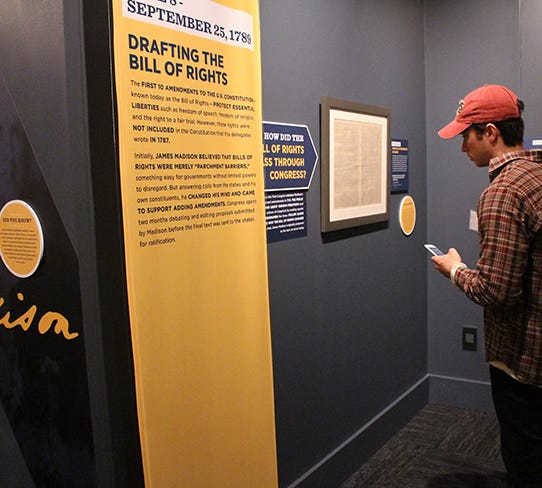
Philadelphia is gearing up to celebrate the 250th anniversary of the birth of our nation with a critical focus on the safeguards created by the founding fathers’ Proclamation of Independence from tyranny. One of the most remarkable blueprints of self-government was born right here in 1787 when 13 delegates produced the first draft of the United States Constitution.
Some may be unaware that many of these envoys felt that the draft was deeply flawed by not specifying individual rights. They believed that the document explained what the government could do, but not what it couldn’t. This absence of a delineated “bill of rights” obstructed its ratification for four years. In the end, the framers heeded Thomas Jefferson who had argued:
A bill of rights is what the people are entitled to against every government on earth, general or particular, and what no just government should refuse, or rest on inference.
Inspired by Jefferson, drafted by James Madison, the American Bill of Rights was adopted and in 1791 as the Constitution’s first ten amendments. They constitute our civil liberties and are the law of the land.
Civil Liberties vs Civil Rights
While most Americans use the terms – “civil rights” and “civil liberties” – interchangeably, they are, in fact, distinct terms. Civil liberties are freedoms guaranteed to us by those Constitutional amendments to protect us from tyranny. They include:
· The right to free speech
· The right to privacy
· The right to remain silent in a police interrogation
· The right to be free from unreasonable searches of your home
· The right to a fair court trial
· The right to marry
· The right to vote
Civil rights are where law and legislation come in. Our civil liberties are protected against misuse by civil rights laws established through the federal government via federal legislation or case law. Our civil rights entitle us to the basic right to be free from unequal treatment based on certain protected characteristics, such as race, gender, disability, and more, in settings such as employment, education, housing, and access to public facilities.
For example, the right to marry is a civil liberty, while gay marriage is a civil rights matter. So, if a same-sex or opposite-sex couple is denied a marriage license because the court clerk has decided not to issue any licenses, their civil liberties have been violated. But if the clerk denied marriage licenses only to LGBTQ+ couples, it’s a civil rights violation.
Unlike civil liberties, which guarantee individuals certain broad-based rights, civil rights imply protection based on certain characteristics.
Birth of the American Civil Liberties Union to defend those rights
Another conundrum: In 1791, when civil liberties were enshrined in the Constitution, most citizens had no way to uphold them. Over a hundred years passed when “most common constitutional violations went unchallenged because the people whose rights were most often denied were precisely those members of society who were least aware of their rights and least able to afford a lawyer. They had no access to those impenetrable bulwarks of liberty – the courts. The Bill of Rights was like an engine no one knew how to start.”
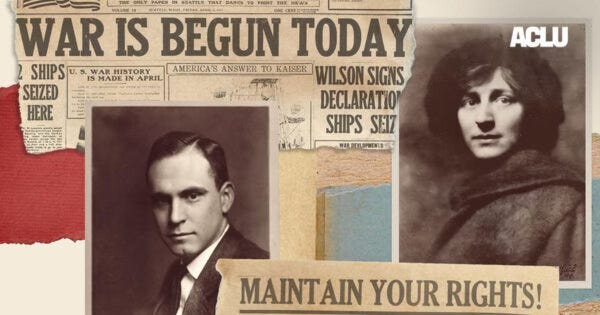
In the early twentieth century, all that changed. A small group of visionaries that included the world-renowned author, Helen Keller, “dedicated themselves to holding the government to the Bill of Rights’ promises.” In 1920, they founded the American Civil Liberties Union and joining forces with the already established National Association for the Advancement of Colored People, NAACP, “began to challenge constitutional violations in court on behalf of those who had been previously shut out. This was the beginning of what has come to be known as public interest law,” providing the missing ingredient that made the constitutional system and Bill of Rights finally work.
Relevance in 2026
Many citizens, on both sides of aisle, are shocked by federal storm troopers currently attacking ordinary citizens in multiple U.S. cities. Even the popular podcaster, Joe Rogan, once an avid Trump supporter who repeatedly questions ICE’s terror tactics, recently asked on his show, “Are we really gonna be the Gestapo, ‘Where’s your papers?’ Is that what we’ve come to?”.
In this semiquincentennial year, the application and defense of civil liberties continue to evolve through new laws and court interpretations, particularly in the face of political polarization and emerging technologies. And organizations like the ACLU remain active in defending these rights against government actions they deem overreaches, ensuring that the foundational principles of limited government and individual freedoms are upheld in a changing world.
It can’t be stated too strongly that Americans must know their rights and how and when to defend them.
“We are devastated by the news that ICE killed a woman this morning in Minneapolis. This tragedy is further proof that ICE is out of control, endangering our communities, and must end this operation before anyone else is brutally hurt or killed,” said Deepinder Mayell, executive director of ACLU of Minnesota. “Since the launch of ‘Operation Metro Surge’ we have witnessed a remarkable string of unlawful activity targeting Minnesota communities and Minnesota values — this affects us all. We will keep observing, documenting, and fighting for the rights of all Minnesotans.” Of course, the ACLU does so nationally.
In a January 2026 article in The Atlantic, author David Frum called out the “combative stance” of the current administration, reminding ordinary citizens “ICE’s powers against U.S. citizens are limited. Americans can record ICE operations, follow ICE motorcades, and vex and annoy ICE personnel, and there’s not much that ICE or Border Patrol agents can legally do to stop them—hence the turn to unlawful force instead.”
It can’t be stated too strongly that Americans must know their rights and how and when to defend them. Any American can become a potential target when the foundations of civil liberties begin to crumble and democracy veers towards dictatorship. No city or neighborhood is immune. It is an American duty to defend this nation’s hard-won civil liberties and civil rights.
This article was originally published at Susan Schaefer’s Substack. Subscribe HERE.