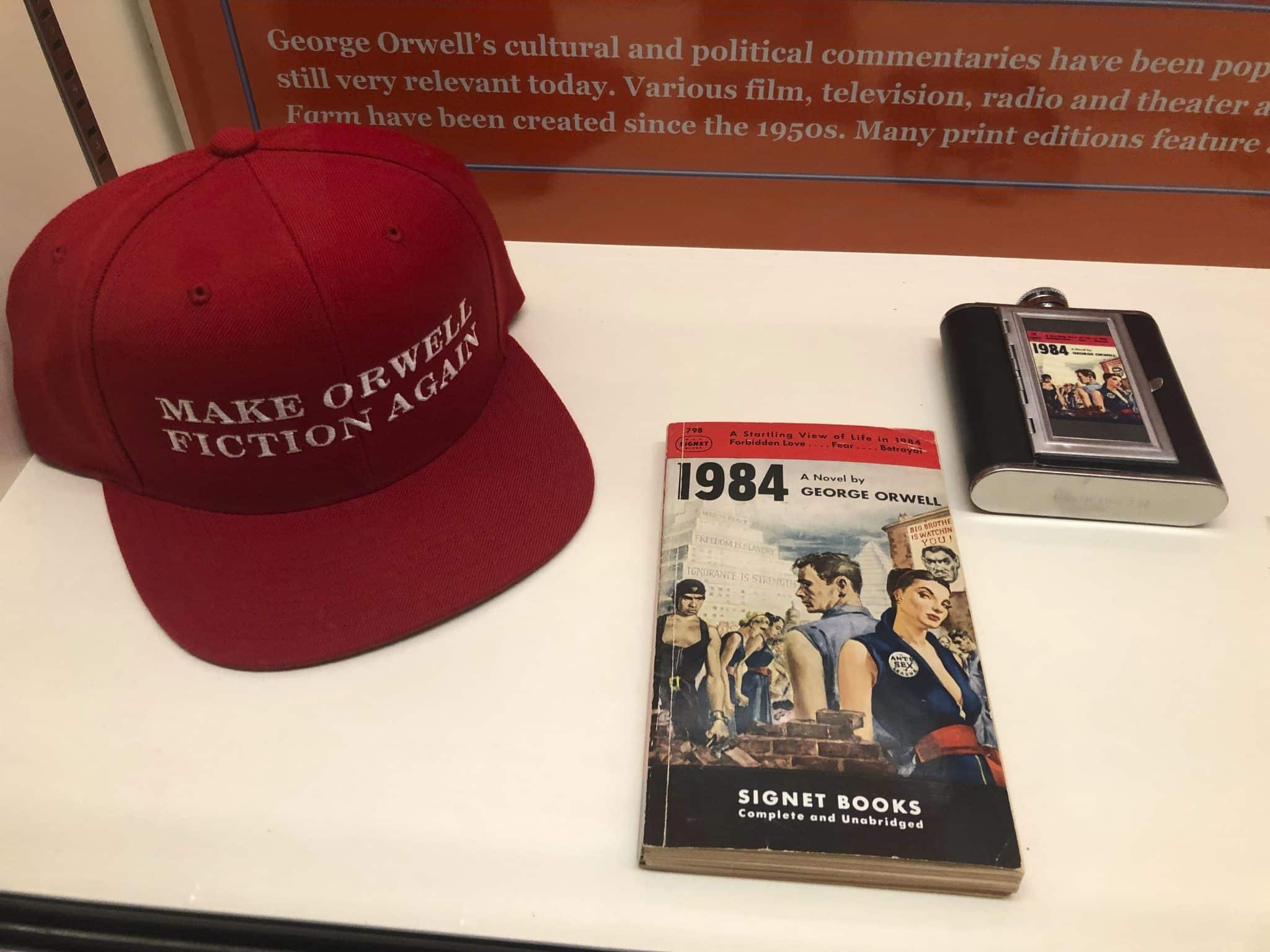
Back in December I read an article Laura Beers published in The Conversation where she compared White House Press Secretary Karoline Leavitt’s press conference on the so-called truth about the good news of the state of the economy under President Trump’s stewardship to the repeated pronouncements of the Ministry of Plenty in George Orwell’s ‘1984.’ This led me to pick up and read her book Orwell’s Ghosts: Wisdom and Warnings for the Twenty-First Century. Beers is a professor of British history at American University whose writing has appeared in the New Republic, Washington Post, CNN, among other publications. She joined me to speak about her book and the enduring value of Orwell’s insights for modern society, especially under this new Trump Regime.
Listen on Apple, Spotify, Podbean, and iheart
TRANSCRIPT
What is your first memory as a young student of being introduced to George Orwell?
The first Orwell I read probably like most people was Animal Farm, which I read in middle school in Montgomery County, Maryland, just outside DC in the last days of the Cold War. So I think after the fall of the Berlin Wall, before the collapse of the Soviet Union. One of my strongest memories actually is watching the CIA funded cartoon version of Animal Farm in class, but we very much read the book as an allegory for the Soviet Union. We spent a lot of time up with the whiteboard mapping snowball onto Trotsky and Napoleon onto Stalin. And we read it in that context. And so it wasn’t until later that I began to think of Orwell as anything other than really a Cold Warrior, because that was my initial introduction back in the late 1980s.
So as you grew older and grew intellectually, could you just kind of discuss and describe how your interpretation of Orwell’s evolved from that Cold War framework that you were provided in middle school?
Well, I guess, you my intellectual journey with Orwell, you know, it began in middle school, he was with me through every phase of my scholarly career from a middle school student to a professor and teacher myself. When I was in high school, I read 1984, again, in the context of an English class. And, you know, there we probed some of those ideas about totalitarianism as expanding beyond the context of Stalinism and the broader idea of totalitarianism as a potential threat in any kind of society, including a U.S. context. But it wasn’t until I got to college that I really realized that Orwell was not just an author of fiction. And in a freshman seminar on 20th century Europe, I read Homage to Catalonia, which is his book about his own experience volunteering to fight on behalf of the Republic during the Spanish Civil War and how he sort of naively travels to Spain thinking he’s fighting fascism in the form of, fighting against Franco’s insurrection in Spain and instead realizes, you know, what a mess the Republican coalition is and particularly what a malign influence Stalinist intervention in the Spanish Civil War has had. And he ends up fleeing across the Pyrenees into France in the end of the memoir before he’s arrested by Stalinist agents as someone who’s presumed to be a Trotskyist saboteur, which he knows himself not to be. And so it’s a very complicated book about the messy politics of the late 1930s and one where you see Orwell’s evolution into that anti-Stalinist position, which most people associate him with, but really how it grows out of a determined anti-fascism, which is why he volunteers in Spain. But then he stayed with me as I went to graduate school. And actually, I read The Road to Wigan Pier, which had a huge influence on Orwell’s Ghosts. It’s actually, if you read the copyright page, the one book I had to ask for copyright permission from, because I quote from it so extensively. But it’s really unlike his, you know, it’s a political book, but in a very different way, because it’s writing about the politics of inequality and unemployment, and really looking at the corrosive impact of class inequality on British society. And it’s also a very self reflexive book where he looks at his own class privilege, and the way that that has facilitated the life as a journalist, as an author that he’s chosen to lead in the way that other people don’t have access to the same advantages that he had just as a position of his birth in what he refers to as the lower upper middle class. So, you know, I I saw a different Orwell at different stages of my own intellectual career, but then I also found myself increasingly turning to him and reading his writing on my own, particularly as I became a writer myself. So reading Why I Write, Politics and the English Language, My Country Right or Left some of these essays, you know, really helped me think about both how to be a politically committed author, but also the importance of using the English language honestly and in kind of pursuit of truth in my own writing. And now that I teach at American University in DC, I teach a course where
Across the semester, my students read eight of Orwell’s book-length works and several of his essays. And so they get to basically go on that intellectual journey that I did across 20 years in the space of 15 weeks. They get to know all the different iterations of Orwell and kind of think about him as a really three-dimensional and nuanced political thinker.
And that’s what actually led you to write Orwell’s Ghosts: Wisdom and Warnings for the 21st Century.
Yeah. I mean, I taught the course. The course is designed as a history course, and it uses Orwell’s writing as an introduction to the politics of the early 20th century. So Orwell also, in addition to the books I’ve mentioned, writes his first novel, Burmese Days, is about imperialism in the British Raj in modern day Myanmar, then Burma. He writes about unemployment in Down and Out in Paris and London, and also about sort of these people on the political and social fringes in that book. And he has a series of novels and non-fiction works that kind of address almost every relevant topic for someone who’s studying the history of the interwar period. Orwell becomes our zealot. He’s our figure who pops up again and again. And we used to explore that early history, but my students in that class, and partially because American University is full of policy wonks, people who want to go into government or activism or consulting. And, you know, so they’re always making connections with the present. And they really pushed me to see the enduring relevance of Orwell’s writing, not just for understanding the 1930s and 40s, but for understanding our current political moment. And so I really have to credit my students … I’ve taught the seminar for several years now, but for pushing me to think about Orwell’s relevance to our current politics and ultimately to write Orwell’s Ghosts.
Now it’s hard to put him into like a neat and tidy political box, you know, nonetheless, some of his broad political and philosophical tenants would be and you’ve already mentioned a few of them was that he was an anti-imperialist, an anti-colonialist, and a democratic socialist.
I think that’s in many ways what gets lost when you only read Animal Farm and 1984. And I think particularly for a generation, and I was at the very tail end of that generation, who came to those texts in a Cold War context. So if you know Orwell only as a Cold Warrior, you could think maybe he’s a neoliberal. Or maybe he’s the original liberal. Maybe he’s, forget even the neo part, given that he’s writing in the 30s and 40s. But you know, someone who’s interested in individual liberty and very suspicious, if not antagonistic to the idea of a powerful state. And he definitely is someone who feels very strongly about individual liberty. But that’s the real tension within Orwell’s writing, because he’s also someone who believes that the state has the potential to wield a valuable social influence, that it has the potential to help rectify class inequalities and kind of smooth out those differences between the rich and poor, which is really important for him. That good governance has the potential to correct some of the harms that have been done by empire over the previous two centuries. And he’s very conscious of the harm that the British empire has done in encouraging poverty and underdevelopment particularly within the British Raj, but more broadly within the global South, that he’s conscious of the ways in which the rule of law, the English hanging judge, as he jokingly refers to him, is a sort of fearsome figure, but one who is uncorruptible. He says, there’s a value in the rule of law that the English, he thinks is a real positive aspect of British society. And so he believes in the state.
And it’s for that reason that he calls himself a democratic socialist. And he’s actively supportive of the Labor Party, though he thinks it’s deeply flawed. During the 1940s, he’s the supporter of Clement Attlee’s Labor government that’s formed in 1945. But he’s also conscious of the tension inherent within that, right? That if you give the government power, there’s the potential for that power to become corrupted. And I think the most valuable reading of 1984 is one that sees it as this warning and hence the subtitle wisdoms and warnings for the 21st century. You know, it’s a warning that’s still relevant today that, you know, we need the state, but we need to very jealously guard our liberties and to, because absolute power corrupts absolutely, I think is something he very much believes. And that if you’re not looking out for democratic liberties they’re at risk. And that risk can come from either the left or the right. And I think one of the reasons that the Big Brother’s government in 1984 is called INGSOC, which is short for English Socialism, is to make that point coming out of the Second World War and the defeat of fascism, that the threat of totalitarianism can come from the left or from the right. And it can come from internally as much as you can see and identify it abroad and that you need to be vigilant about your own government.
And I think in our current political moment as Americans, I mean, that’s a very important lesson for people to take from Orwell.
Given Orwell’s politics, it’s interesting, if not funny or absurd, the disparate figures that have tried to claim him as a comrade or brother-in-arms. People like Josh Hawley and Donald Trump Jr. to Hillary Clinton, to Russian diplomat Maria Zakharova, or even a corporation like Apple.
Yeah, and I mentioned, mean, people of a certain age will remember there’s a famous, with the innovation of the personal computer, the original Apple IIe, an Apple advertisement in which they sort of show this woman who is in Technicolor, busting through these kind of automatons, worshiping the Big Brother … a kind of old school mainframe computer and saying this is going to revolutionize society and it’s going to empower the individual. And so there have been these these corporate attempts to lay claim to the ideology of Orwell as well as these political attempts. But I think in some ways the political ones are more worth thinking about today that we can also talk about the surveillance technology and the role of technology in Orwell’s writing.
But I think the way he’s been used by a Right who see him as a defender of freedom, but really very narrowly a defender of a certain type of freedom, as a kind of freedom of speech that allows you to be anti-woke, that allows you to say things that are politically incorrect and the notion that this is the freedom that Orwell is trying to defend. But I think he’s very clear in his writing about the political ends and political responsibility that comes with being an author. And he writes about this in My Country Right or Left. He writes about it in Why I Write. And he says, basically, for the past decade, everything that I’ve written has been in furtherance of democratic socialism and against fascism.
And so he thinks that people should have the liberty to say what they want. He’s not someone who thinks you should be locking up either ICE protesters or kind of Charlie Kirk right-wing pundits. But he believed in using language in furtherance of what he saw as political truth and political change in a progressive democratic framework.
Before we get into a little bit more about the censorship versus free speech, truth versus falsehood kind of debates, given the political attempts to co-opt Orwell, maybe it would be good for you to define what the term Orwellian means.
And so I think Orwellian as it’s used, if you look it up in the Oxford English Dictionary has specific reference usually to 1984 and to the dystopia of 1984? And so it’s about either political totalitarianism or about censorship, which is one of the signal features of Big Brother’s tyranny in 1984.
And so using Orwellian in that way allows it to be used by the political right to say, the left and cancel culture are Orwellian. You know, this is an attempt to shut down free discourse by not allowing people to say things that are politically incorrect or DEI is Orwellian because it’s not allowing people to make choices that are against woke ideology.
And I concede, and you I would be wrong to say that this is not a common usage of Orwellian, but the book is really encouraging you to think beyond that and say, well, what did Orwell as a writer and as a thinker himself believe? What were his values? If we use Orwellian in the way that we would use Shakespearean or Keynesian, as a reference to someone’s ideas more than is a dystopia that someone wrote about, what do Orwell’s ideas look like? And how would maybe society be better if we thought about them critically or sought to put them into practice?
So you note that in I that Orwell writes, essence of liberty is the freedom to say two plus two makes four. But on the flip side of that, would he defend the right to say two plus two equals five or what maybe Kellyanne Conway would defend as an alternative fact?
Yes, there are facts and there are alternative facts. One of the tensions that I really try to tease out in the book is this notion between freedom and truth. And I say, and it’s hard to project back, what would Orwell think? Orwell’s been dead for 75 years now. But it’s hard to see him thinking you should lock someone up for saying two plus two equals five, right? I mean, he really did believe in free speech. But at the same time, the world that he’s writing, you know, in defense of is not a world in which people walk around saying two plus two equals five or two plus two equals seven. It’s a world where people say two plus two equals four. And that’s what he’s concerned about. He’s concerned that a tyrannous state is going to start spewing, you know, manifest untruths and that it’s going to shut down people who try to speak truth to power.
He’s not out there sort of defending the right to spew your own version of crazy and to be allowed to do it. He believes in freedom. He does think people have those rights, but he’s concerned about defending some normative idea of truth, which he does believe exists against what he sees as the corrupting power of a tyrannous and dishonest state.
Do you think he’d make a distinction between being deplatformed by a private company like Twitter or Facebook and then just the state censoring someone or an entity?
I think that is an important distinction and one that really gets lost when people throw around Orwellian. When you talked about Josh Hawley invoking Orwell, he was invoking Orwell against Simon and Schuster canceling his book contract. He says, this is Orwellian censorship and thought policing. Actually, it’s not. It’s a private company saying they won’t pay you six, seven figure advance to publish your book. I mean, we should all be so lucky. And his book was then published by another publisher.
That is not the type of censorship that you see depicted in the pages of 1984, right? When instead for the mere act of keeping a diary, not publishing it, but merely having it, Winston Smith is ultimately arrested, tortured and broken in prison. And his mind left so cracked that he’s happy to believe that two plus two equals five or whatever the regime says it is. And I think one of the things actually that or we’ll just couldn’t envisage that has come to pass in our 21st century society is that often the greatest control is coming maybe not from the state, but from private platforms like, Google, or not so much Twitter anymore as Twitter’s influence has declined since Musk took it over. But I mean, these kind of mega media corporations.
But when Orwell is thinking about censorship, he’s thinking about state censorship. And that comes through very clearly and is a product of his historical context. I mean, he’s writing in the shadow of national socialism in Germany and state fascism in Italy, as well as the kind of ongoing Stalinist regime in Russia. And it’s the all-powerful state and the censorship it’s capable of imposing that really is what he sees as the biggest threat to free thought at that point.
This state censorship is something that we’ve seen increasingly encroach upon public education. For listeners in Bucks County and Pennsylvania, the state and locally, it’s been ground zero with what’s been dubbed like the school board wars or just kind of a flare up of this long standing broader war on public education. You talk a little bit about this in your book, for example, Florida’s Don’t Say Gay law, a state where middle schoolers are taught how slavery allegedly taught slaves job skills, or Oklahoma’s law that bans teaching curriculum that might cause a student to “feel discomfort, guilt, anguish, or any other form of psychological distress on account of his or her race or sex.”
Could you talk a little bit about maybe like how Orwell would kind of approach these developments if he were alive today?
Happily and I think this is one of the things that those on the political right have found most controversial about the book because the argument that I put forth and that I would stand by is that I think Orwell understood the dynamics of power and this is one of the things that I think he came to keenly appreciate when he was serving in the Indian police service in Burma and he came to see himself as someone who was an agent of the powerful,
but who never went into a police station, he said, or a prison without feeling that he should be behind bars. And he said that it made him go on in the rest of his life to always be on the side of the oppressed because he felt so guilty about his complicity as an oppressor in what he saw as an unjust regime. And I think in the context of these curriculum wars and my own sons are in school in Montgomery County, Maryland, which has also been ground zero for these. The recent Supreme Court decision about whether or not parents could opt their students out of curriculum that was involved reading certain text about LGBTQ subject matter was Montgomery County was the plaintiff in that, MCPS.
But the question I think becomes who’s the disenfranchised and what’s the power dynamic look like? And I think in the MCPS case, you had these parents who were saying, we want to make sure that our children are not exposed to these LGBTQ ideologies at a young age. And the Supreme Court decided to protect their right not to expose children to those ideas.
But in the case of Florida and or other states that have these curriculums that don’t want to make people feel guilt because of their racial complicity in slavery and other oppressive regimes, of course, the U.S.’s history, the balance of power still is very clearly on the side of white Americans, right? And I think kind of protecting a white American’s right not to be made uncomfortable by studying aspects of history that might problematize a kind of narrative of a triumphal manifest destiny narrative is clearly not being on the side of the oppressed. And so it would be insane to pretend that Orwell was woke. He’s someone who had some real issues with misogyny, was not, particularly comfortable in any way with homosexuality. But he was someone who saw himself as on the side of the victim, and on the side of the oppressed. And I think in that sense, he would be very uncomfortable with the way these curricular wars are shaping up in a way that protects those with the dominant power in society against exposure to other viewpoints or perspectives.
Out of curiosity, was Moms for Liberty active in Montgomery County where your kids go to school?
I’m not sure of that actually. I don’t know which organizations that raised the objections to the MCPS curriculum. I’d have to go back and look at who has the standing in that Supreme Court case from last year. Are they the ones who are active in Bucks County right now.
Yes, very much so. Although what we’ve seen over the last like four or five years is, you know, after they kind of captured control of a few different school boards, they’ve completely flipped the other way. What was once a Moms for Liberty super majorities in school districts like Central Bucks or Penridge and Bucks County. Now they’re nine zero, nine one Democrats. So I think what we’ve seen is when communities educate and organize and mobilize against what I would say are kind of like fascist groups trying to seize control of public education that you can effectively take that control and power back.
But as we’re talking about this, we should also note that this kind of state censorship and war on history isn’t unique to the United States. There are similar issues in the United Kingdom where you’re talking to me from, what was dubbed the history wars?
Yeah, and really about a decade ago when you still had the conservative government in power and Michael Gove, who at various points has made unsuccessful bids for leadership of the conservative party, but was Minister of Education briefly in the 2010s and really kind of ignited this debate about the national curriculum education in the United Kingdom is not as decentralized as it is in the U.S. where really states are determining the curriculum. And so there was a whole fight over the national curriculum, which really was again about this idea of the kind of fragility of whether or not British students, school students, should be made to question a kind of triumphalist narrative of the British empire and to look at people like John Clive, who’s a great military hero in the British Raj in some narratives, and the dark underside of some of what happened in terms of British colonial expansion in 18th century India. In some ways, merged into a question about how fragile is this sense of a certain idea of Britishness if even education about the more uncomfortable parts of Britain’s past is potentially enough to destabilize a faith in British identity. And how do you build a kind of robust identity that can both take ownership of and learn from, as well as the more problematic parts of history, as well as being proud of those parts that have … Britain is the Britain of the Magna Carta, of one of the longest enduring democratic frameworks since ancient Greece. And how do you balance those aspects of history and have a sort of richer and more nuanced and Gove’s, I mean, he just sort of said, all right, we just don’t talk about the bad parts. And I think that is problematic, but we’re seeing that being played out, I think, across the U.S. in state context today.
And I think it’s important to kind of highlight the fact that these types of totalitarian acts and behaviors that Orwell warned against are happening in democratic societies.
Yeah. And I think that’s one of his points, right? Why he sets 1984 in Great Britain in a kind of near future dystopia. He wants to say it can happen. It’s not just these Germans who the British haven’t had much time for for centuries. It could happen here. And I think that is the enduring value in some ways of 1984 is a reminder that it could happen here in a seemingly, in a Western democratic society with seemingly really robust institutions to protect individual freedoms.
You also point out that Orwell’s concerns and contributions to debates around politics and language weren’t exclusive to censorship and free speech or truth versus falsehood. You write that he was equally outspoken about the ways in which dishonest politics unconsciously, but inevitably corrupts political discourse and language more broadly. Could you explain that a little more?
I think the best way to think about explaining that is to watch a Karoline Leavitt press conference. I mean, you see the way that if someone is made to stand up day after day, and I don’t envy her, despite my feelings about her political agenda. But I mean, it is just very difficult to spin falsehoods day in and day out, and you end up contorting yourself linguistically in ways that are increasingly uncomfortable. So the other day, when a reporter pointed out that Trump had said Iceland instead of Greenland multiple times at his speech at Davos, she says, that is just simply untrue. If you look at his written comments, he was saying this is a country made of ice, and it’s sort of, all right, but the discussion wasn’t about his written comments, it’s what he said standing up at the podium.
So those linguistic contortions, or when she talks about the price of eggs, or anything else, it’s just sort of, increasingly, when she’s not outright lying, she’s sort of tying herself in knots to skirt around outright lying in a way that just makes political language sound increasingly like gobbledygook.
And Orwell has several examples actually from both the left and the right politically. Several of his examples he does draw from the political left and the Stalinist apologist political left who he cannot stand in Britain and says, okay, these are the ways that these people are trying to tie themselves in knots to justify what Stalin is doing in Soviet Russia as somehow advancing the cause of socialism and that they just sound increasingly divorced from reality.
But I think you see that happening on both sides of the political spectrum today.
So what are some of the other ghosts of Orwell that continue to haunt us? And in particular, maybe could you provide like a few current examples to put them in context?
One of the things that Orwell writes extensively about is class inequality. And he writes very empathetically, I think, about the ways in which people’s choices can be constrained by class.
I think when we look at MAHA, make America America Healthy Again food campaigning, this was something that Orwell had a lot to say about. Because he said, I’m torn in some ways as someone who he was himself a very healthy eater. He grew a lot of what he ate. He had a small farm in the from the 1940s. But he says when you dictate to people who don’t have the same resources to make healthy choices, and when they’re living on a very stingy public assistance and say, you should be, you know, eating meat and drinking whole milk and all the rest of it and you condemn them for spending money on French fries or chips as the British would call them. That it actually bespeaks the real ignorance of the way that people’s lives and choices can be constrained and the way that sometimes buying a tasty treat like a pack of chips is the one of the few times that you can say yes to something in your life. And that if you want people to eat in a way that’s more healthy then maybe instead of just being didactic and lecturing to them about food nutrition, you should think about creating a social system in which eating french fries is not the one thing that they can do as a positive indulgence in their lives. And so he’s sort of thinking really critically about what it means socially to create a world in which people can have healthy diets and how that’s not just about lecturing to people or being didactic or judgmental, but it’s about creating a more positive and socially equal environment. And I think that’s something that very directly correlates to a politics of the 21st century where those inequities in diet, and as well as other socioeconomic inequities are really visible and where you’re seeing increasingly a kind of punitive language around obesity is something that’s classed as about ignorance and poverty. And it is very much about poverty, right? But it’s not necessarily ignorance that’s driving that.
I think that there’s a lot that can be learned or lot profitably that we can get from reading Orwell on gender, because I think it’s a place where he has some real blind spots. And I think one of the things that really, if you read him in the context of someone who saw himself, as socially progressive and is on the side of a kind of social democratic change. And then you read the kind of casual misogyny that’s written into a lot of his writing, both fiction and nonfiction. I think it is also useful in our current moment for thinking about where it is that a kind of feminist progressivism and a social democratic progressivism do and do not overlap.
And I think the analogy, most people who are feminist see themselves as politically on the left, but not everyone who’s politically on the left sees themselves as a feminist. That comes through very clearly in Orwell’s writing in the 1940s. And I think it again holds true today and really pushes us to think about why that is, right? Why is it that this broad church of a lapped progressivism contains many people who don’t see themselves as allied with a gender progressivism. So I think there’s a lot that still holds real value in our 21st century moment to get from reading this author of the 30s and 40s, who was tackling problems that have stayed with us a century later.
How do you think we should reconcile these contradictions with figures like Orwell or, I like Jack London. I loved his book, The Iron Heel, but he was also a racist, right? And I think for some, you know, they reflexively will just dismiss it as being more of a reflection of the time they were living in, but I don’t think that necessarily holds water because there were anti-racists and feminists, you know, at the same time that these seemingly progressive people have these beliefs. And on the other end of the spectrum, like I feel like some people would just want to, you know, maybe dismiss someone like Orwell or London, summarily, because of these personal shortcomings.
And Orwell also loves London, right? And some of Orwell’s early kind of social investigative work in which he kind of goes undercover, slumming, clearly London is an inspiration for that. I don’t think Orwell is really hung up at all on whether or not London is a racist, right? But I think he does become more self-reflective on the degree to which his younger self was a racist as he grows older.
I guess my broader answer to that is sort of like what I said earlier about these history wars, right? I mean, I don’t think … Orwell writes a great, one of his most moving essays I think is called My Country Right or Left. And it’s really an explanation of his patriotism despite all the critiques that he’s had of Britain and of British society over the previous, his conscious adult life. But he says, when it comes to it, I believe in Britain, I am patriotic. And I think you can believe in Orwell and still recognize that he has a lot of problems in the same way that Orwell believes in Britain, but still recognizes it has a lot of problems. But the important thing is to recognize them, right? To look at him as a man in full and think, okay, what was really valuable and insightful about the way that this man impressed the world and also what was problematic about it?
If you are so insecure in your beliefs and things that in order to validate your idea that someone has value, you have to say they can’t have flaws, then that’s on you. But I think Orwell holds up to the idea that he is a flawed individual and we can look at those flaws and we can own them and analyze them and take something from them. But that doesn’t mean that we say, he doesn’t have value as a writer.
I think that’s a place where I think cancel culture did for a while go too far, right? I think it’s kind of foolish to say that Thomas Jefferson didn’t contribute great things to American society because of his problematic sexual and racial politics and personal actions. And there’s an element of throwing out the baby with the bathwater that I think is unhelpful about some of cancel culture.
And I think there is value in Orwell despite the fact that he clearly has heels of clay.
You mentioned that he was a patriot or considered himself a patriot. How would Orwell differentiate between patriotism and nationalism?
I think some of his best writing is actually on the idea of nationalism. And he interestingly makes a very clear distinction between patriotism and nationalism.
He’s very clear on what he sees as the distinctions between patriotism and nationalism. And he writes in his 1945 essay, Notes on Nationalism, “a nationalist is one who thinks solely or mainly in terms of a competitive prestige. He may be a positive or a negative nationalist. That is, he may use his mental energy either in boosting or in denigrating. But at any rate, his thoughts always turn on victories, defeats, triumphs and humiliations.”
Sound like anyone we know?
“Nationalism is power hunger tempered by self deception. Every nationalist is capable of the most flagrant dishonesty, but he’s also since he’s conscious of serving something bigger than himself, unshakably certain of being in the right.”
And he talks about different types of nationalism, which aren’t just about the nation state, but he also talks about communism as a form of nationalism, pacifism, political Catholicism, and Zionism.
He sees it as just a commitment to being for your team at the expense of someone else. And that’s where for him there’s a clear distinction between nationalism and patriotism. You can be a patriot and believe in your country and don’t believe that having your country’s back means denigrating someone else, that there has to be a winner or a loser. Whereas nationalism is a zero-sum game. Patriotism is not a zero-sum game.
And that is for him, I think, a real important distinction. So he says he owns to being an English patriot, but he doesn’t see himself as a nationalist.
Like nationalism, feel like populism is another word with the definition that often gets muddled or misused and abused. On the surface, it would seem like Orwell is a populist or maybe a progressive populist, but at the same time, there’s warnings against right-wing populism. Could you differentiate between the two for us?
I think Orwell, I don’t know that I would agree that he’d consider himself a populist because he’s very specific throughout his career. He refers to himself as a democratic socialist. And I think in that phraseology, democratic is as important as socialist, right? I mean, he believes in individual liberty and the individual right to articulate their politics through a support for a socialist state, right? The voice of the individual never gets lost from that.
And I think in populism, right, I mean, you can have populists who are articulating a kind of will of the people for a greater social good, but it’s usually a leader who’s the one giving voice, not the individual. And he is a strong believer in the voice of the individual. And that’s why I think his emphasis on liberty, which really is a through line throughout all of his writing, is important not to let go of. And this is something that’s often been championed more by the political right than the political left when they hold up Orwell. But I do think it is an important through line of his political thought that he does believe in the voice of the individual. And he’s very wary of all powerful leaders, be they left, be they right, be they populist or more otherwise totalitarian, that kind of veto of individual liberty remains important to him.
I really wish that Orwell was alive today because I feel like with the Trump regime, he would have no shortage of things to write about and to critique day to day. But that being said, I think there’s still a lot we can learn from his writings, which is, one of the main arguments of your book. So to end us off with this interview, I was wondering if you could just give one last pitch to listeners, young and old, about why they should read or reread Orwell?
I come back to Orwell again and again. And I come back to his writing in all of its different forms. I recently listened to a new version of an audiobook of 1984, which gave me really different perspective on it, just hearing it read aloud. But reading and re-reading Orwell, I think one of the things that I’m increasingly impressed upon is how individual integrity can go hand-in-hand with a kind of belief for a collective better future. But that there’s this tension between them, right? And thinking about how you achieve something better for the collective while also defending liberty and the trickiness of doing that is something that I grapple with in my own politics on a day-to-day basis. But I think just looking at how this very self-reflective and politically committed but flawed writer was also grappling with those problems almost a century ago is something that is valuable. It’s valuable to look at his own reasoning through them, but also to just think about the way that these problems are always with us and what it requires of a politically engaged writer and thinker.
Plus he’s a wonderful writer!