
This article originally appeared on Inside Climate News, a nonprofit, non-partisan news organization that covers climate, energy and the environment. Sign up for their newsletter here.
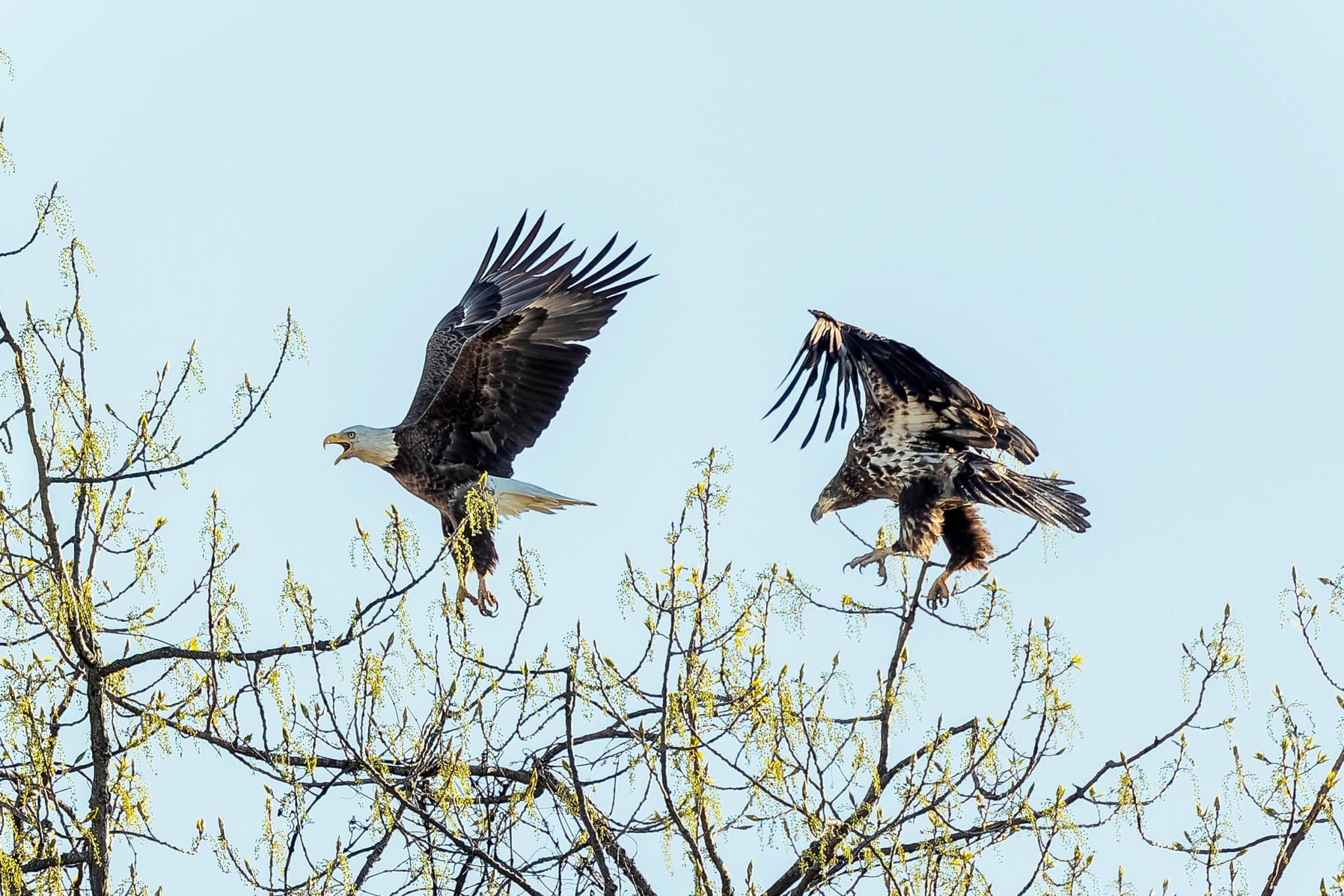
When two bald eagles built a nest in Philadelphia in 2007, it was the first time one had been recorded in the area in 200 years.
Today, eagles can be spotted swooping over Wissahickon Creek, flying near Kelly Drive and soaring above FDR Park. Their return to American skies is one of the 21st century’s great conservation stories. From near-extinction lows in the 1960s, the estimated population of bald eagles in the United States has rebounded to more than 315,000.
But scientists are again worried about the eagles’ future. Although a 1972 ban on the insecticide DDT made their comeback possible, they are still threatened by habitat loss and lead poisoning. And a new danger, an unusually persistent outbreak of avian influenza, has killed hundreds of them nationwide since 2022.
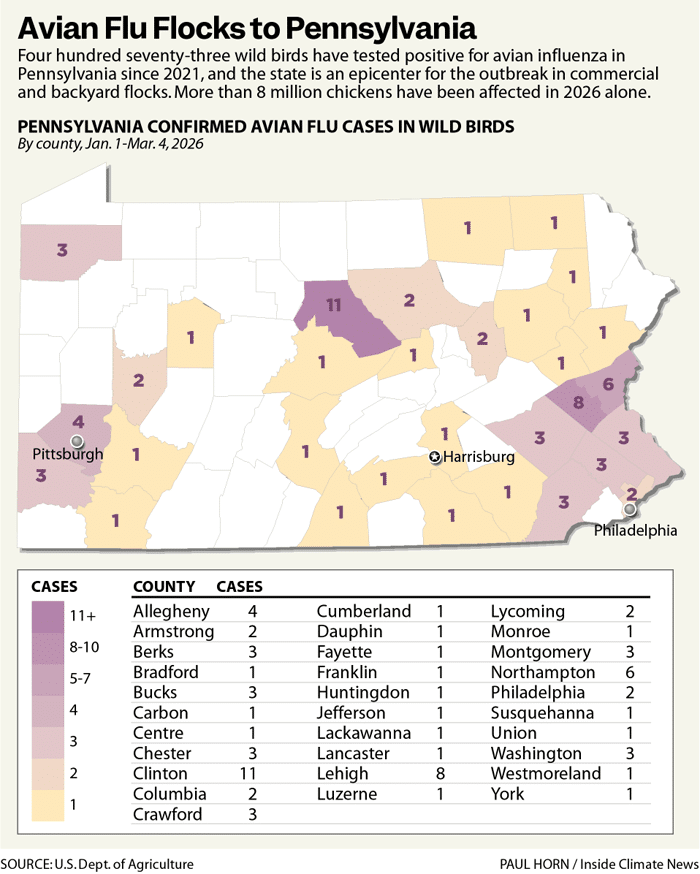
Pennsylvania is a center of the current outbreak, with more than 480 cases officially detected in wild birds and almost 16 million domesticated birds affected over the past four years, according to the U.S. Department of Agriculture. Six million of those birds were affected in just the last 30 days.
Wild birds’ migration patterns lead to spikes in the spring as thousands of birds pass over Pennsylvania on their way north. Pennsylvania and its densely clustered poultry farms are directly in the path of the Atlantic Flyway, a major migration route stretching from South America to the Arctic.
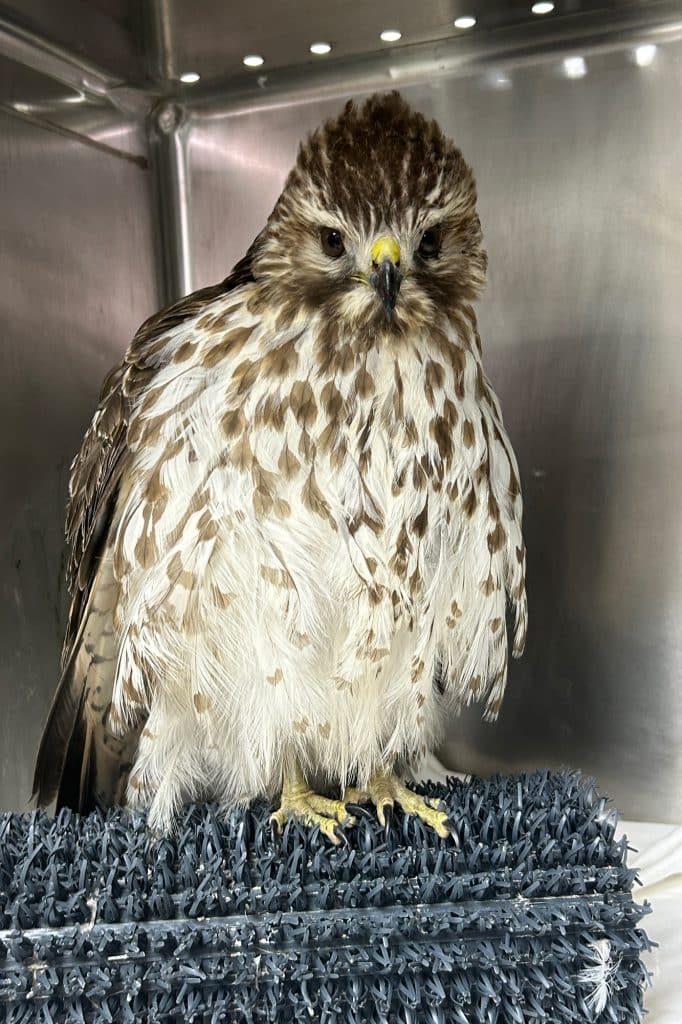
Snow geese have died by the hundreds in Pennsylvania, and this year, Canada geese, American crows, mallards and multiple species of hawks and owls have tested positive. Waterfowl are the main carriers of the flu, but raptors—birds of prey—can get sick when they hunt or scavenge infected birds. Recent research suggests the virus is spread primarily by wild birds in North America.
The state is testing as many birds as possible as it tries to contain the illness in Pennsylvania’s poultry industry. “Since the outbreak, we’ve been operational seven days a week,” said Lisa Murphy, resident director of the Pennsylvania Animal Diagnostic Laboratory at the University of Pennsylvania’s New Bolton Center, which works with the state Department of Agriculture and Penn State University to test birds for avian flu.
Last month, Gov. Josh Shapiro said the state was in “crisis mode” as it dealt with half of all avian flu cases in the U.S. “Pennsylvania is really, sadly, at the epicenter of this,” he said.
“This is a virus that we thought would burn out two years ago,” said Russell Redding, Pennsylvania’s secretary of agriculture. “This strain has not diminished in its strength, and to the contrary, it’s actually strengthened.”
A “Clear Threat” to Raptors
Since bald eagles returned to the area in the early 2000s, a nesting pair at the John Heinz National Wildlife Refuge in South Philadelphia have become a yearly attraction for visitors in the winter and early spring, when the eagles incubate their eggs and raise eaglets.
“I remember when we had first started seeing them at the refuge,” said Jaclyn Rhoads, vice president of the Friends of Heinz Refuge, a nonprofit founded to support restoration and education at the site. “It is such an emblem of freedom and hope, not only for Philadelphia, but throughout the country.”
Although avian flu numbers are low in the Philadelphia area at the moment, Rhoads is concerned about the refuge’s beloved nesting pair. In the last few months, the deaths of hundreds of Canada geese just over the Delaware River in New Jersey have been blamed on avian influenza.
So far, the USDA has recorded 48 bald eagles with avian flu in Pennsylvania. USDA’s published wild bird detection numbers likely represent a vast undercount, said Nicole Nemeth, a researcher at the University of Georgia who has studied the virus’ impacts on black vultures and bald eagles.
“One black vulture that you see listed easily could represent a site where 100 or 150 other birds died,” Nemeth noted, “but one bird was selected to send to someone like us for testing.”
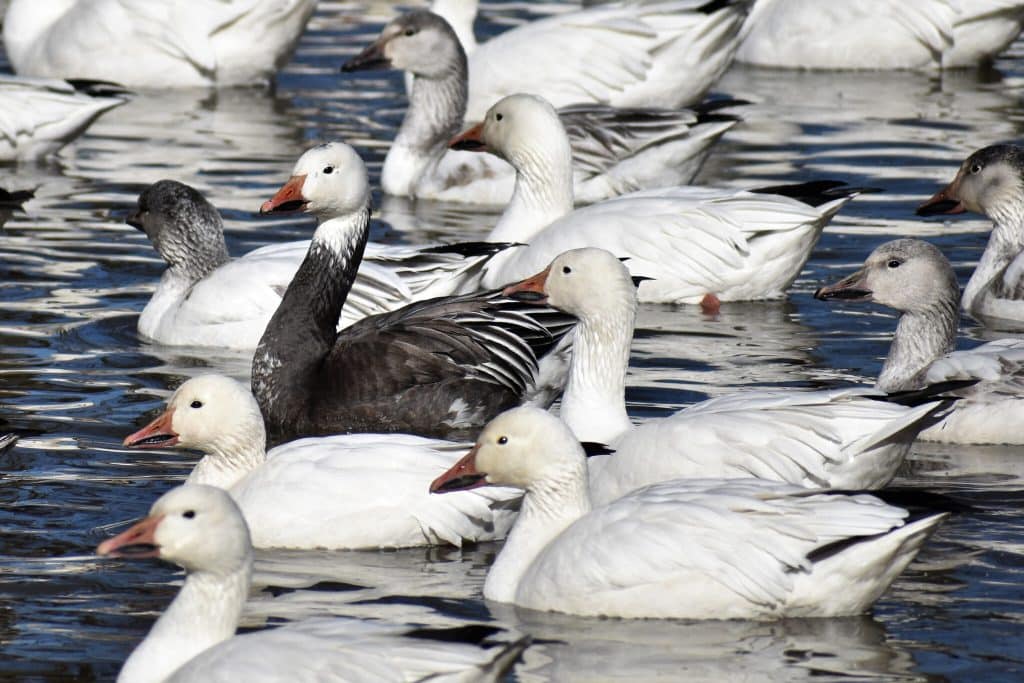
A 2023 study Nemeth co-authored found “an alarming rate of bald eagle nest failure and mortality” for eagles living along the southeastern coast of the U.S. as a result of the outbreak, documenting “fatal, systemic” illness from avian flu in breeding adults and nestlings. Combined with similar reports from Europe, Asia and Africa, the results “indicate a clear threat to raptor health,” the researchers concluded.
At the Raptor Center at the University of Minnesota, they’ve seen a leveling out of raptors with influenza since the outbreak began in 2022, said Dana Franzen-Klein, its medical director. “At this point, it’s something that is kind of like COVID for us, where it’s stabilized, it’s here, it’s not going away.”
But the long-term impacts of this strain of avian influenza on wild birds and particularly on raptors are unknown. Scientists are studying how the larger numbers of deaths at the beginning of the outbreak could have disrupted breeding patterns. Birds that survive the disease could develop chronic symptoms, potentially affecting reproduction, migration and lifespan.
Nemeth has seen one case of a bird that had to be euthanized because of chronic neurological impairment likely caused by avian flu. “Its head was tilted. It never seemed quite right. It basically had long-term brain lesions and impacts on its neurologic function that will never really be better,” she said. “We don’t have a great idea how many survive and how many have that, but it’s absolutely happening.”
While some bald eagles have developed antibodies that may confer protection, Nemeth is concerned about the eaglets and other baby birds born each year with no immunity.
Raptor populations can take longer to rebound from losses than other bird species because many do not reproduce at a fast rate, said Neil Paprocki, a researcher who has studied the effects of the avian flu on rough-legged hawks. Bald eagles lay only one to three eggs per year.
READ: With Waters Rising, Pennsylvania’s Historical Treasures Must ‘Adapt or Collapse’
“With all the other stressors affecting these birds outside of influenza, when you get something like influenza that comes in and takes out a bunch of the breeding population, there is the potential that the breeding population just kind of stays low moving forward,” he said.
Scientists hope the bald eagle can help bring attention to the toll that avian flu is taking on many wild birds at a time when their populations are already declining because of climate change and agricultural development.
“They can be a sentinel or a symbol for the many, many bird species that have died and are dying,” Nemeth said.
A High-Risk Future
In past outbreaks of avian flu, the disease “would typically be present in the local ecosystem for one migration season, and then by the time that migration season ended, it would fizzle out,” Franzen-Klein said. “This strain has been very different. It has continued to circulate in wildlife.”
In addition to birds, the virus has spread to mammals, including dairy cows, elephant seals and smaller animals like skunks, raccoons, foxes, rats and bobcats.
Some wildlife rehabilitation centers in Pennsylvania that care for sick birds are overwhelmed. Others are setting up precautions in case the flu comes to their doorsteps.
“We’re well over 100 for this year of birds that have come in that have either passed away in transit, passed away within minutes of being here or were euthanized after observation,” said Janine Tancredi, executive director at the Pocono Wildlife Rehabilitation and Education Center in Monroe County.
That’s fewer than they saw last year, she said, but it’s more than enough to keep the staff extremely busy, especially as they must follow strict biosecurity protocols for quarantine and personal protection equipment disposal for every case. Tancredi urged the public to call ahead before bringing in a bird exhibiting any of the symptoms of the flu, like lethargy, seizures, tremors and instability.
READ: The ‘Toxic Cocktail’ Brewing in Pennsylvania’s Waterways
The Schuylkill Center for Environmental Education, in Philadelphia, has stopped accepting water fowl as patients. “We are taking every abundance of caution,” said Sydney Glisan, director of wildlife rehabilitation.
Barbara Malt is the president of the Lehigh Valley Audubon Society. In December, a group of birders in the area found a sick great horned owl. “This one was just out in the open, lying on its side in the path, but alive,” Malt said. The owl later tested positive for avian flu.
Malt recently found four dead Canada geese floating in a local pond where she planned to take a group of children to do a bird count. She said she worries less about the effects on waterfowl than about raptors, whose populations are less stable to begin with. “These are species that are not over-populated, and we really don’t want to be losing them,” she said.
There have been “mass casualty events” of snow geese and Canada geese in the area, but also “major declines” in black vulture observations at the group’s annual Christmas bird count, said Brandon Swayser, who chairs the bird count committee.
“A lot of people just don’t understand how a little action can have long-term risk,” said Bracken Brown, biologist-naturalist at Hawk Mountain Sanctuary in central Pennsylvania. For example, people can track the virus on their shoes from places where waterfowl congregate to areas where other birds can catch it. “This virus is now pervasive in the environment,” he said. “It’s not like we’re going to be able to stop it.”
That’s why farmers, workers and the public must follow biosecurity safety measures so human movement does not contribute inadvertently to transmission. The risk for birds in Pennsylvania is likely to remain “very, very high” for the next few months, Redding said.
Murphy said sometimes she wonders, four years into the outbreak, what the future holds. “Is this our new normal?” she asked. “There’s arguably nothing normal about it.”