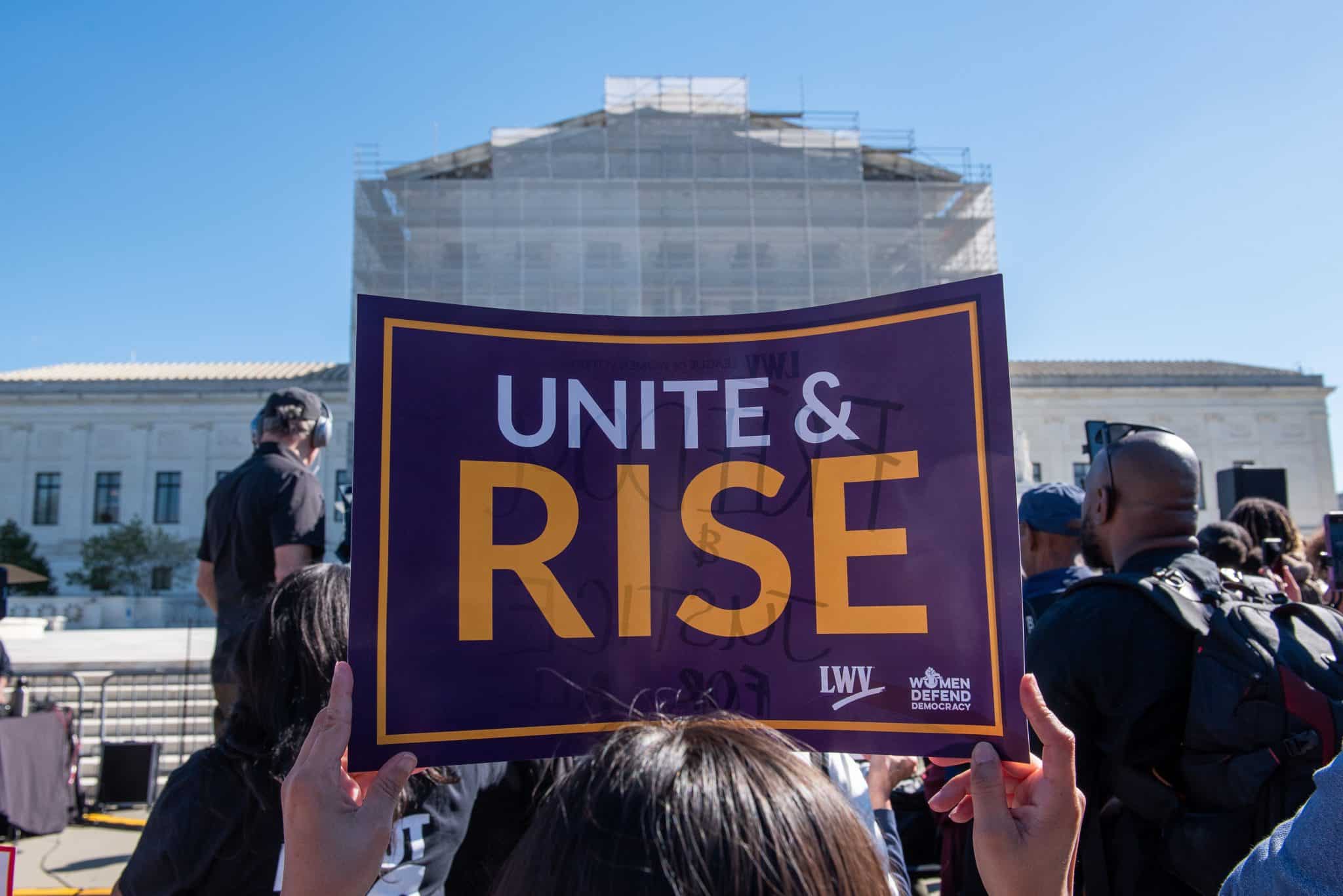
Once again, American women’s rights are under open fire.
After President Donald Trump’s appointed conservative Supreme Court majority overturned the 1973 Roe v Wade decision guaranteeing women the right to abortion and reproductive health care, some four years later Republicans are now effectively looking to turn back the clock even further to before the 19th Amendment was ratified. Scores of women could be turned away from polling places if the SAVE America Act is passed by the Senate.
Gréta Bedekovics, director of democracy policy at the Center for American Progress, said legislators have “promised a vote before the March recess,” which runs from March 30 to April 12, 2026.
“I’m very concerned – with IWD [International Women’s Day] going around in my head, we’re about 100 years out from getting the right to vote and now we’re fighting this bill which would make it harder for millions of women to vote,” Bedekovics said.
Adrienne King, president of the NAACP Bucks County Branch, had her daughters’ future weighing on her mind as America faces this potential voting rights setback.
“As a Black woman and mother raising daughters, I am deeply concerned about any legislation that could make it harder for eligible Americans to vote,” said King. “The right to vote is foundational to our democracy, and history shows that barriers often disproportionately impact women and communities of color.”
Bucks County Beacon previously reported after last year’s failed attempts to change voter identification requirements that last month the U.S. House of Representatives narrowly passed the SAVE America Act by a 218-213 vote, Republican Rep. Brian Brian Fitzpatrick (PA-01) helping push it over the finish line with his vote.
If adopted and signed into law, Tara Murtha, director of impact and engagement at Women’s Law Project in Philadelphia, expects the SAVE Act to “interfere with women’s voting rights and run afoul of the19th Amendment,” which guarantees American women the right to vote.
“We would expect litigation to be filed challenging the act on that and other grounds to be all but guaranteed. If passed, there is no possible way to implement such a massive change in time for the 2026 elections. Election experts are warning it would wreak havoc on current election administration and place massive unfunded burdens on state and local governments,” Murtha added.
While less often part of the SAVE America Act discussion, Murtha said it’s important to understand how restrictions in the proposed legislation would also “undermine registration by mail and online registration, because there is no clear mechanism to ‘show your papers’ other than in-person.”
In addition to eligible women voters, others potentially impacted and harmed by the legislation include anyone who has changed their name like transgender people and domestic abuse survivors.
“This bill would also disenfranchise people who don’t readily have access to specific documents or the resources to obtain them, which are disproportionately Black and low-income voters,” Murtha said.
That means legal citizens with the required documentation who lack resources, transportation or the ability to travel in person to get to a polling station would also become disenfranchised, she noted.
The Bipartisan Policy Center reported these voting facts:
· Citizenship is already an established requirement to register to vote – and to cast a vote in federal elections. The1996 Illegal Immigration Reform and Immigrant Responsibility Act prohibits non-citizen voting.
· Instances of non-citizen voting are rare.
· Many eligible voters do not have or have ready access to the SAVE Act’s “documentary proof of citizenship.”
· Better options to confirm voter citizenship should be placed on the government – not voters.
· SAVE Act penalties could create “unintended consequences” for election officials and administrators.
“Many people might think if they know their election official (they can vote) but under the bill, but election officials are criminally liable for accepting documents [not specified] and a [Pennsylvania] Real ID will not count” as proof of citizenship, Bedekovics said.
At the issue’s heart is restricting voting access by requiring voters to provide documented proof of citizenship at the time of their voter registration and an approved photo ID when they vote.
Women whose names do not match their birth certificates or do not have either an Enhanced Real ID, which are only available in five U.S. states that share borders with Canada or a current passport – because they took their husband’s name when they married – could have additional hurdles to clear before being able to cast their votes.
“Birth certificates, passports, naturalized citizen papers, military records, or an adoption decree” are acceptable forms of identification, according to Bedekovics, “but it would have to include your current name, because with your birth certificate you would have to also show photo ID.”
“Watching your husband cast a vote and you not being able to do so casts a long shadow over women’s civil rights gains,” Bedekovics added.
Among the women most impacted by the SAVE Act could be those conservative Republicans living in red states supporting the legislation if they don’t have their paperwork in order or the ability to drive to polling stations to cast their votes in person.
READ: The Secret Plot to Take the Election Out of Voters’ Hands
“In many of the states, the biggest supporters of this legislation would in reality be the most impacted,” Bedekovics said.
However, there are even one or two (women) Republican lawmakers raising the alarm.
“As Republican U.S. Senator Lisa Murkowski noted, many Alaskans would have to get on a plane or ferry just to be able to vote. That’s not democracy. This mandate would also eliminate community get-out-the-vote voter drives,” Murtha said.
Along with Alaska, larger land-mass states could get tangled because the legislation would force people to fly to get to polling stations, in some cases 8-hour flights “to show ID to vote,” Bedekovics said.
In an OpEd published by the Anchorage Daily News, Murkowski wrote “I support voter ID – but oppose the SAVE America Act.”
“In its present form … it would also require states to submit their voter rolls to a database maintained by the federal Department of Homeland Security, which would, in turn, tell the states whom to remove,” Murkowski wrote on her official website.
Ilene R. Sheinson, president of the League of Women Voters of Bucks County, said “the SAVE America Act would impose sweeping new ‘show your papers’ requirements, preventing millions of eligible Americans from registering and voting … Every time a voter casts a ballot, including when requesting and submitting an absentee ballot. This act seeks to solve an issue that does not exist.”