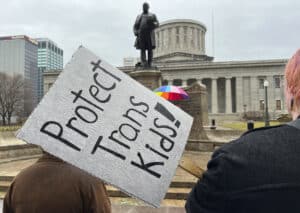

With my two sons about to graduate Neshaminy High School, I wrote a guest opinion in the May 30, 2000, Bucks County Courier Times. I supported a student whose novel idea caused controversy. That Opinion bore the same title as this column and speaks to the student walkouts over ICE’s inhumane tactics. Walkouts occurred nationwide including at Neshaminy, Pennsbury, Quakertown, Pennsauken, Souderton, Upper Perkiomen, Centennial, CB West and CB East. These students’ important voices show that education is not limited to the classroom.
Facing school discipline, threats and violence students still walked out. In Virginia 303 students at Woodbridge High School were suspended for walking. Governor Abbott’s Education Agency required students to be marked absent and threatened teachers and school systems that facilitated walkouts with investigations and sanctions.
In Quakertown the chief of police, out of uniform, was videotaped rushing a group of student protestors and putting a 15-year-old girl in a chokehold. This maneuver killed Eric Garner and George Floyd.
In that May 2000 column I discussed students running for Neshaminy student council president who were offered 30 seconds of airtime during school announcements to state their platform. One candidate contacted Howard Stern and convinced him to speak on his behalf. Once community members found out that Howard Stern spoke to students they complained to the School Board.
READ: Why I Support Pennsbury High School Students Protesting ICE
In supporting that student and principal I said the true meaning of education is not simply being in your seat and listening to a teacher or reading a textbook. It is developing skills that will last a lifetime such as thinking for yourself and making your own choices. Learning that takes place outside the classroom or from other students can have even greater educational value. I said those complaining community members were teaching students “that if you don’t like another’s idea just try to censor it, the same type of outdated thinking that led to book burning and book banning.”
Who would have thought that 23 years later Moms for Liberty would ban books?
My then 16-year-old son writing for the teenage section of the Bucks County Courier Times wrote a satirical article comparing school guidelines to prison. The paper photoshopped a picture of him in a prison uniform covered in tattoos and large black shadows around his eyes. He was scary looking. His concerned newspaper adviser asked if I objected to printing the article and picture. If my son was bold enough to write it I would stand behind him.
His high school humor included “Parole – summer, You’re out for a little bit, but you know you’re going back.” “Community service – homework, You don’t want to do it, but you know you need to because it’s the only way to get out.” “Prison food – school food, Prison food is looking pretty good.” He discussed needing to use the restroom during class. He pleaded for a pass. After the teacher finally signed his pass claiming he disrupted class he sat down in his chair as the moment passed. “Hence the phrase we now know as the ‘Pass’”.
One Letter writer complained about his tattoos not realizing they were photoshopped. Another writer said: “Teenagers need structure ‘cause kids are stupid, they don’t understand.” I responded in the paper, “Maybe if schools begin to respect teenagers, kids won’t think school is prison, but will see school as an oasis, where their opinions are valued, their individuality protected and their voices heard.”
Putting aside Governor Abbott’s and the Quakertown Sheriff’s politics (the Sheriff’s shared Truth social account called the Democratic Party a domestic terrorist organization), the throughline connecting the student protests with school is prison and Howard Stern is the way schools and the community treat students.
READ: Young People Aren’t Abandoning Democracy — They’re Waiting to Be Invited In
Watching videos of Governor Abbott denigrating student protesters and the Quakertown Police Chief charging the students, I thought of a book I read in high school – One Flew Over the Cuckoo’s Nest. Abbott and the Police Chief posed as Nurse Ratched demanding obedience and squelching individuality. The students embodying McMurphy fight for their individuality only to face lobotomy.
As my then 16-year-old son said: “Listen to our teenage voices for once … You’d think we were a danger to society instead of society’s future.”
After I submitted this Opinion the Beacon published “Iran War and Other Tough Topics Give K‑12 Teachers Chance to Teach Students How, Not What, to Think.” That author described a program he developed teaching more than 3,000 educators to put their lesson plans away when current events like the Iran War present that elusive teachable moment.
He, like I, argue that the best teachable moments are not found in textbooks or teachers’ lectures. They are found in students thrashing out ideas through discussions of real issues with their teachers helping them “craft compelling questions” and developing critical thinking skills they need for a lifetime.
READ: A Lost Generation of News Consumers? Survey Shows How Teenagers Dislike the News Media
Maybe if that program had been in place in the Quakertown school system the students would have had a safe place to explore the issues surrounding ICE and felt protected not abandoned. A teachable moment eluded Quakertown.
Quakertown could have created a project having students research and discuss opposing points of view in the ICE protests in Minnesota and major protest movements in US history including labor, women’s suffrage and civil rights. Here are two examples of the role of African American children in the civil rights movement for discussion. Six-year-old Ruby Bridges integrated an all-white school but needed federal marshals to ensure her safety. High school students engaged in sit-ins at white-only lunch counters enduring far worse abuse than the student ICE protesters.
As a 48 year Bucks County resident I implore Bucks’ teachers to periodically keep the textbooks closed and the lectures silent. Instead, open a newspaper in class and throw a dart at the front page or opinion/editorial page to pick a topic whether it is the Iran war, immigration or I dare say this Opinion. And if your students are like my grandchildren and have never read a paper newspaper then use an online media outlet like the Beacon which provides enough news stories and Opinions in a week to last the entire school year. And read and adopt the program it describes.