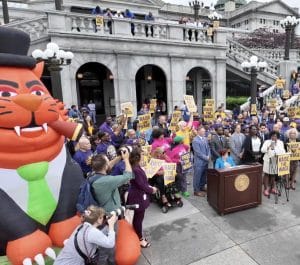

For the third time in four years, the Pennsylvania House of Representatives has passed legislation to raise the minimum wage. For the third time, this bill now sits in the Senate awaiting action.
The question is no longer whether we should raise the minimum wage. The question is why we haven’t already.
Pennsylvania’s minimum wage has remained at $7.25 an hour since 2009. In the last 17 years, the cost of living has risen dramatically. We all feel it in our wallets and see it in our budgets: housing, groceries, childcare, and transportation all cost more. Yet wages at the bottom have been frozen in time.
Meanwhile, every one of our neighboring states has moved ahead. New Jersey, New York, Delaware, and Maryland have all enacted higher minimum wages, with several already at or approaching $15 an hour. Even West Virginia has surpassed Pennsylvania’s wage floor at $8.75 an hour. The result is simple: we are less competitive as a state, both for workers and for businesses looking to attract and retain a stable workforce.
This is not just a matter of fairness. It’s a matter of economic competitiveness.
Hundreds of thousands of Pennsylvanians would see a direct benefit from a minimum wage increase. These are not abstract numbers; they are our neighbors, home health aides, childcare workers, retail employees, food service workers. They are people who work hard every day and still struggle to make ends meet.
When wages go up for working families, that money doesn’t sit in a bank account. It gets spent in local communities. It goes toward groceries at neighborhood stores, meals at local restaurants, and services provided by small businesses. Raising the minimum wage is not just about helping individual workers. It’s about strengthening our entire economy from the ground up.
Raising the minimum wage isn’t just the right thing to do for Pennsylvania’s families. It’s a smart way to save taxpayers’ money and strengthen our economy. When workers earn a fair wage, they are better able to support themselves and are less reliant on government programs, helping transition more people off public assistance and reducing costs to taxpayers, including millions in Medicaid spending.
If we recognize that rising costs warrant regular pay increases for those in government, we should extend that same basic fairness to the hardworking Pennsylvanians who are the backbone of our economy.
The legislation passed by the House takes a balanced approach, gradually increasing the minimum wage to $15 by 2029. This phased timeline gives businesses time to adjust while finally delivering long-overdue relief to workers who have waited more than a decade for change.
A 1995 law ties Pennsylvania legislators’ salaries to the Consumer Price Index (CPI), ensuring their wages keep pace with inflation. That adjustment occurs automatically each year unless lawmakers choose to freeze it. This same courtesy has not been extended to those working minimum wage jobs in our state. The legislation passed by the House would finally correct that imbalance by, after 2029, indexing the minimum wage to the CPI so it keeps up with the real cost of living. If we recognize that rising costs warrant regular pay increases for those in government, we should extend that same basic fairness to the hardworking Pennsylvanians who are the backbone of our economy.
READ: Right-Wing Nonprofit Linked to a Combative PR Firm Is Opposing a Minimum Wage Hike in Pennsylvania
According to the Keystone Research Center, 11% of our workforce, or 38,000 workers would benefit from a $15 minimum wage in Bucks County. And 26% of those are workers who are 40 or older and 20% are parents. The impact of this bill isn’t abstract, it’s real and tangible for our neighbors who deserve to make a living wage. And it’s real and tangible for our local businesses who would see the economic impact of higher wages being spent right here in Bucks County.
The House has done its job. Three times. The path forward is clear.
It is time for Senate Republican leadership to bring this up for a vote, which they refused to do for the two previous bills. Senate Democrats are ready and willing to move forward on this issue. Pennsylvanians deserve to know where their elected officials stand on an issue that directly impacts their livelihoods.
Hard work should be rewarded with a fair wage. Right now, Pennsylvania has fallen behind and we cannot afford to wait any longer to catch up.