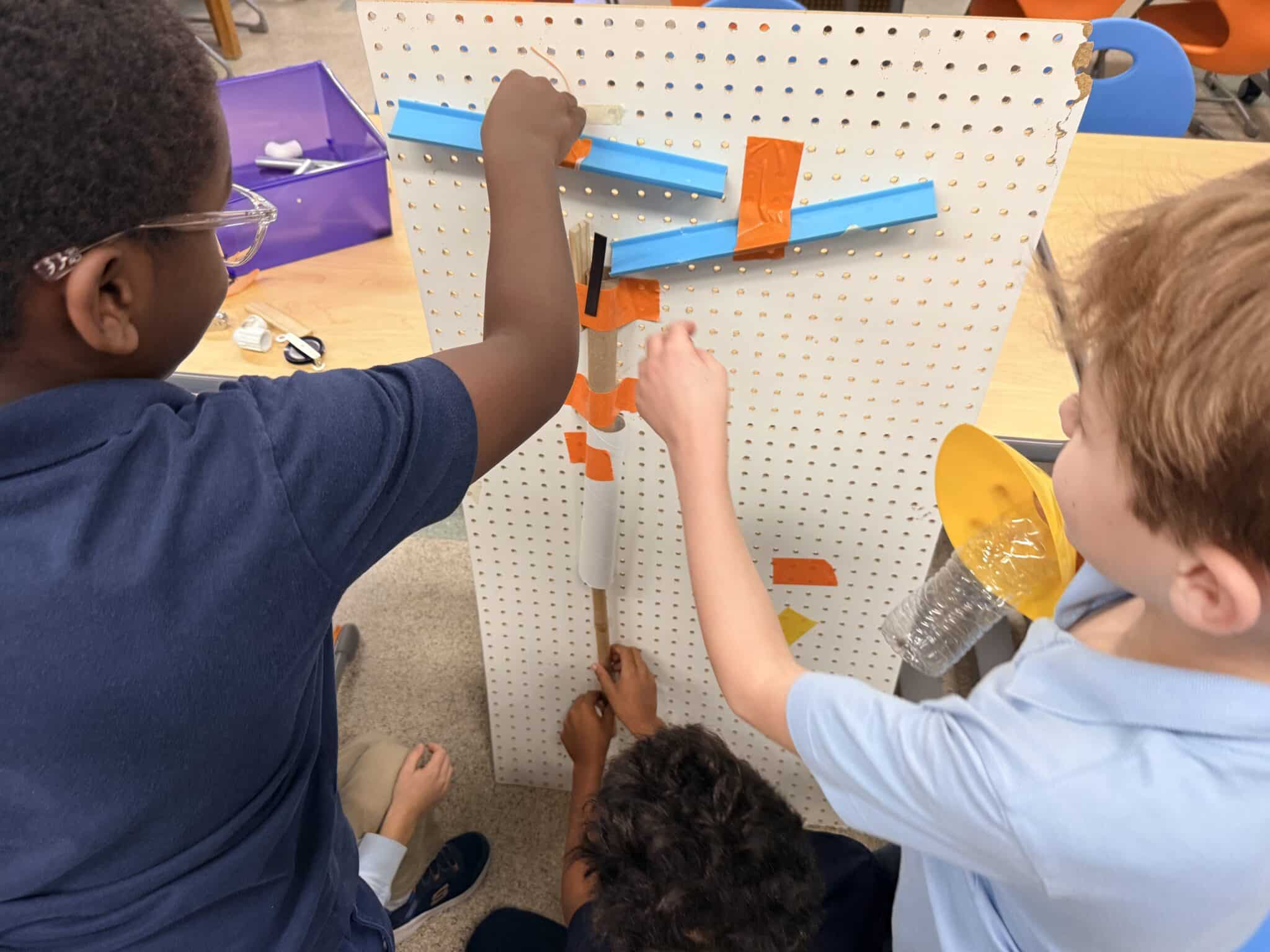
My 3rd grade students buzzed around our classroom workshop with purpose, picking out cardboard tubes and pulleys, wooden blocks and duct tape. Their task? Create a system to water plants, and integrate simple machines with various actions and reactions. Before introducing the project, I’d reflected on the previous four years. I wasn’t convinced these particular lessons were effective. So, I reviewed notes, photos, and videos of student projects and invited a pre-service teacher to help me redesign the unit. Mr. Mark, a Drexel University junior, created introductory slides, built example models, and kicked off the project.
As students Alexis and Reese took note of a marble moving down a cardboard ramp at different angles, I watched Mr. Mark listen closely to their ideas and nudge them in productive directions. He handled materials to demonstrate something but never took over. Alexis and Reese continued to tinker until their marble reliably fell into their cup.
Rube Goldberg devices—systems with a simple goal but with complex and often illogical components—are a common classroom project for teaching creativity, collaboration, and engineering. Our education system, like one of these devices, is just as convoluted. While the primary goal is to educate young people and support their growth as engaged members of our communities, some actions and reactions may undermine that goal. Systems should be built to support my work toward this goal—and be designed to keep teachers like me in it.
For instance, my work with a pre-service teacher isn’t recognized by my school district, even as his presence in my classroom is transformative. With the support of my principal, with funding from my school’s families, and in partnership with a Drexel professor, I brought Mr. Mark to my school. And we are all better for it.
Our classroom collaboration with Mr. Mark shouldn’t be a fortuitous accident; it should be the blueprint. Pennsylvania does not have enough teachers, especially when it comes to teachers of color. A recent report citing research from Penn State University’s Dr. Ed Fuller describes the crisis as more than 280 public schools losing more than 20% of their teachers year after year. Our state and some districts have strategically invested in stipends to pre-service teachers, residency programs, and future-educator programs in high schools.
But there’s more that must be done to keep effective educators in classrooms. Focusing on this side of the teacher shortage—strategic staffing as laid out in a recent Teach Plus Pennsylvania and PA Needs Teachers report that I helped author—stabilizes our schools, elevates the profession, and supercharges student learning gains. In fact, we found that teachers in schools that embrace one of the models are 50% less likely to leave the classroom.
At least two principals have asked me if I’ve considered becoming a principal. My response? I want to lead in and from a classroom—and be supported by excellent principals. When a district curriculum leader suggested I should have his job, my response remained the same: I want to do my job, supported by leaders like him. He has done just that, inviting me to present at workshops and design curriculum. But a teacher’s ability to lead shouldn’t depend on the luck of having great administrators like I’ve had.
READ: Student Teachers Should Be Paid for Their Work
We need teacher leadership models that empower classroom teachers to lead rather than leave. Pennsylvania should look to examples like Arizona State University’s Next Education Workforce to develop models in which teams of teachers, paid teacher residents, and community educators collaboratively meet the needs of a cohort of students. Exemplary teachers take on additional responsibilities for mentoring new teachers like Mr. Mark and lead teams of teachers.
We can further reorganize our staffing models by shifting some middle-level managers to classrooms as team members who have daily contact with students. Returning these former teachers to schools while keeping them in district-level roles helps ensure classroom expertise guides district decisions. A teacher coach who collaborates on a teaching team and works with students not only ensures that the coach is practicing what they preach but also frees up another teacher to take on other roles.
My students learned that the best Rube Goldberg devices aren’t just complex—they are intentional. Alexis and Reese, with Mr. Mark’s help, compared potential solutions before selecting the most reliable design. Our education system should be no different. By reimagining teacher leadership pathways and creating sustainable models for professional growth, we can replace the convoluted “actions and reactions” with a better model: one in which experienced teachers just like me stay so student success is achieved by design, not by chance.