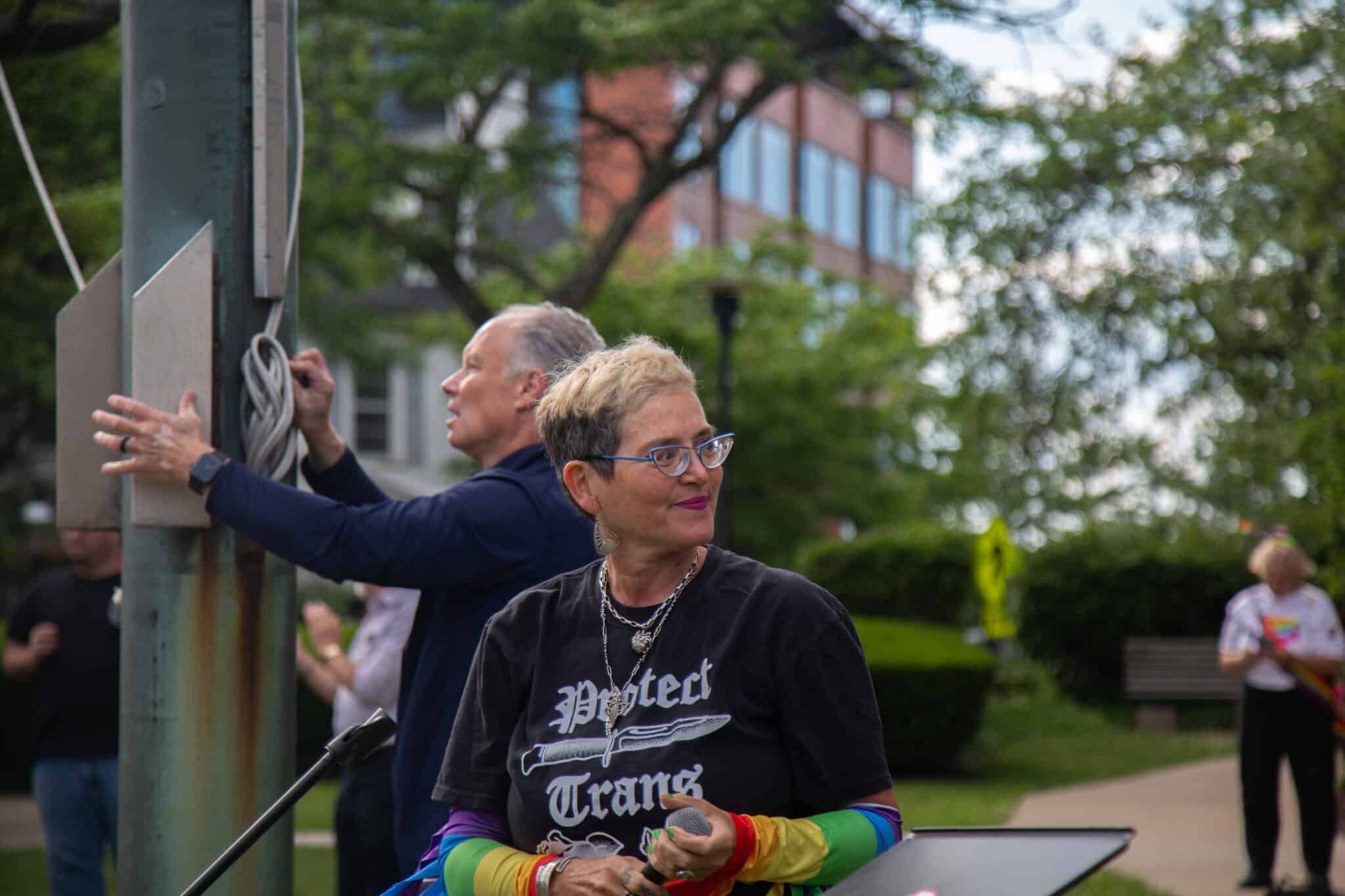
Marlene Pray (she/her) is a queer activist, sexuality educator, and community organizer whose work spans over three decades of LGBTQ+ advocacy, anti-racism, and social justice movement-building. She founded and directs the Rainbow Room, Bucks County’s LGBTQ+ youth center at Planned Parenthood Keystone, which has been a lifeline for queer youth in the region for 24 years. A PhD candidate in Human Sexuality Education, she has trained educators, organizations, and communities across the country on LGBTQ+ inclusion, racial equity, and youth empowerment. Her public service includes serving on Doylestown Borough Council, where she championed the borough’s LGBTQ+ anti-discrimination ordinance, and she continues to lead through board roles with the NAACP and NAMI Bucks County. Marlene lives in Doylestown and brings her whole self to the work — as an organizer, mother, homicide survivor, and earth-based celebrant committed to collective liberation.
She joined me to kick off Pride Month, to talk about its history as a riot, as protest, and as a demand, and what the fight for LGBTQ+ rights looks like today.
Listen on Apple, Spotify, Podbean, and iheart
Marlene, when and why did you first become involved in LGBTQ+ advocacy and organizing?
It’s kind of hard to put a start date on it. It certainly is connected to my own emerging identity development as a queer woman and as a bisexual person. But as far as organizing and activism related to LGBTQ rights, that really began for me when I was living in Ohio and working at Antioch University. So I would say that’s when I began to actually be involved in advocacy efforts. There, at what was then, and is again, Antioch College. I was a graduate student, but working for Antioch while studying at the university.
Then, fast forward to moving to Doylestown, which was about 30 years ago. Pretty soon after I got here, I started work for Planned Parenthood and began working in the schools, leading sex education all over the county, and quickly realized that there was really no place for queer teenagers and young adults to go to hang out, to make friends, to explore and learn about their identities, to get actually accurate, medically accurate and inclusive sex education. So I started the Rainbow Room 24 years ago with a group of young people and supportive adult allies and parents. And that certainly launched my more career-oriented—I mean, it’s part of who I am and part of my life—but very much became a core part of my work, as well, at that point. There’s a much longer answer in there, but those are some of the pieces.
You also asked why. I mean, for me, it was partly because of what didn’t exist here in the community I lived in, in my home. And hearing from young people about how much prejudice and discrimination they were facing and also the lack of support and the desire for something to exist here. It was very unusual at the time to have a suburban/rural community with a queer youth space or center. At the time, we didn’t—of the 13 school districts in Bucks County, we only had a few GSAs. And even those struggled to exist and to fight against resistance and to understand what their rights were. So that was a huge part of it, really just witnessing and hearing these stories. And also seeing the faces of youth light up in classrooms when I would even mention and support and express as valid the diverse identities around whether someone was gay, or straight, or trans, or bisexual, or questioning, or asexual. And just to see heads lift up from desks that were otherwise kind of zoned out during whether it was even a program on puberty, or HIV prevention, or abstinence, or healthy relationships.
Sex education doesn’t have a very good history of being radically inclusive around, not only sexual orientation and gender identity, but also around race, and that was a huge thing that I was working with at the time and studying about in grad school. And then my own experience, and also having an older sibling who came out in college and really faced a lot of challenges within our family structure and within our community, but also faced and was welcomed with so much radical love within her social circles and just seeing how much of an impact that makes. Then there’s certainly a lot of connections to other movements for social justice, and for rights, and for humanity, and for feeling loved, and protected, and valued.
So this was back in 2002. I was wondering if you could just explain a little more, provide some more details about what that organizing looked like to start the Rainbow Room and the kind of intergenerational nature of it.
Yeah, definitely. There were so many different things happening that I was witness to or connected to at the time. I mean, for one thing, there weren’t a lot of visibly queer people speaking to young people in the community at that time, outside of our amazing, vibrant community of New Hope. But even that was very isolated from teenagers. In fact, ironically, or rather illustratively, one of the hardest school districts to get a GSA going and thriving was the New Hope-Solebury School District at the time.
Wow.
We actually had teachers telling us, I will lose my job. I will be targeted so hard by the conservatives in this community. There is a backlash from the reputation, the well-earned reputation, that we have of being a gay-friendly town and there’s almost this hyper masculinity response to it, which is how it was described at the time. So that was just another thing on the landscape that was like, geez. Because we looked at opening a Rainbow Room building in New Hope, and actually realized that was not a friendly place for teens. Not to mention there was no public transportation and some other really nuts and bolts priority issues like that.
But also, again, just this start as I was out teaching and working for Planned Parenthood as an educator, young people started just coming up to me at the end of programs and saying, can I give you my email address in case you ever do something to support us? And I had to file a folder in my office of young people or their parents that said, if there’s anything more that I could ever be involved with, please let me know. And those were some of the kiddos that I communicated with when we first started.
There was also an incident that happened right in Doylestown. There had been a young man, a boy at Central Bucks West who died by suicide. I never knew him. I didn’t know his family. He came out to his parents, was rejected, and ended his life that night. The students at Central Bucks West were reeling from this loss of their peer, and they wanted to meet and talk about it over—you know, what, I don’t know what it was called then, but now it’s called advisory—their like break period in the middle of the day, kind of like homeroom. And they were actually told by one of the administrators at the school that they were not allowed to do that. They were not allowed to talk about that without supervision that included restricting talking about this person’s sexual orientation. So they contacted a local parent who contacted me and said, they just need a place to get together and talk about this. Not only are they in pain, but they were just told they can’t actually talk about this kid’s sexual orientation in relationship to what happened. So, a few of us found a space for them to meet and that grew into then—you know, I also was running an afterschool program at Lenape Middle School at the time called Youth for Unity. We met once a week and had a welcoming, wonderful space there. We were part of what was then called the Teen Task Force. That group started before I even worked at Planned Parenthood. It was really about peer education, peer support and exploring issues, current issues of human rights. And a lot more stories began to be shared about LGBTQ issues. That was part of how I got connected to what had happened with these students in a local high school.
I basically went to my CEO and board and said, I’ve got this group already going, but we’ve got kids from other districts that want to come. Can we use the existing boardroom of Planned Parenthood as a meeting space? So we did. Called our first meeting. It was a lot of those kids from that local GSA that came, from that local school that came, that were also part of a Gay-Straight Alliance at the school at the time. And some of these other kids that I just said, or their parents, who had said to me, please let us know if you ever get anything started. Because it became actually painful, especially as a sex educator when we pride ourselves on, If we don’t know the scientifically medically accurate age appropriate response to a question you have, we will help you find it. And yet I was getting these questions literally week after week of: I might be gay, where do I go? I might be trans, who can talk to me about this? I think I’m bisexual, but I have no one to talk to. I wanna just hang out with other LGBTQ people, but I don’t know where to find them. So I was like, I’m going to figure this out at some point. So if you want to stay in touch, please do.
Our first meeting, I still remember the first kid that came in, I was putting the sign on the bulletproof glass at the Planned Parenthood Medical Office upstairs. It was a kiddo from New Hope Solebury School District. And the sign said, welcome to Bucks County’s LGBTQA Youth Center, because we didn’t have a name yet. And in the kiddos tumbled from all over the county and including, I had a core group of kids from Hatboro Horsham High School that came those first—right when we got started. Within like a month, there were over 20, 30 kids a week coming. Immediately we realized two things that were desperately needed that didn’t exist in the county.
One was support for their parents. Some of the kids were like, can you please talk to my mom? or my dad’s waiting upstairs and wants to be part of this meeting. That’s so ridiculous, but he needs somebody to talk to. And the other thing that was really lacking at the time and still is was supportive mental health, informed, really informed expert mental health support and resources. So we were able to right away, I went to a couple adult allies and said, we need a PFLAG chapter in Bucks County. Would you be willing to help host it, start it? And I found a local pastor that was willing to do that, Pastor Ginny, Rest in Power. She was an amazing resource for us in those early days. That PFLAG chapter is still going strong. We have actually a pretty amazing PFLAG chapter in Bucks County and have absorbed a couple other neighboring groups that just needed more support and resources. And [it] actually meets on the same night of the week as the Rainbow Room once a month in the same building, so that families can come together. Kiddos come into the Rainbow Room, parents and family go to the PFLAG meeting. It’s not part of what we do, but we are, like so many organizations in the community, very close partners.
And that other piece of mental health support meant, okay, I’m gonna start going, our educators and trainers are gonna start going out and doing trainings for mental health providers. Because we could find like two at the time. Plenty of people were ready to put a rainbow flag on their, you know, like in their office, which was amazing and is clearly an important, you know, visible symbol of you’re loved and we see you. But even more important, including Pride flags being raised at schools, is not just the appearance of Pride symbols, but actual concrete, knowledgeable training and support to go along with that. So we began training mental health providers in how—and that is certainly, you can get those trainings, thankfully, almost weekly at different resources and online all across the country now.
Yeah, and pretty quickly the kids came up. with, they had a whole list of names. Some of them still make me laugh to think about, but the one that everybody liked the best was the Rainbow Room, so that became our name. And same thing a few years ago when we started our Rainbow Room Junior program, the kids came up with the name ROYGBIV for the acronym of the colors of the rainbow, not of the rainbow flag, but of the actual rainbow. And it’s still called ROYGBIV. So, yeah, so those were some of those early days.
That’s great. Just to clarify: PFLAG really took the lead in engaging with parents and helping them navigate through this, for many new world, based on the experiences of their children?
Absolutely. And while PFLAG doesn’t provide training—so that’s something that we provide, and we actually have regular, like bring your parent or supportive adult nights at the Rainbow Room where we sit together and have conversations between the youth and the parents, or sometimes grandparents or foster parents, or we’ve even had kids on those nights bring a GSA advisor from school that is supportive of them.
So, yeah. PFLAG really has that support space. One of the really important things for people to know about PFLAG is, first of all, it’s a volunteer-run national organization. They have some of the best resources online for parents. So, if there’s a parent out there listening to this or reading this, and you want to know more about what your kid might be going through, or how to support them, or what some of the terms are that they’re using, head to the PFLAG website, pflag.org. You can also find all of the chapters around the country on that website, but you can also learn about things. They also have a whole section on faith and LGBTQ support. So, whether you’re Muslim, Christian, Jewish, Buddhist, UU [Unitarian Universalist], Pagan, they have links that offer support for people of different faiths of how to understand and support the young people—or the people. It’s not just for parents or friends of children, it’s for anyone.
And it really welcomes people at every step on their journey. So even if you are like, I am not okay with this. Like, not only am I scared for my kids’ wellbeing, which is also something parents should not let their kids know. Talk to your therapist or a PFLAG about it. Don’t put that weight on your kid. But if you’re even really struggling with understanding or accepting who they say they are, PFLAG welcomes you. There’s not a litmus test there other than that you have an LGBT person in your life who you love and want to understand how to be supportive of them. So yeah, yay PFLAG.
I mean, it’s such a difficult task being able to kind of communicate effectively and educate, I think, not just parents, but the general public. I think it’s something that some in the movement are still struggling with. I’m not sure if it’s necessarily their fault, but I think that’s a reason why we’re still seeing a lot of bigotry and backlash to the LGBTQ community even in 2026.
Yeah, I mean, you know, we also have so many people using queer people and queer rights as sledgehammers against all kinds of rights. So that even if they don’t really care about trans people or intersex children, they have decided that this is a volatile issue where they can gain favor. Which, similar to struggles to protect abortion rights, the right wing didn’t care about embryos and babies. They cared about maintaining segregation and racism. So they—I mean, this is their own information. This is not like some secret. But they actually figured out that if they focus on abortion and homosexuality and also masturbation, by the way, as a topic to teach. Rest in power, Jocelyn Elders, a former Surgeon General who was fired for saying that it’s healthy to masturbate.
But they know that those issues are more easy to manipulate people, and because openly saying I’m a racist bigot and want to prevent Black people from voting, because that became more unfavorable in the ’50s and ’60s and ’70s, they realized, hmm. We’ve researched and found that actually focusing on abortion is a way that we can get people, and LGBTQ—I mean homosexuality is the word that they use, which is still a very valid word. But if they could rile up some hysteria and present misinformation and get people afraid around those issues, they would be able to have them support their leaders, and thus keep their leadership and their white patriarchal rule in power. Similarly, I mean, my gosh, we look at what happened with trans rights and our beautiful, beloved trans community. Just absolutely weaponized and lied about, with so much—it was so ugly and continues to be so ugly. And we see what’s happening, that it wasn’t just hateful rhetoric. It also resulted in, and continues to result in, an unprecedented number of laws and policies being pursued to target and harm trans people.
And in response, we also have a party that is supposedly the party of human rights that largely ignored these issues and just thought, ooh, this is too volatile. If I say something about this, I’m gonna lose the, you know, the centrist people of my party, which we have seen is actually very much not the case. But sadly those—and there’s just a lot of fear and misinformation. And just the repetition of some of these lies that is hard to, as humans, filter out if you are not actually educating yourself and also being present in the lives of these people that are being lied about, you begin to believe those things. Same with racism, you know. As a white person, fully not in some kind of training camp to be in a racist group, but very much in training to be, you know, a passive racist just by the nature of being raised and, you know, going to school in this country.
I’ve heard that from a lot of people, even folks that I believe are supportive of LGBTQ plus rights and trans rights. I’ve seen this kind of trepidation or concern that leaning into championing human rights or trans rights is somehow some kind of electoral obstacle. I wonder how you get through to these people and kind of get them to maybe change their position or their thinking on that.
Well, you could be absolutely talking about the rights of Black people, right? In the pre-civil rights and during the civil rights movement. There has been so—and even back during women’s suffrage, the fear that if we talk about Black women and Black men gaining the right to vote, we’re going to lose steam here. Which we know is not actually what happened, and was just deeply rooted racism to not understand, and not also know that it’s worth it to fight for everyone’s rights.
So everything that you just said, I mean, that you’ve quoted other people as saying, are part of the pattern of resistance to actually truly championing civil rights and human rights. And it’s just not true. It’s just not true. Not only is it cruel and dehumanizing, and not only does it hurt, in this case, trans people and queer kids, it also really hurts cis people and straight kids. Our straight cis children are not benefited in expressing and understanding the fullness of humanity and of their own expression and humanity by having it silenced, and not being able to understand and be taught and be part of a world where it’s being fought for. So it’s just not true, and it’s really discouraging. The other thing that’s—and people are being lied to about it. We’re being lied to about it by our own respected leaders within our own circles who are telling us to be cautious about these things because it’s going to cost us votes.
So first of all, that’s not true. The data has been very clear, including in purple and red communities. The election outcomes in some of these communities where people have openly championed LGBTQ rights are remarkable, and you would just think that people would look at that and say, oh. But that’s also a pretty sick, pretty disturbing, measurement tool of how far to go, is how much can I win an election? And the other thing that I think is incredibly apparent right now, especially in looking at the Central Bucks School District and the Pennridge School District here in Bucks County is that it’s vital to get open bigots out of office. And people who literally are openly saying that they don’t want to support the well-being and safety and success of all children, and that people aren’t allowed to use their own pronouns or read books about them and about other people.
But once we make those changes and we’ve seen some dramatic shifts in leadership, we need to hold these people accountable. Because if we just make the changes and assume, good, whew. Which is a lot of what it feels like, because it’s also been exhausting, you know? Then on the heels of making some local changes, we have an open pedophile bigot in the White House with ICE raids in our communities, and the Department of Education being dismantled, and just on and on and on, it becomes a little bit hard to say. I get it. It’s hard to show up at your school board meeting and tell people that are your friends that you helped get in office, hey, you got to do better, and we’re here to support you in it, but we’re also going to hold you accountable. We’re not going to leave you to just run everything. And also, they don’t know everything, and that’s part of why we have to work together so we can teach each other.
I think that’s why social movements shouldn’t tie themselves to political parties because that, you know, bends them to forget that sometimes they need to be combative or antagonistic with those parties that they might actually identify with.
Yeah, for sure. Some of the hardest stuff I faced in office once I was elected was actually from within the democratic establishment. I was like, Hey, y’all don’t own me. And it was partly because of my vocal support for LGBTQ rights, for civil rights, for human rights within the 2.5 square mile Doylestown borough. It took years to get a Pride flag raised in Doylestown Borough, even when we were an 8:1 and 9:0 Democratic majority. There was significant resistance. And that often just requires some education, but also some, I’m not just gonna sugarcoat this and try to tell you you’re great. We got some stuff we disagree on and we’re gonna push back on it. And if you’re not gonna take care of our community, then we’re gonna put someone in place who will, but then we have to hold them accountable, because it’s easy to slip at times.
Marlene, each June we observe Pride Month to mark the anniversary of the 1969 Stonewall Uprising. What does Pride Month mean to you?
Well, Pride is protest, first and foremost. Pride was a riot and it was an uprising. What Pride also means to me, is honoring the history and the often forgotten legacies of trans people, and particularly Black and brown trans women who led that movement and quite literally put their lives and their safety and their freedom on the line in order to fight for that for everyone. And that is such a profound message for us today.
So it’s certainly a celebration, and Doylestown loves a celebration. Which is where I live, and where the main Rainbow Room Center is. It is also a requirement that we advocate for rights, and liberation, and freedom as part of Pride. So to me, it is an honoring of the protest for LGBTQ rights and for other rights too. Pride was also very much about housing, and poverty, and certainly about anti-racism.
But it was a demand, and Pride is a demand. It is not just like, hey, can we be nicer and can we suspend some bad policies and can we just do little things, please? It is a demand. And it’s important that we have demands. I mean, again, we look to the civil rights movement; this was not a movement that was widely popular. Well, it was widely popular, but it wasn’t majority popular. If we wait for the majority of people to sign on because we try to make things palatable enough and water them down, the changes are not significant, and sometimes we slide back. That’s certainly what’s happening now.
Yeah, I mean, it’s not just about representation or visibility, it needs to be grounded in justice. But do you think that’s something—this radical kind of legacy of Pride—that has gotten lost at all with modern-day Pride celebrations?
Sure. There is so much commercialization of Pride, and some of that feels a little icky at times. Like there’s even part of me who used to love Pride and now I feel exhausted. But that’s also because so many different communities are like, can you come to our Pride event? Can you raise the flag here? Can you speak there? You know, that’s kind of a good problem to have. But also within all that: Okay, what are you doing after you raise the flag? What are you doing after I give a sermon at your church? What are you doing after you have tabling outside of your event? What policies are you changing? What practices are you changing? What, how are you building support within your group, within your town, within your organization? For your corporation, how are you actually putting real support in place so that if it’s a company, you’re making sure that people have access to the medical care that they need to stay alive and to affirm their identity?
But there is certainly—to your question of whether some of it has gotten lost, absolutely, but also some of it has gotten so much bigger. There’s so many more Prides. There’s so much more visibility of Pride around the world, but certainly also around in the US, and absolutely within Bucks County. I mean, when we opened, New Hope didn’t even have a Pride event yet. They certainly had smaller Pride events, but they didn’t have their big Pride event. We kind of emerged around the same time. Then the next one after that, I believe was Doylestown. And then now there are a number of events that are within local municipalities or just groups within different towns.
What I wonder about, for every single one of them, including Doylestown, where I’m on the executive committee of the Doylestown Pride Festival: what are we doing besides celebrating and entertaining people and bringing people together in family-friendly, positive community events? Are we actually using our voice and our collective leadership? Because there are pretty, pretty heavy hitters in our executive committee, as far as what people have access to. Are we using that to actually go back and increase representation in all the different entities we represent? Are we advocating for policies, and visibility, and behavior change in those places? And are we also taking steps that we know are gonna help save kids’ lives? Because we really have, we already have a crisis with mental health amongst young people in this country. And some of the data that’s come out even in the last few weeks from some of these national surveys with significant data, with 30,000 respondents that are teenagers. And seeing the often two, three or four times as high rates of depression, suicidality, self-harm amongst LGBTQ teens. And that’s not because they’re LGBTQ. It’s because of the oppression, and the discrimination, and the bullying that are rampant in many of our communities, homes, and schools.
What can people look forward to this Pride Month locally?
So many things are happening. We already have celebrated New Hope Pride, so yay New Hope, for kicking things off in May. Starting June 1st, five o’clock, right on the courthouse lawn, the county of Bucks will be raising the Pride flag. It will actually be young people, mostly from the Rainbow Room, but any young people are welcome to join us. They are the ones who actually hoist that flag up on the flagpole where it flies for the entire month of June, right on the grass lawn of the old courthouse smack in the middle of Doylestown, our county seat. The very next day, Yardley is raising their Pride flag. Buttonwood Park, six o’clock, it’s gonna be super fun. The Rainbow Room Youth are gonna be part of that. Then we’re all going out for pizza after in Yardley and supporting the businesses there that are part of Pride. Carrying on through the first few weeks of June, other municipalities in the area, uh—
I just saw that the Hatboro Police Department is raising a Pride flag at the police department. I mean, come on, if you can raise one at a police department, you can raise one at a high school. Let’s go. North Penn School District over in Lansdale, their school district has been raising a Pride flag at the school administration building for years. I’m not actually sure what the date is this year, but it’s always right at the beginning of Pride month. Then there are events—Newtown Borough is raising a Pride flag, then coming up, throughout the month, because it’s not just about flags, right? I mean, if you go to the Doylestown Pride Festival website, there are numerous activities. There are film nights, discussion nights. We have a queer artistry open mic night that’s for youth—actually, everybody’s welcome to come—that the Rainbow Room puts on at the Tile Works, which always is a fabulous event with usually, you know, 100 or more people present, bring dinner, bring a blanket, sit outside on the grass and enjoy a really beautiful night of expression and art. There’s gonna be an event at DelVal University in Doylestown that’s also part of the Doylestown Pride Festival. There are also things happening in Lower Bucks, and other than Yardley, I can’t recall what they are right at the moment. Yeah, so there’s stuff happening and there’s room for more.
I mean, the other thing that any person or business can do is put a pride flag up. And if you are looking for one, you can buy them in Doylestown at Siren Records and all the proceeds get donated to both the NAACP of Bucks and to the Rainbow Room. You can also certainly find them online, and lots of stores have them now. Or you could contact the Rainbow Room, and we will give one to you for free. Whether it’s a little one or a three by five one, we sell them for $10 just to get them out in the community. You can hang one at your workplace, you can hang one at your school, you can hang one up from your front porch, and furthermore, you could leave it up all year, because Pride is not just in June. Those are just small things that you can do.
There’s also the one other thing I’ll mention is that there’s gonna be an online Zoom virtual panel happening. You would think I would know the date because I’m the moderator. But it’s already on the Welcome Project, Facebook page, Instagram, and socials. The focus of that panel is where are we at now? It’s about not only some of the challenges and oppression that LGBTQ people are navigating, but very much about the joy. Because while this has always been part of the history of any movement for civil rights, we have hope and we have joy while we are in the struggle. This is not just a pit of despair. This is very much how we get through things and we know that we will win. So that’ll be a really cool panel, and there’s both a middle school student, a high school student, some young adults all across the LGBTQ spectrum, that are going to be on that panel.
Great. And one last question, Marlene. You’re organizing a Pride march and can include three LGBTQ+ figures to speak at the event. Anyone from history or the present, from anywhere around the world, who would you call?
You know, my mind goes to Sylvia Rivera and Marsha P. Johnson. And it really goes to—I would love to have three middle and high school people lead it and speak, and they don’t have to be famous. They don’t ever have to have won an award or received recognition or been in a cool article of Teen Vogue or The Beacon. But to have three young people that represent parts of the LGBTQ community and also could speak to and represent racial diversity in this community and country, that to me would be the best possible leaders of a Pride march.
Marlene, thanks so much for the work that you do for the community and thanks for coming on The Signal. You’ll have to come back on again soon.