
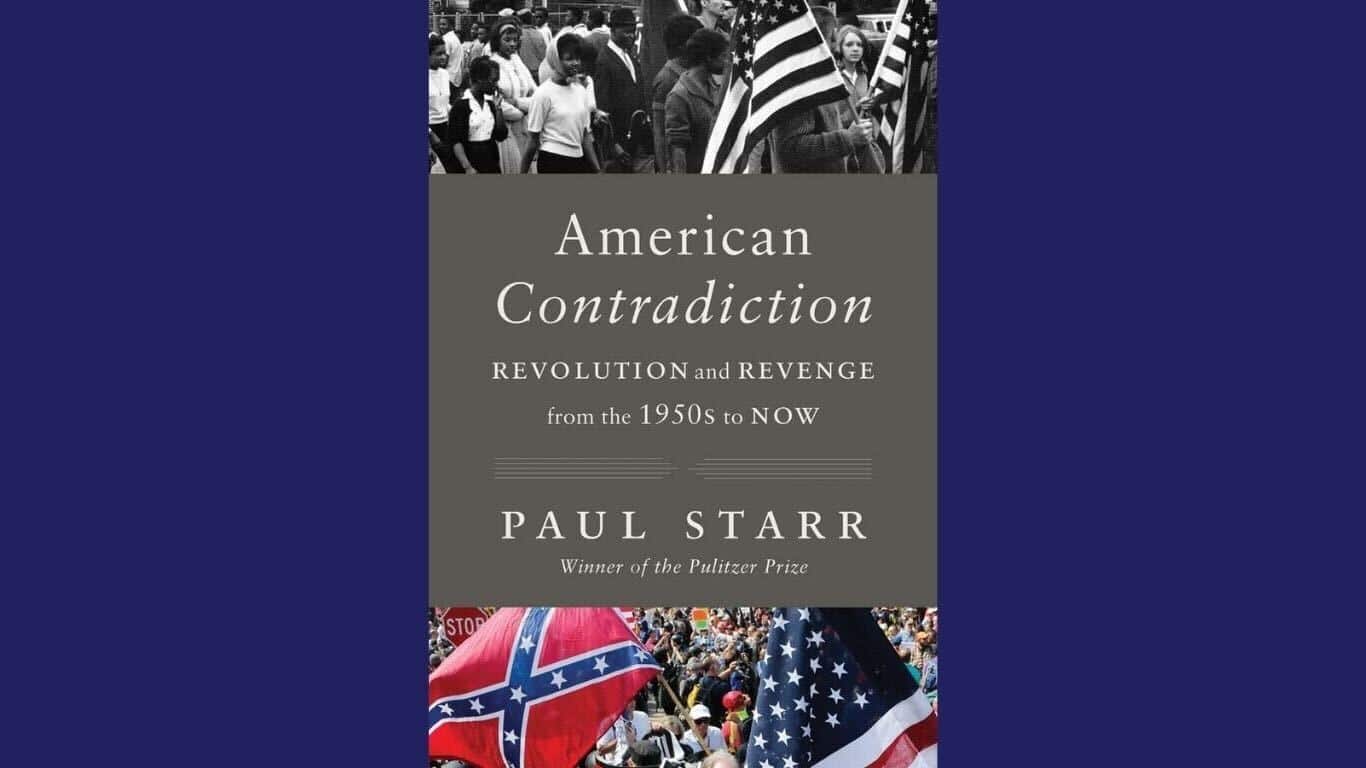
In American Contradiction: Revolution and Revenge from the 1950s to Now, Paul Starr argues that our country is built upon a series of complex, overlapping conflicts between the status quo – expressed in economic, political, and cultural forms — and the people challenging it.
The American contradiction began with our nation’s founding. As a baseline for his study, Starr begins with and returns often to slavery, which stood for centuries in direct opposition to the prospect of freedom in the New World. “Unlike a paradox, a dilemma, or mere hypocrisy, a social contradiction is a source of conflict at a deep level, over first principles, as slavery was.” (6)
Further, the author asserts that potential solutions to our “social contradiction,” are subject to the perceptions of the respective sides, a path that may foster positive change or reverse it. (7) Improving public attitudes towards race, gender, or class advanced the spectrum of rights in America. Conversely, reactionary corners in American society — Starr points to the former Confederacy—can resurface and fester into periodic backlashes against change. (334)
American Contradiction is masterclass in nuance essential for understanding America’s ongoing predicament. Starr sees history as a series of interlocking events that occur at differing tempos which, in turn, create friction within America. Legal and institutional progress rarely moves in concert with cultural and social advances. History is, from his perspective, a series of lines that parallel, overlap, reinforce, or contradict each other.
Starr adeptly unpacks the complexities of politics, culture, economics, race, class, gender and a host of applicable aspects of contemporary life. Examples populate the entire book.
In the modern era, racial and gender equality proceeded at a pace that forced religious institutions to adapt, a process that motivated both progress and regression among major American denominations. (3) American industrial decline eroded the economic foundations of society, especially for white men who lost the certainty of generational employment and significant union benefits. The rustbelt expanded as changes to immigration law introduced newcomers from nonwestern countries to an America that could not assimilate them in same manner as the past century. The ripple effect of these changes extended easily into politics. Starr notes that moderate Democrats who supported free trade policies like NAFTA “went sleepwalking to their own political funerals.” (13)
The starting point for modern American history is the post-World War II era. In many respects, it was a time of optimism and consensus. Yet, as Starr notes, “nearly every aspect a post war life reflected the contrary influences of an expansive economy and restrictive culture.” (32) Prosperity fostered complacency, particularly within labor unions and, on the opposite end of the scale, rising expectations among the economically, socially, and politically dispossessed.
The civil rights movement was a prototype for challenging the American contradiction in this environment. It followed a variety of strategies that ranged from the NAACP tradition of litigation to direct action sponsored by the Southern Christian Leadership Conference and Black congregational churches. (62) More importantly, the civil rights movement by virtue of its organizing success served as an inspiration for reformers — women, other ethnic and racial minorities, and the LGBTQ+ community — who challenged the postwar status quo. (53, 69, 74)
American politics also experienced a profound shift after 1945. The New Left challenged the assumptions of an older generation of political and social activists. (117) The same was true on the political right. William F. Buckley, a self-styled “intellectual revolutionary,” adopted “a brash willingness to defy political convention” defined by moderate Republicanism under Dwight Eisenhower. (122) Eventually, conservatives would learn that the expanding “rights revolution” in America might apply to them as well. Identity politics would become a closed loop.
For most of the post-World War II era, the Republican Party successfully contained its own reactionary, radical elements, from John Birchers to the Tea Party, and practiced a degree of bipartisanship on issues that deeply divide us today. As governor of California, Ronald Reagan supported both abortion and divorce law reform. (135) Nixon adopted progressive policies regarding the environment, work safety, equal opportunity, and education. (125-130)
READ: New Book Explores the ‘Dark Passions’ Fueling American Politics
However, as Starr argues, although many of these policies reflected shrewd politicians, not all of their decisions moved in lock step. The Republican “counterrevolution” of the sixties and seventies was a matter of deliberate strategy. Nixon’s landslide re-election in 1972 was a sure sign that “alienated working- and middle-class whites” were joining a cultural and social backlash. (117) While Reagan could oversee one of the last bipartisan reforms of immigration law in 1986, his tax policy was regressive, his alliance with the Christian right damaged public health policy during the AIDS crisis, and the administration’s anti-union activity hurt working class Americans in the long run.
Reagan changed the political trajectory of the country, a path that became increasingly evident when Bill Clinton adopted the neoliberal policies of the Democratic Leadership Council and promised help for “people who work hard and play by the rules.” (173) Even when Clinton made some progress in traditional Democrat policies, like tax policy, he surrendered that ground over NAFTA, law enforcement, and welfare reform. (177) By 2000, many of the distinctions separating America’s two major parties had narrowed, at least in terms of policy.
The new century witnessed an inflection point in American history where constituencies existing on the margins found a way into the mainstream. There was an accumulation of reasons old and new: the widening wealth gap, the ongoing atrophy of private sector unions, badly misinterpreted census demographic data (203-211), a Supreme Court led by John Roberts that pursued “strict constructionism” while being remarkably friendly to corporate interests, among many other factors. (302-322)
Perhaps the most important contributor to our present state was the result of leadership. Starr observes at the book’s midpoint that: “Social and political divisions have always existed in the United States. A nation’s institutions and its leaders can minimize or at least paper over those differences, or they can enlarge and aggravate them.” (171) Clearly, we live in a time where the Republic Party chose the latter option, to cultivate ”mostly downscale and heavily rural white voters.” (230) Instead of mitigating the divisions that separated the country, they chose to “make the pot boil.” (231) This has been the essence of Donald Trump’s approach to the American contradiction since the start of his presidential career. (254)
A recurring theme is American Contradiction is the “fifty-fifty country.” (159) Applications vary.
Politically, elections and the impact of the electoral college illustrate Starr’s point rather well. Hillary Clinton won the popular vote by approximately 2.8 million in 2016 but ultimately lost the election. The 2000 presidential election and subsequent Bush v. Gore decision presents the sharpest edge of contemporary American partisanship. (323-325)
Starr’s treatment of “a fifty-fifty society” is somewhat more problematic. (203) There are deep divisions in America on a host of issues addressed in the book. The separation on reproductive rights following the 2022 Dobbs v. Jackson’s Women’s Health Organization decision is one among many examples.
But what socially and culturally divides us is a sliding scale, as Starr contends throughout the book. Latino perception of race is not anchored to their origin but their current state of assimilation. Public tolerance of a host of issues, from drug use to premarital sex, to gay rights, has changed significantly since World War II. Starr regularly makes effective use of polling in American Contradiction to prove the point. (94-95, 295-297)
READ: Pennsylvania Needs an Independent Redistricting Commission to Ensure Fair Representation
Lastly, while the book spends considerable energy on the structures influencing the political system, a discussion of gerrymandering is strangely absent. The practice is pronounced in Republican states like Texas and Florida, as well as Democrat districts in Illinois and definitely contributes to our closely divided “fifty-fifty” political landscape. Similarly, the author does mention the winner-take-all process influencing Republican elections, but not the modern Democrat use of superdelegates to thwart popular candidates like Bernie Sanders. (261)
Starr offers a bleak vision of America in 2025. As is the case with many studies of contemporary politics, the breakdown of basic democratic norms is a cause for serious concern. Worse still, Donald Trump’s “repudiation of those norms and his indifference to legality” was augmented in 2024 by the Supreme Court’s decision on official presidential conduct. (357)
For historians, American Contradiction is a primer on developing and understanding the complexities of causation. For the layperson, Starr’s work is key to deciphering the root sources of a country in the midst of a political and social crisis. For these reasons alone, it is essential reading.