Could Pennsylvania become known for a new kind of farming?
The push for statewide regulation of AI data centers in Pennsylvania – also known as AI data farms – was placed on hold Feb. 4 when a vote slated to happen in the House Energy Committee on House Bill 2151 was postponed. As of Thursday, no new dates were provided.
Just a day before the vote was supposed to happen, Pennsylvania Gov. Josh Shapiro doubled down in his annual budget address touting Pennsylvania as a leader ushering in a new tech era defined by AI data centers.
“Pennsylvanians are innovators,” Shapiro began in his address to the state General Assembly, “when it comes to innovation, no sector of our country’s economy is growing faster than data centers and artificial intelligence.”
He added Pennsylvania is “well-positioned to play a leading role in that effort” as the second largest energy producer in the nation behind Texas.
“It’s no wonder why, last summer, Amazon chose to invest $20 billion in our commonwealth — the largest investment in our history. At the same time, we need to be selective about the projects that get built here,” Shapiro told the Pennsylvania General Assembly. Shapiro announced the Amazon deal last year, where the tech giant plans to build AI data centers in Salem Township (Luzerne County) and Falls Township (Bucks County) with multiple counties in the commonwealth also under consideration.
Local environmental advocacy groups, however, urge caution.
“We would like a [legislative] pivot and moratorium so municipalities can put in place good quality ordinances, rather than a pro-industry, community and economic [development] authority to put these regulations in place,” said Delaware Riverkeeper Maya K. van Rossum.
Shapiro announced the Governor’s Responsible Infrastructure Development (GRID) standards, developed by his administration and with community input, “to hold data center developers accountable to strict standards if they want our full support.”
“I know Pennsylvanians have real concerns about these data centers and the impact they could have on our communities, our utility bills and our environment. And so do I,” Shapiro said in his address.
HB 2151, sponsored by Democrat Kyle Donahue (HD-113) serving a portion of Lackawanna County and co-sponsored by 17 others, including Bucks County Rep. Jim Prokopiak (HD-140), is expected to provide a model ordinance for local municipalities to use as a starting point when crafting their own.
“The proposed legislation would merely provide a tool for local municipalities to use – if they choose to – in their efforts to craft a zoning code that protects the health, safety and welfare of their communities. Ultimately, each municipality would be free to use some, all, or none of the sample ordinance,” Prokopiak said in an email.
Prokopiak explained municipalities are currently “on their own when a data center is proposed in their community” and that guardrails are needed to protect residents.
READ: Not Everyone Is Sold on the Benefits of Amazon’s Data Center Coming to Falls Township
“However, most municipalities have not updated their zoning codes to cover data centers, which could negatively impact their communities,” he added.
No Republican members of the House are listed as signing onto the HB 2151, according to its legislative page.
The Delaware Riverkeeper Network, Green Amendments for the Generations and Food and Water Watch are among the groups who oppose a sweeping statewide model ordinance, even though proponents say it’s just intended to provide a baseline for local officials’ work in managing data center construction and operations within their boundaries.
The ordinance would amend the Pennsylvania Municipalities Planning Code, of which the model ordinance would become a part – and could change the land development landscape for communities.
“The proposal for a data center for Plymouth (Township) is different from the community in Montour County. The goals and priorities are all different. The municipal ordinance process is about honoring those differences and the obligation of the state legislature should be about honoring them and protecting them,” said van Rossum.
Van Rossum is also founder of Green Amendments for the Generations. Green Amendments is a nonprofit organization dedicated to advance green legislation and American’s Constitutional rights to pure water, clean air, a stable climate and healthy environments for present and future generations.
Last November, the Montour Planning Commission recommended against an AI data center rezoning request. Talen Energy requested Montour Planning Commission rezone about 800 acres of agricultural land to allow for an AI data center. Montour County Commissioners denied Talen’s rezoning request February 10, Inside Climate News reported.
Action News also reported a massive data center development plan in Plymouth Township was abruptly withdrawn over a legal issue with the developer.
AI data center development currently falls under the state Department of Community and Economic Development Authority, according to van Rossum. She said this was the wrong approach to make for the massive impacts these decisions could have on Pennsylvanian’s daily lives.
“We think it’s the wrong orientation, the wrong entity and the wrong motivation,” van Rossum said.
“HB 2151 would undermine Pennsylvanians’ Herculean grassroots efforts to keep dirty data centers out of our communities – it must be stopped.” – Ginny Marcille-Kerslake, Senior Organizer for Food & Water Watch Eastern Pennsylvania.
While individual municipalities are free to adjust language and impose restrictions on a state-wide ordinance model, opposition advocates said the intention of the bill is to “fast-track” these developments – placing a hardship on rural areas and less affluent counties with fewer resources to push back against them.
“Currently, municipalities are on their own when a data center is proposed in their community. I believe that we need guardrails for proposed data centers to protect our residents. Each municipality must ensure that their zoning regulations protect their citizens; however, most municipalities have not updated their zoning codes to cover data centers, which could negatively impact their communities,” said HB 2151 co-sponsor Prokopiak.
Pennsylvania municipalities are not permitted to outright ban a legal land use; however, they may restrict, regulate and provide specific areas or zones where designated land development and uses may occur. This process happens through zoning ordinances.
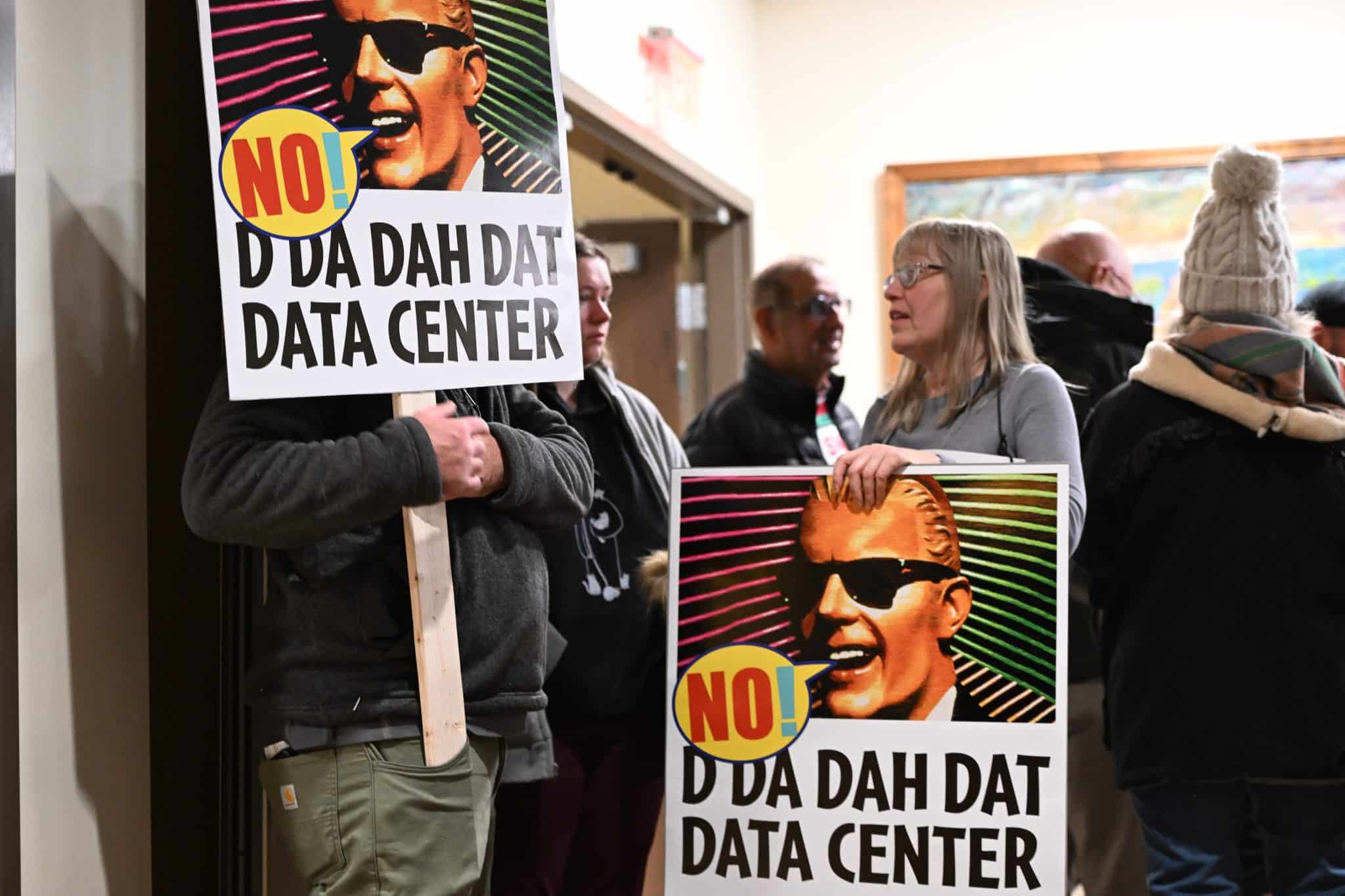
Local advocacy groups continue to rally opposition, citing record numbers of citizen objections flooding municipal meetings across the commonwealth, according to van Rossum.
Shapiro also addressed some concerns in his budget address earlier this month that many opponents have over AI data centers including the potential for rising utility and resource costs and the depletion of natural resources.
In October, 2025, Food & Water Watch became the first national group to call for an AI data center development moratorium. Since then, more than 250 organizations have joined the opposition effort, including 17 from Pennsylvania.
“HB 2151 would undermine Pennsylvanians’ Herculean grassroots efforts to keep dirty data centers out of our communities – it must be stopped,” said Ginny Marcille-Kerslake, senior organizer for Food & Water Watch Eastern Pennsylvania.
READ: Big Tech’s Fast-Expanding Plans for Data Centers Are Running Into Stiff Community Opposition
Food & Water Watch welcomed HB 2151 committee consideration postponement.
“No one has seen the ordinance this bill would end up producing,” Marcille-Kerslake explained. She said to date no plan has been made public to address the decommissioning of an AI data center campus, once it becomes obsolete.
“Food & Water Watch has a model ordinance for data centers, based on a decade of experience to protect communities where there is fracking,” she explained.
Most municipalities follow a standard process for land development plans and conditional uses.
Marcille-Kerslake said a decommissioning plan, in which a bond or escrow fund is provided up front by the developer to guarantee funding for site decommissioning, removal and clean up is a common practice with many land uses to provide “in case [the business entity] is gone in five or 10 years, so the communities aren’t left with a stranded asset.”
“It is really speculative [AI data center construction], as it’s for a demand that is not currently there,” added Marcille-Kerslake.