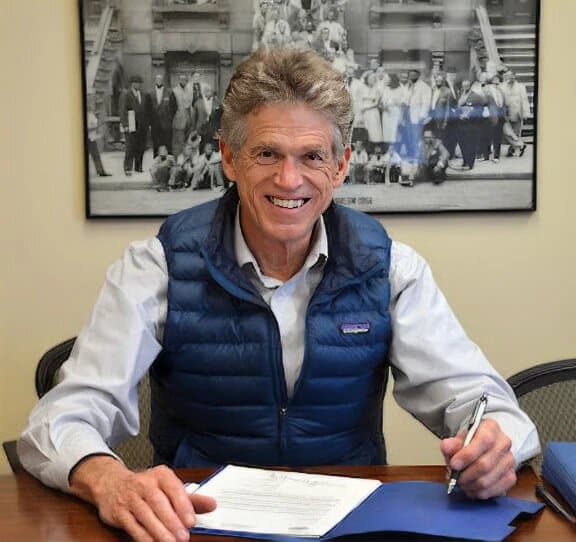
Tom Taft comes from a family with a 200 year history of dedicated public service. Tom wanted to add to that and his own legacy with a run for Congress as a Democrat in PA-01 but had to end his campaign after failing to gather the required number of signatures. Nevertheless, he joined me to talk about politics in Bucks County’s first congressional district, and the race for the Democratic nomination in May for a chance to unseat Republican incumbent Brian Fitzpatrick.
Listen on Apple, Spotify, Podbean and iheart
Tom, for listeners seeing your last name or hearing it in our introduction, can you explain why it might be ringing a bell of familiarity in their heads?
So, my grandfather’s grandfather, my great grandfather’s father, was named Alfonso Taft. He was a judge in Cincinnati, and he was a very strong advocate for civil rights. He attended the first Republican National Convention in 1856 as a delegate, and then in 1860, he returned to push very hard for Abraham Lincoln’s nomination.
And he also was particularly noted for having assisted free African Americans, i n particular, one gentleman, George Washington Williams, who became one of the first African American attorneys in Ohio after the Civil War. Mr. Williams said of Alfonso Taft, when Alfonso ran for governor of Ohio, he said, Judge Taft, the only man in the cabinet of any president since the Civil War to exact the powers of the Constitution to protect the Black man in his pursuit of his constitutional rights.
So I come from a family that believed very strongly in the 1860s, 1870s and 80s in civil rights and for what the Republican Party [at the time] stood for. So my family has since—Alfonso Taft became the attorney general of the United States and then also the ambassador to Russia. Then his son became both president and Supreme Court Chief Justice. And there was really sort of a split in the family when it got to my grandfather. He was much more liberal and his older brother Robert became known as Mr. Republican. So that split has existed in the family. At this point, my father, who had been the head of the Republican Party in Northeast Ohio was voting as a Democrat by the end of his life because he felt even back then that the party had deviated from what it originally stood for. And then every single person in my generation has been a lifelong Democrat without any exceptions at all. We are all Democrats. And I believe there’s much more hope within the Democratic Party for getting back to the original beliefs of the Republican Party than there is currently in today’s configuration of the Republican Party. So members of my family have been, you know, city councilmen, mayors, county commissioners, United States Senator, United States Governor, President, Supreme Court Justices, so there are a whole lot of Tafts that go back and forth in American history.
So for people who need to brush up on their American history, it was your grandfather who was president, and that was William Howard Taft.
My grandfather was the mayor of Cincinnati. His father was William Howard Taft, who was both president and then, under Warren Harding, became the Supreme Court Chief Justice. He’s the only man in American history to have served both roles. Can I tell you a quick story about how he became president?
He and Teddy Roosevelt met each other walking to work when they were both young, and both of them felt very strongly about the fact that they were sick of patronage jobs being turned over every time there was a new administration. Roosevelt was in Washington to start to really focus on the civil service, and Taft was there as a judge. They both felt really strongly about fighting this patronage battle and they became close friends. Teddy Roosevelt made the promise that he wouldn’t run for president another time. So he looked at William Howard Taft and said, OK, Taft, what do you want to be? Supreme Court Chief Justice or president? And Taft said, my God, I’ve never been—I’m not a politician, I’m a judge. I want to be Supreme Court Chief Justice, thank you. And his wife, Nellie Taft, said, no, he’s going to be president. So it was her call. She was a very strong-willed, bright woman. And I think Taft was counting on her helping him run the country and sadly she suffered a stroke shortly after he was elected. He viewed the White House as the loneliest place he ever lived.
So what was your childhood like? Were you steeped in politics from an early age?
The interesting thing about my childhood—of course you don’t know that your childhood is any different than anybody else’s—we all ate dinner together every night. And, you know, my brother teased me and then my parents told him to stop. Then eventually, the conversation always went back to issues of justice, equality, fairness. So my upbringing was all about issues of the United States: what are the issues we are facing today and how do you figure out a way to do what’s right? My father was one of those people that absolutely could never lie. He wrote a book about, he called it Political Rules of the Road. And they all make sense. He had a lousy memory. He said, never tell a lie. Then you don’t have to remember what you said. Another one was, respect the janitor. Another one was to call people by whatever name they want to be called by. He had a gentleman that changed his name to General so-and-so, and my father originally called him the same name, his original name, and the gentleman was upset, and he said, from then on, I called him the name that he chose, and we were able to have good conversations. So he also had endless numbers of lessons. One was that as a county commissioner, he was able to get—he was a minority, so there were two Democrats and he was Republican back then. He said, Tom, I can get anything done as long as I was able to convince the two other commissioners that it was their idea. And I think his notion was he really cared more about accomplishing important policy, than he cared about how much attention he got for having done it. So I think those are all things that were pounded into my brain my whole childhood.
So as you were growing up and then kind of transitioning into adulthood, when did you become politically engaged on your own terms, so to speak?
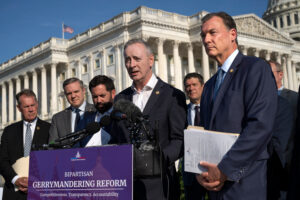
You know, I’ve really been drawn to Bucks County exactly because the congressional district in Bucks County is what I believe almost every congressional district in the country should be. Which is that the county is essentially the district. So if you are concerned about issues in Bucks County, you have a congressman, you can work with that congressman. When I look at gerrymandered districts across the country, they’re just really discouraging because, you you look at Jim Jordan’s district in Ohio, he’s not representing a local community with a set of common concerns. And so my real interest has been in Bucks County.
Back in 2005, I had Neil Samuels from the BCDC come to me and said—I was living with a wonderful person at exactly this address in Helberg Avenue in Chalfont. And Neil Samuels came, he said, Tom, know what? We’ve got a guy that we just can’t endorse. Will you just please just run for County Controller? So my first taste of Bucks County politics was rushing to get all the forms done and then speaking at the endorsement meeting in 2005 and really enjoying it. So they endorsed me for County Controller. Ironically, the Republican Party sued and said I didn’t really live where I lived. And after I’ve been grilled for 45 minutes, a Democrat attorney stood up in court and asked me the three questions that determine residency. I answered them honestly and then the judge said well, there’s no one here from the neighborhood to back him up, so I’m taking him off the ballot. So that was my first experience with Bucks County politics, that is a little bit odd.
But it was great, because I got to know Patrick Murphy back then when he was first running, and I’ve been able to watch him grow up from being a very nervous speaker to being a confident congressman and—undersecretary of the army. So yeah, I really have been attracted to Bucks County, and I’ve been in a number of roles. I’ve been a teacher, I’ve been a carpenter. I’ve been a licensed general and solar contractor out in California. I came back and got a masters in public private management from Yale. When I got back in ’85 is when I really began to get more and more interested in politics myself. The issue that was so surprising is that when I was building houses in California, Paul Volcker was trying to break the back of inflation and push mortgage rates up to 14%, and it really became impossible to build houses and actually sell them. So he was successful, but that’s when I said, you know, wait a minute, the world’s controlled not by my lumber store, but by a man 3000 miles away. So I went back and got a public and private management degree, and since then I’ve been really interested in moving towards politics.
And how long have you been living in Bucks County for?
Well, I lived in Bucks County for a number of years and then I was working as a chief operating officer at Germantown Academy and the sweet person I’d been with needed to move back to New York, and I needed to stay with my job at GA, so we went our different ways. But she’d been living at 84 Hellberg Avenue in Chalfont, and I had been living with her. When she left, I bought the house, and I’ve spent the last four and a half years—I tore the original house down because it was falling down and then I built a house that I hope will be net zero in its energy use. I think I’m going to be able to generate more electricity than I use. I’ve super insulated the house, it’s airtight, it’s got an energy recovery ventilator. Even the hot water heater is a heat pump. I’m hoping the house can be an example of how we can rethink how houses are built. So 2,500 years ago, Aeschylus was a Greek poet and he said, only primitives and barbarians lack knowledge of houses turned to face the winter sun. And every house in my neighborhood has the garage on the side of the winter sun. My house has 40 feet of windows facing the winter sun. So if the sun’s out in the winter, it’s in my big room in the house. Someday I’ll have to have you over to take a look at it.
That’d be great, thanks. You recently announced, this was last month, that you were running for Congress in PA-01 in the Democratic primary for a chance to face incumbent Republican Brian Fitzpatrick. Now on March 10th, it looks like you’ll be ending your campaign. What happened?
Yeah, so one of the requirements in order to run for Congress is that you collect a thousand signatures, and you’ve got to do it in three weeks. So there were a lot of issues around that. I’d love to come back to them, but I’d love to begin by explaining why I wanted to run against Brian Fitzpatrick.
In 2016, I watched a debate between Steve Santarsiero and Brian Fitzpatrick, and the moderator said, hey, Steve, you guys in Harrisburg raised taxes. And what’s the deal with that? And Steve responded and said, well, wait a minute. We raised taxes, but all of it was for infrastructure projects, so you can literally see your tax dollars at work. These were important projects. I think they’re going to pay for themselves in terms of the economic benefit of addressing them. And Brian stood up in 2016 and said, well, we Republicans are going to slash taxes and cutting taxes is going to generate huge economic growth. And I was in the audience and I wanted to stand up and scream, but I didn’t, I behaved myself. But it really stuck with me because that whole notion of some configuration of the trickle down theory just made absolutely no sense, never has and never will. So I sort of tracked Brian since then….So Steve lost in 2016, Scott Wallace lost in 2018. In 2020, I met with Patrick Murphy, Scott and the DCCC and indicated my interest in running. But that was when Patrick was really wanting to give Ashley Ehasz a chance. And I said, hey, I’m a team player and supported Ashley and wished her well.
But this whole issue, the thing that’s really driven me to want to run for Congress, is that Republicans continue to say that cutting taxes creates economic growth, and it absolutely doesn’t. In what was called the 2017 Tax Cutting Jobs Act, it cut taxes, but it didn’t create any jobs. Even the Wall Street Journal documents that the loss of income from the taxes was never matched by additional jobs or economic growth or anything else, and it was a money-losing proposition. What I feel really strongly is that really since Ronald Reagan, the notion is that somehow the government is cheating you or mistreating you. And Ronald Reagan really was one that started this push towards, well, we’ve got to get money in the hands of job creators. And that term drives me crazy because they’re just money accumulators, they’re not job creators. And after the 2017 tax cut, corporations had so much money that they started buying back a trillion dollars of their own stock every year. And the first year that happened after 2017, 400 billion of that trillion dollars of stock buybacks went to overseas investors.
So you follow the money, it comes out of the U.S. Treasury, goes to corporations, and it goes from the corporations, it goes to overseas investors. It’s literally money just leaving the country, there’s no economic growth. And that’s really been the thing that has driven me crazy that Republicans keep pushing that. And I think most Americans don’t understand how awful stock buybacks are. There are very few times in any situation that you get given free money, but a corporation, when someone buys their stock, it’s absolutely free money. You don’t owe interest on it. If you go bankrupt, you don’t owe anybody back any money, and people have bought your stock because they think the value is going to go up. A stock buyback is an indication by a company that we have absolutely no idea what to do with your money. We have so much of it sitting here in our bank account. We don’t have any jobs we can create, we don’t have anything we can do with it, so we’re going to give it back to you. This was free money. No interest. We’re going to give it back to you. And the only reason to give it back to stockholders is that when you finish buying back stock, you have the same company and fewer shares. The only thing that does is increase the value of the CEO’s stock portfolio, because you have the same company, fewer stocks, and therefore you have a higher value for the CEO’s stock portfolio. But you didn’t create any economic value at all.
So it’s interesting that the Republicans call the 2017 Act the Tax Cut and Jobs Act. When Biden was in, we had a bill that was called the Infrastructure Investment and Jobs Act. And Biden was focused on trying to create jobs by having specific infrastructure projects. It seems to me that’s the way to make things happen in this country: you don’t just give wealthy people more money. You actually set up projects that companies can apply for, can contribute to, the government can help make it happen. I think the most dramatic example is the investment that Biden allocated to Intel. Intel was incentivized to build this huge factory in Ohio. And Donald Trump says, well, wait a minute. We’re giving Intel all this money. We ought to have some shares in Intel instead of just giving the money.
Donald Trump and the government is now the largest stockholder in Intel. And the money that he used to buy all the Intel stock was from Biden’s Infrastructure Investment and Jobs Act. The irony is, and this is a little bit of a sideline, is that Republicans don’t know socialism when it hits them in the face. Because socialism, by definition, is when the government controls the means of production and Donald Trump now has, as the largest stockholder in Intel, has a big say in exactly what Intel does or doesn’t do. So that’s a pretty close form to socialism and Donald Trump doesn’t even recognize it for what it is.
Well, the Republicans have always been about socialism for the rich and then free market capitalism and social Darwinism for everyone else.
Exactly. Actually buying the Intel stock is dramatic. Obviously the contrast is when Obama bought, saved the auto companies by buying stock that as soon as, as soon as the companies had recovered, he got rid of the stock and got back out of a socialist position. It’s been a thorn in my side that Republicans keep pushing this idea. When Mike Johnson came around to 2025, he said, oh, we know we’ve got to pass this bill because there are 10 million jobs hanging in the balance if we don’t extend these tax cuts. Mike, that’s a completely made up number. There were no 10 million jobs hanging in the balance if you didn’t extend the 2017 tax cuts in 2025.
So my real motivation for running was to try to finally say—the fact that we’ve lost to Brian Fitzpatrick five times, is that I keep thinking we missed the mark on what Brian is about as a congressperson. He continues to believe that cutting taxes creates jobs and it doesn’t. My hope in running was that I could convince people to realize that even though Brian comes across as quote unquote bipartisan, that he seems like a nice guy, he’s friendly, he appears at every community event, his newsletters, if you read them, leave you feeling that he’s walking on water—but Brian, you have been an advocate of this tax policy that is hurting the pocketbooks of every single regular American in Pennsylvania’s first congressional district. I felt strongly that the way to defeat Brian is to stop talking on issues where he controls the conversation. And my effort was to try to really force him to confront the fact that Republicans have pursued an economic policy that has hurt the pocketbooks of every person in Pennsylvania’s first congressional district and every person across the country. This is the wedge that’s been driven between Americans—this super wealthy class and everyday Americans trying to work two or three jobs and pay their bills. So my whole goal was to lead Brian Fitzpatrick directly to the fact that you’re having trouble affording groceries, paying for your electric bill, especially this last one that’s going to be so brutal in this cold weather we’ve had.
I think the way to defeat Brian is to stop trying to argue whether he’s bipartisan or not, whether he voted for this bill or didn’t vote for that bill. And I was concerned that Ashley’s second campaign was focused on: Brian Fitzpatrick can’t be trusted. Well, the fact is, in normal day-to-day life, voters have trusted Brian Fitzpatrick. My goal was to try to say, Brian can’t be trusted, but let’s talk about your pocketbook. And I think the notion of focusing on the pocketbooks of people in Bucks County is much more to the point, and much more critical than this general notion that Brian can’t be trusted. That hasn’t worked five times. My concern is that we’re headed down that same path. I think Bob Harvie—I was at a breakfast gathering for one of the municipal organizations and Bob talked about Brian, the things he’d done, and he finished with, Brian just can’t be trusted. It gave me pause, because we’d been there five times in a row. I’ve got Democrats living next to me and say, well, yeah, I’m a Democrat through and through, except I love Brian. My goal in this campaign was to get people to stop loving Brian and have them understand that if they’re having trouble buying groceries, Brian is right at the center of that and always has been.
So then, why hasn’t your short-lived campaign gained traction? Do you think you waited too long to kind of announce?
Yeah, unfortunately, I’m sitting in this house that I’ve spent four and a half years building. It’s super insulated, and I built it myself for four and a half years, eight, 10, 12 hours a day. I thought I had gotten to the point where I had met all the requirements for a certificate of occupancy and I got hit with a new inspector, who said, no, no, you’re going to have to do X, Y, Z. I mean, it was a real shock because I had home insurance, everybody seemed fine, and I hadn’t met with this inspector before. So what happened is that I was delayed almost two months in being able to get into the campaign. So I really didn’t have enough time to get things started and build some momentum. It really was a timing issue for me, and I recognize that it was much too late actually to try to pull off a campaign. On the other hand, I also didn’t want to give up without trying. So that’s where I ended up. I didn’t really have enough time to build a team of people that could go get those thousand signatures in three weeks.
And so the thousand signatures, really, that was the hurdle you couldn’t overcome.
Yeah, that’s the only reason I’m not continuing to run, is that the endorsement—a couple of things. The endorsement coming on the 21st, and not wanting to cannibalize the ability of other candidates who I respect, who are running against Bob, left me in a position of having to work pretty hard to try to find ways to go collect those signatures outside of the normal petition signing events.
Why do you think the party’s endorsement of Harvie served as such an impediment to you and potentially other candidates?
The way the party is set up now is that there are like 34 municipal organizations there. I’m part of the Chalfont-New Britain Dems, but all across Bucks County there are Warrington Dems, there are Warminster Dems, the Bensalem Dems. So all 34 of those organizations have the ability to communicate with all their members and to set up signing events, and really the drive-by events are the best. So if you’re a Democratic voter, your organization sets up a drive-by event. You drive by, people are outside, you sign a bunch of signatures for the various positions of state representative, state senate and for governor, and then you head on home. But as soon as the Bucks County Democrats endorsed Bob Harvie, none of those 34 organizations were allowed to work as an organization and allow petitions to be signed for other candidates.
READ: Let Bucks County Voters Have a True Choice in May’s Elections
So all of a sudden you’re locked out of the entire normal framework for being able to gather signatures. And that’s why I became particularly sensitive when there were other people that set up signing parties that I didn’t want to be competing with, especially against Lucia Simonelli, for petition signatures.I wanted to be sure one of us made it through that thousand signature hurdle. She’s a friend and a great candidate and I think together we had some good voices to bring to the primary, but I’m hoping and assuming that she’s made it today.
I will say that a local party endorsement doesn’t necessarily guarantee a win for who they endorse. So for example, in New Jersey, the Morris County Democrats endorsed Tom Malinowski, but he ended up losing in the primary to a progressive candidate, Analilia Mejia, in a shocking upset. And she was someone that—he out fundraised her by, I think it was close to like at least half a million or three quarters of a million dollars. And she was someone that was just part of the progressive wing of the party who was endorsed by folks like Bernie Sanders and AOC.
Absolutely. I remain committed to making sure that there’s a vibrant, intensive primary. But one of the things that I think happened with the Bucks County Democratic Committee is that there was a really nasty primary in 2016 with Steve Santarsiero, and then there was another nasty primary with Scott Wallace, and all of a sudden, they say, God, we can’t have primaries anymore because we’re trying to beat Fitzpatrick and we’re just hitting ourselves and that’s not very effective. What I’m really concerned about this time is that they haven’t come up with a winning strategy yet. So the BCDC, the Bucks County Democratic Committee, has not developed a winning strategy, and I’ll be very honest, I don’t think Bob Harvie so far has demonstrated that he is in a position to actually take on Fitzpatrick and win. I do think at this point, a progressive candidate with a clear message will give Bob a good, healthy primary contest. And I’ll be honest, I either want to see Bob Harvie adjust how he campaigns or see a progressive candidate pull an upset. I just think, unfortunately, that the Bucks County Democratic Committee has settled into a formula for running against Brian Fitzpatrick that almost guarantees a loss. And as you pointed out with other races, having a committee—the high level committee—select the candidate in order to avoid a primary, in order to avoid people banging heads, at this point has the effect of almost guaranteeing that Brian is going to potentially win for a sixth time.
The original thinking was, well, we can’t fight with ourselves because that’s going to give Brian a head start. Scott Wallace did say that the person who ran against him essentially was writing the Republican campaign ads against him. I don’t think any of the candidates running this year against Bob Harvie have spent a minute in that kind of negative advertising, negative talk. We’ve all been focused on: how do we actually come up with some new thinking that will resonate with the voters in PA01 and actually defeat Fitzpatrick? That’s why I’m so committed to having one of us at least be in that primary, and speak clearly and effectively to the voters of Pennsylvania’s first congressional district and say guys, here’s some different thinking that you’ve heard than what you’ve heard before from the BCDC.
I think Brian is potentially vulnerable, but I’m also worried that he’s so clever in how he walks lines between an issue and sort of throws a bone to all different types of people that Brian—unless we come up with new and different thinking—he’s gonna walk into the Congress again for a sixth time. So that’s my big concern. I can honestly say to myself, I didn’t join this campaign for my ego. I feel good about myself, I don’t need that. I really joined it because I’m so disgusted with the way Republicans think they can fool Americans, really since Ronald Reagan … You know, Ronald Reagan’s famous sentence was, the nine worst words in the U.S. government is, I’m from the government and I’m here to help. And I would like the sentiment to be, I’m from the government and I am here to help. I really believe in the ability of good policy and good government to improve the lives of all Americans. I don’t think the Republicans could care less.
Now, if we’re looking back towards past elections, Scott Wallace was the candidate who came closest with losing by only 3%. Although he had millions and millions of his own dollars to spend—which helped, right? Especially when you’re going up against a financial juggernaut like Fitzpatrick, who gets out of state money from all over the country. However, I think one of the other things we’ve seen, maybe with someone like Ashley, is that she didn’t have deep roots in Bucks County. Whereas I will say, Bob Harvie does. Whatever your criticisms of him are, he does have roots in the community, deep ones. And he’s also a countywide elected officeholder. In addition to that, he seems to be talking about at least some of the issues that you’re really concerned with, because he’s really centered, this idea of the American dream and making that more affordable as one of the main planks of his campaign. So where do you think he’s not quite getting it?
Here’s the issue. I am concerned—view yourself as one of 400 Congress people—that you’re going to try to restore the American dream, for me, that’s just too general. I think you need to find something more specific to be able to go after Fitzpatrick. I will say I looked at Bob’s website and they must have made the decision that websites aren’t important anymore. But I would have liked some more substance in his website as opposed to just, well, the American dream is out of reach, we need to try to bring it back to Americans. I’d love to see some very specific goals and objectives that would actually begin to change that. In my mind, it doesn’t make sense to hit voters with a whole lot of different things. That’s why my real concern is that I have not heard Bob articulate what I’ve been trying to say—and what I think some others have— that look, the Republican economic structure and the tax system is designed to hurt most Americans and to help the—apparently now we’re up to 900 billionaires in this country. The wealth gap is just phenomenal. I’d love to see some specific things about how we go about taxing wealth. It’s not an easy issue, but at some point we’ve got to do it. I think there are policies that could essentially make a difference in that. But I haven’t heard them from Bob yet. I think we all agree that Americans are hurting and we want to quote unquote restore the American dream, but I think we need some real substance on how to do that. And one of the things I like about Lucia Simonelli, and that I think applies to me as well, is that good policy at the federal level can make a real difference. I think that currently the Republican party does almost no governing at all, and I think we can come up with very specific policies that you could begin to push. But being a single congressman heading in with the general idea that you want to help the American dream, I don’t think he’s going to cut it against Fitzpatrick.
You know, one of the things is, there are people who are born and raised in Bucks County. There are other people, like me, who could live basically anywhere. I’ve lived in California, lived in Providence, lived in Ohio, lived in a lot of different places. I want to be here. I don’t ever have to go on a vacation, never even leave Bucks County. I love Bucks County, I love everything that it stands for. I love the landscape, I love the history, I love the artists in Bucks County. So, I’m a true believer. I didn’t just end up here by birth. I’m here because this is a great place to live and I don’t want to live anyplace else. So I’m about as big a Bucks County fan as there is.
So why else do you think Lucia sets herself apart from Harvey?
Well, Lucia actually, as she pointed out in the endorsement meeting, is the only one that’s actually worked in Congress. She was a close associate of Senator Whitehouse. She’s working on climate issues. I think she has a real understanding of how bills get passed. She also has an understanding of, and this is really important, it’s what my own father worked so hard on. Politics is the art of what’s possible. So you have to have a strong idea of what you want to accomplish, and then you need to bend just enough in order to actually make it happen. And I think Lucia is sophisticated enough to be able to say, look, this is where we need to go. This isn’t really getting us to that spot, but this is a lot better than where we are now. And I don’t know that Bob has the experience as a county commissioner, especially when they’re ahead two to one, of being able to handle the nuance of working with a really tough, difficult situation and then hammering out a policy that actually works. So I’m a real believer in effective government policy, but also in the politics of what’s possible. I really liked the times I met with Lucia, talking about the issues that she faced in Senator Whitehouse. So I would be more comfortable sending right now—Bob may grow in this campaign, and may really improve, I’m not saying that he won’t—but I think Lucia has the sophistication to actually get to congress and affect policy.
Do you think she can overcome the lack of name recognition? We’ve covered her campaign, I’ve had her on the podcast. But if you’re looking to other local media, like the Bucks County Courier Times, there may have been one article that they’ve published about her campaign so far.
You know, there’s an awful lot of—it’s a big county. There are a lot of people, if you drive from top to bottom. The name recognition is tough. The reasoning with Ashley Ehasz was, well, we ran her once, no one knows who she was, let’s run her again and people will know her better. I just think Ashley’s second campaign could have been structured more effectively. Lucia’s gonna face that same uphill battle. Again, what I’m hoping, is at least even if she doesn’t win the primary, that she will be able to—I hope—have an impact on the kind of campaign that Bob, if he defeats her, does run in the fall. Eventually, if he is a candidate, Lucia could be helpful to him, I think I could be helpful to him, and I think he might become a better candidate. I think Lucia’s main goal is to recognize that it’s going to be very difficult to get your name known in two months to the Democratic voters. The only thing that I would say is that if Scott Wallace won his primary with about 30,000 votes, those are all from activist Democrats. I think between now and the primary, you might really connect with activist Democrats. Then, I have to be honest with you, once you get past the primary, if you’ve got an upstart like Lucia or even—Mike Z is the other candidate running. I’ve gotten to know him in this campaign. He’s just a fabulous, intense, passionate person with great military experience. I think that whoever ends up winning this primary, is going to get huge national attention. This is a purple seat, a swing seat, the Republicans are desperate to hang onto it. I think this is a time, especially, of restructuring a fall campaign, a little different than what Democrats have done, that we could actually win it with. If Bob becomes a stronger candidate, or if Lucia wins the primary or Mike wins the primary, we have a chance to really flip this seat.
I just wanna mention that Tracy Hunt is [was] also running in the Democratic primary. He’s another candidate. And I do hope to have Mike Z, Mike Zeltakalns, come on as well so that he can talk a little bit more about his campaign.
How much do you think foreign policy is gonna play in the midterm in November, given President Trump’s irresponsible—I don’t know what you’d call it—military adventurism abroad? This recent attack in Iran puts the whole Middle East at risk. Never mind the war crime of blowing up a school where scores of children were just murdered, obliterated by a US bomb.
Yeah, you know, it’s really hard sitting here in March to know how things are going to play out by November. I am astounded that Congress was not willing to pass a War Powers Resolution to control Donald Trump.
Can I just add that Brian Fitzpatrick voted against that? I think it’s important to note. I know the Courier-Times in the run-up to the vote, they wrote an article suggesting that Fitzpatrick could potentially buck the party because he’s this moderate. But then when he actually voted, they didn’t follow up with coverage that he voted against this.
So everyone knows: Brian Fitzpatrick gave Donald Trump a blank check with how he conducts war in Iran.
Here’s what is so frustrating. I read everything Brian writes, every press release. Brian specializes in completing press releases that simply give a lot of different points of view and then explain where he came out, and he has a very specific reason why he couldn’t vote for that War Powers Resolution. My feeling was, Brian, you’ve been in Congress for 10 years. If you didn’t like that bill, why didn’t you get enough people together and change the damn bill?
Good question.
Here’s what drives me crazy. Too many people said, well, he’s already done it and we need to support the troops. So it wouldn’t be good for us to try to stop it now by passing this bill. So we’re going to basically give Donald Trump this blank check. I sort of want to say, look, how stupid is that? You know who Donald Trump is. You basically said to him, Donald, you go do something outrageous and get in the middle of it, and then we’ll say, well, you’re already in the middle of it, so who are we to try to stop it? We want to support the troops. I wrote a letter to the editor to the Inquirer the other day and said, look, maybe the troops would like to know why the hell they’re there. Maybe supporting the troops is having you pass that action and then be able to say, Donald Trump, you need to come to us and explain what you’re doing and why you’re doing it. You need to be explaining that to the troops that are putting their lives at risk. I think for the parents of the children who have died, who say, well, why in God’s name were they there? What was the reason? Why did my child give up his or her life for this country when none of us even know why he’s there? So this reasoning that we have to support the troops so we can’t stop what Trump’s doing is the worst narrow-minded reasoning possible. Really, I would say to Brian, you didn’t like the bill? Write another one. The notion of that school being blown up, of American soldiers being killed, in a policy that had no thinking at all.
But your question was about November. I don’t know where this is going to play out by November. I do think at the end of the day, most people vote with their pocketbooks. And what happens in other countries is something that, especially on the local level where their congressman isn’t a big driver. On the other hand, there’s a good chance that this economy may collapse because of what Trump’s done in the Middle East. Then ,what happens in foreign policy will have a huge impact, again, because it’s gonna hit people’s pocketbooks.
Yeah, and we’ve already seen oil skyrocket above $100 a barrel as well.
Just one other thing, I would just say, this idea of supporting the troops, that’s just kind of like this tired and overused political canard that you hear time and time again. I remember during the Iraq war under George W. Bush’s administration, anyone that was against the war was somehow against the troops, when you could legitimately argue those are the ones that are for the troops the most, because they want to get them out of harm’s way.
Absolutely. I think if I’m a soldier in Iraq or Iran, I would like to see a functioning democracy. And democracies thrive when there’s discussion, when there’s compromise, when there’s clear thinking, when there’s a plan where people are held to account. If I’m getting up every morning thinking that, you know, this may be my last day on the planet, I want to know what I’m doing and what I’m doing it for. So I think you’re absolutely right, that supporting the troops is really a matter of making sure that they feel that they’re there on a valuable mission that’s worthwhile. I mean, it was the same craziness in the Vietnam War. It just was so insane that when you think back on it, what? We were fighting in Vietnam because we thought communism might cross the Pacific Ocean and come to America? So we had to stop it in Vietnam? The whole reasoning was was horrific and to think you need to support the troops while they’re doing something that is counterproductive and unplanned is really hurtful. Then this Iran quote, war attack, military action, whatever, is to me one of the most absurd things that’s ever happened.
It seems like we never learn from history. I mean, if you go back to 1953, when we, along with the help of the British, overthrew democracy in Iran, the blowback of that was the 1979 revolution, which led to this theocratic autocracy that the country’s saddled with.
You know, I’m so glad you brought that up because I spent some time going back and looking at Iran. There was a parliament. There was an elected prime minister. He said, look, guys, we made an agreement with the British 50 years ago about oil when nobody even used it. I’m sorry, we either need to completely renegotiate this deal or we’re just going to nationalize the oil. And the fact that the answer to a legitimate claim from a legitimately elected prime minister of Iran was, well, we’re going to use the CIA and we’re gonna undercut you and then we’re gonna overthrow you and then we’re going to install our man, the Shah, into Iran. Then the Shah may not have been as bad as this theocracy has been in terms of torturing people, but the Shah, instead of being an enlightened dictator, he was the one who triggered the revolution in the first place and we triggered the Shah being put in place. We overthrew a legitimate democracy for oil. This is one of those things where—and I totally love this country, I’m a diehard American, I believe in everything that this country aspires to be, but we also need to be honest when we have created the horrific situation that exists in the Middle East and in Iran today. We did it. We threw out a legitimately elected prime minister.
It wasn’t the first time and sadly I don’t think it’ll be the last, and now it’s almost like we might come full circle because the son of the Shah wants to come back to Iran and take over the country.
That’s not gonna happen.
Tom, we’re pushing on an hour now. Before I let you go, and I would love to talk for another hour, but unfortunately I know you have things to do as well as I. But is there anything else that you want to leave voters with as we get closer to the May primary?
Yeah. I have encountered people even in this short campaign that said, well, you know, I’m not really involved in politics. And I would say to every single person, every voter, every citizen in Pennsylvania’s first congressional district: if there has ever been a responsibility you have to be an active citizen in a functioning democracy, it’s this election, this fall, because our democracy is at risk. It is on a terrifying tipping point and we have to address it.
The other thing is, let me say to every single person: Lucia cares about climate change. I built this entire house to demonstrate that we can begin to address climate change. If you don’t think we’re about to drive off a cliff, you are fooling yourself. So get out, be an involved citizen, and please understand how critical the climate change issue is, because I have eight grandchildren, and 50 years from now this world will look very different if we don’t act together.
Well, Tom, thanks so much for coming on the signal. I really enjoyed this conversation we had. I hope you’ll come on again. Thank you so much for the work that you do locally.
I really appreciate the opportunity. Take care. Thanks again.
Transcript edited by Alexa Schnur