For more than a decade, PRRI has been tracking American attitudes about nondiscrimination protections for LGBTQ individuals, religiously based service refusals, and same-sex marriage. In our latest report, we find that while solid majorities of Americans continue to support nondiscrimination protections and same-sex marriage rights, support has dropped slightly over the past three years. Similarly, Americans’ opposition to allowing small business owners to refuse service to gay or lesbian customers on religious grounds fell from 66% in 2022 to 59% this past year.
Here are my five major takeaways from our latest report.
1. More than 7 in 10 Americans support LGBTQ nondiscrimination protections — including most people of faith.
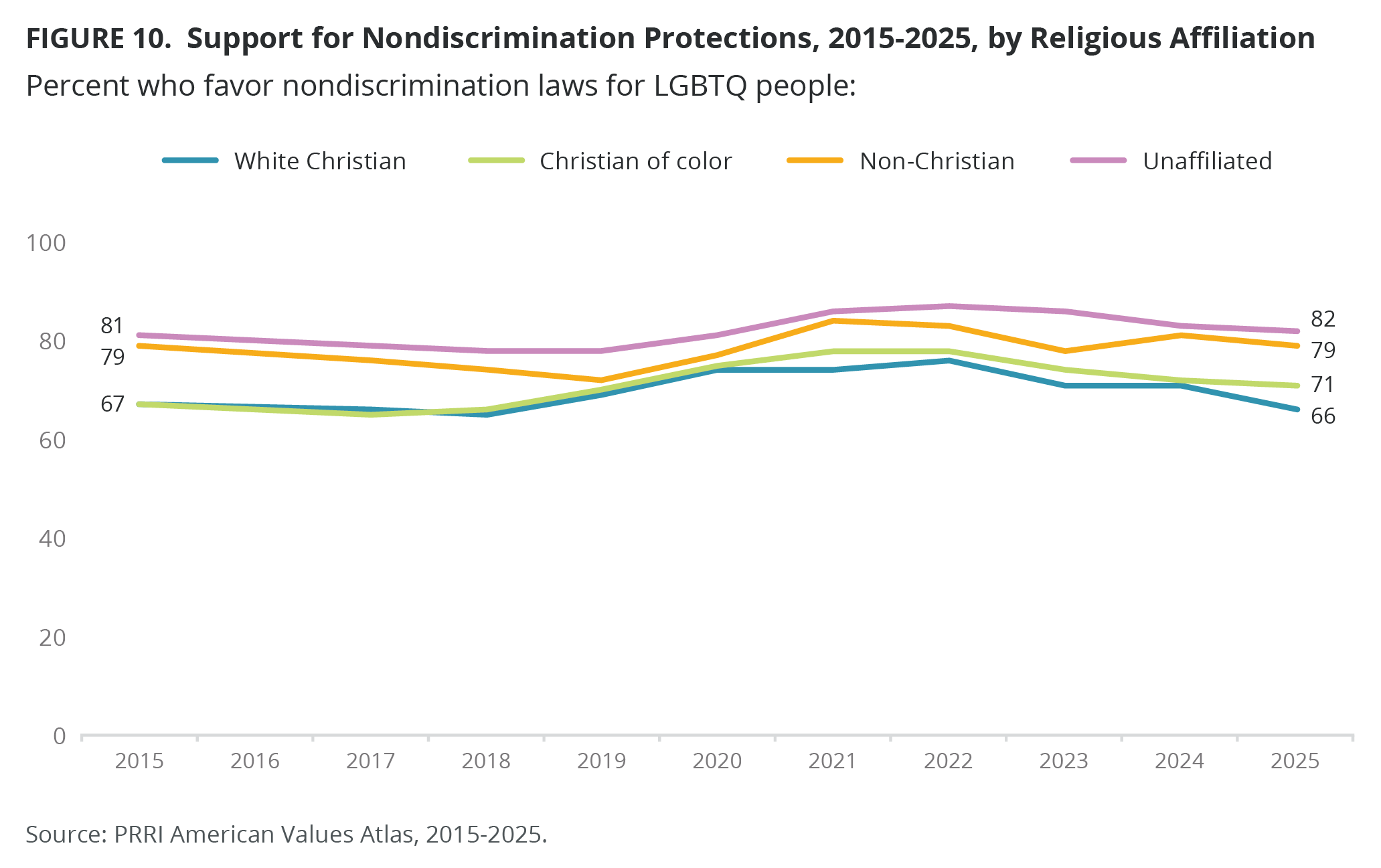
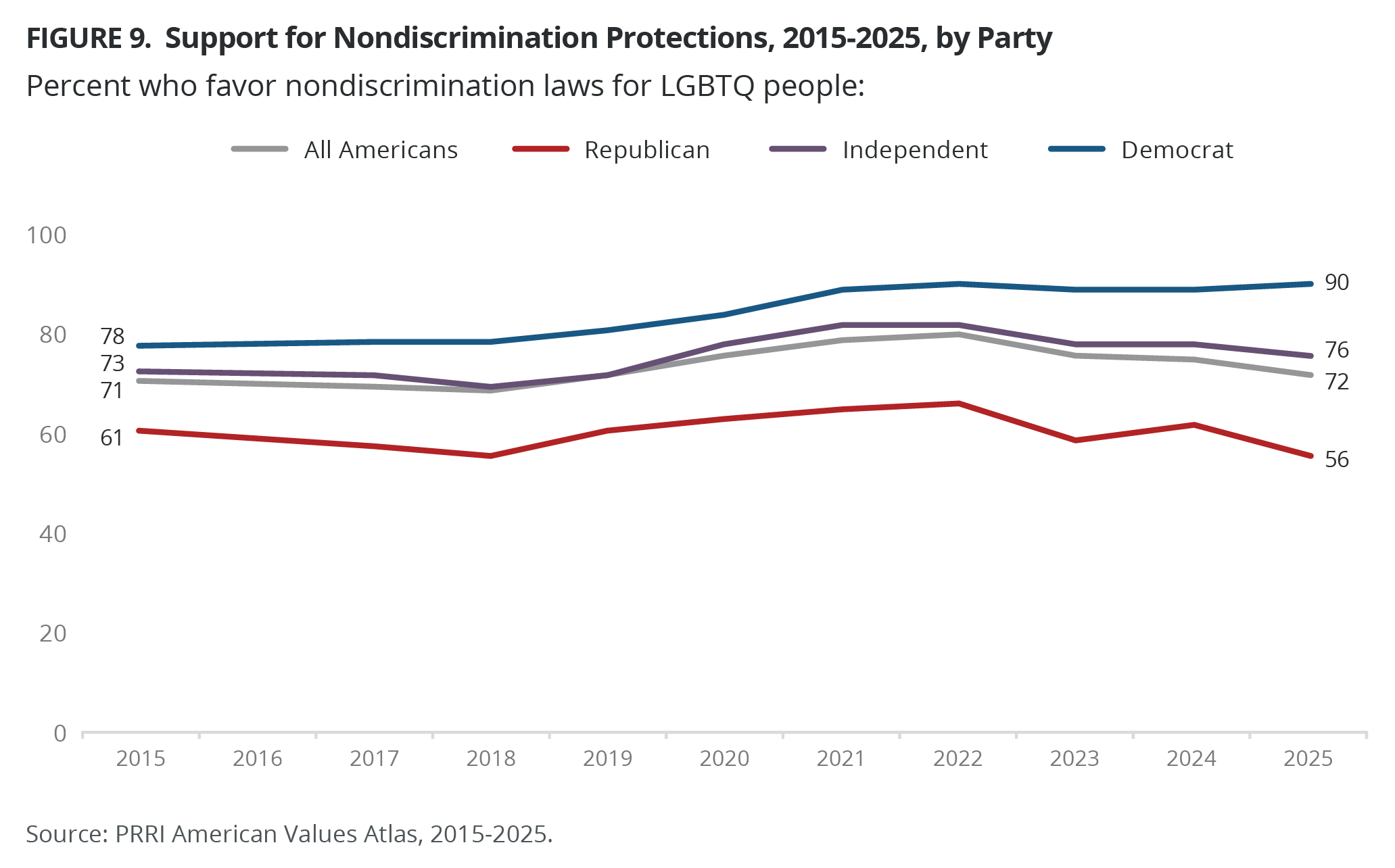
Since 2015, PRRI has polled Americans on laws protecting LGBTQ individuals in jobs, housing, and public accommodations. Support has remained stable, moving from 71% in 2015 to 72% last year. Majorities in nearly every faith group support these protections — ranging from 54% of white evangelical Protestants to 92% of Unitarian Universalists — with Jehovah’s Witnesses being the only exception. While support peaked among most groups several years ago, white Christians have seen the most notable decline in the past three years, from 76% in 2022 to 66% in 2025.
2. Declining support for LGBTQ nondiscrimination protections is largely driven by Republicans.
In recent years, conservative Republicans in state legislatures around the country — and the current Trump administration — have worked overtime to curtail the rights of transgender Americans. In the last days of the 2024 election cycle, the Trump campaign and other Republican candidates showered the airwaves with ads featuring anti-trans rhetoric. In the past week, Trump demanded that any version of the SAVE Act — ostensibly designed to make elections more secure from voter fraud — that appears before him to sign include provisions targeting transgender athletes and children. (That bill faces an uphill battle in the U.S. Senate.)
The GOP’s persistent emphasis on transgender issues has meaningfully shaped support downward among Republicans. In 2025, 56% of Republicans supported nondiscrimination protections — down from 66% just 3 years ago. At the same time, however, support for broad nondiscrimination protections has remained steady among Democrats. Given that white Christians make up roughly 2 in 3 Republicans, it is not hard to see how support among white Christians has tumbled 10 points since 2022.
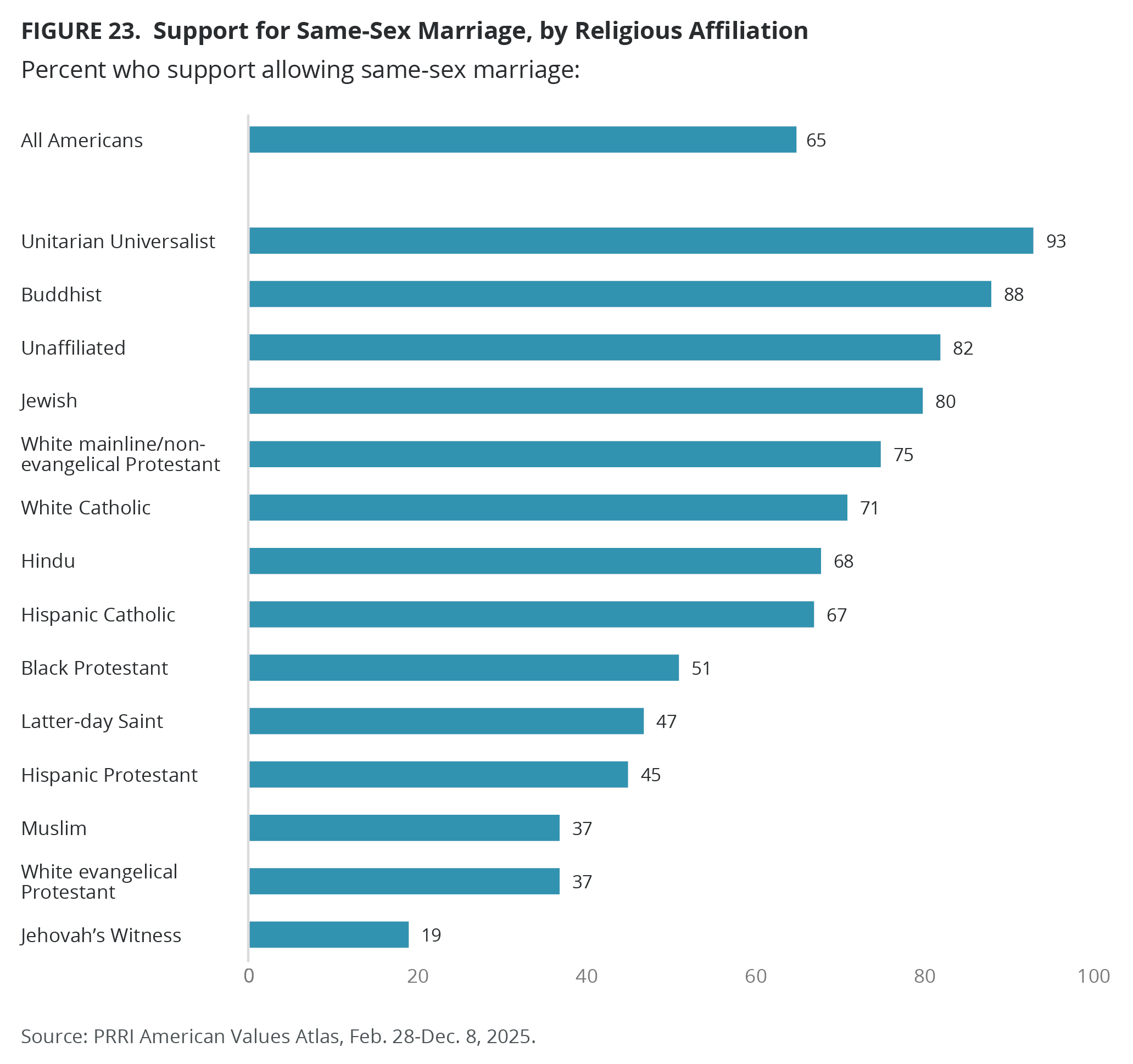
3. Support for same-sex marriage is higher today than a decade ago, though support has slipped since its peak in 2022; most people of faith continue to support marriage equality.
Support for same-sex marriage remains higher today than a decade ago (65% in 2025 vs. 53% in 2015), but public support peaked in 2022, when 69% of Americans supported marriage equality.
Partisan shifts tell a more nuanced story. Notably, Republican support for same-sex marriage has not declined in the past three years, but roughly half of Republicans continue to oppose it. While Democrat support for marriage equality remains robust, support among Independents has declined in the past three years, now standing at 69%, down 4 points from its 2022 peak (73%).
It’s worth bearing in mind, however, that marriage equality enjoys broad support among most people of faith, including more than two-thirds of Catholics, white mainline/non-evangelical Protestants, Hindus, Buddhists, Jews, and Unitarian Universalists.
4. Young Republicans in recent years have trended far more socially conservative, helping to drive a broader decline in support among younger Americans for LGBTQ rights.
Contrary to the expectation that younger generations act as a moderating force, young Republicans have trended significantly more socially conservative in recent years, contributing to an overall decline in support for LGBTQ rights among younger Americans.
In 2015, 80% of Americans ages 18-29 supported nondiscrimination protections for LGBTQ Americans. Last year, that percentage declined to 70%. This shift is particularly surprising given that younger Americans are more likely to identify as LGBTQ and are more likely to have a close personal relationship with someone who is queer than older Americans.
The decline is primarily driven, however, by cratering support among young Republicans. Among Republicans ages 18-29, support for LGBTQ nondiscrimination protections plummeted from 74% in 2015 to just 50% last year. As recently as 2020, two-thirds of young Republicans backed same-sex marriage; today, only 52% do. Meanwhile, support among young Democrats on these measures has remained the same or inched higher.
5. Americans’ views on transgender rights reveal a paradox that may shape future elections
American public opinion on transgender rights reveals a striking paradox: broad support for general protections, but hesitation regarding specific policies.
Recall that 72% of Americans support laws protecting LGBTQ individuals from discrimination in jobs, public accommodations, and housing.
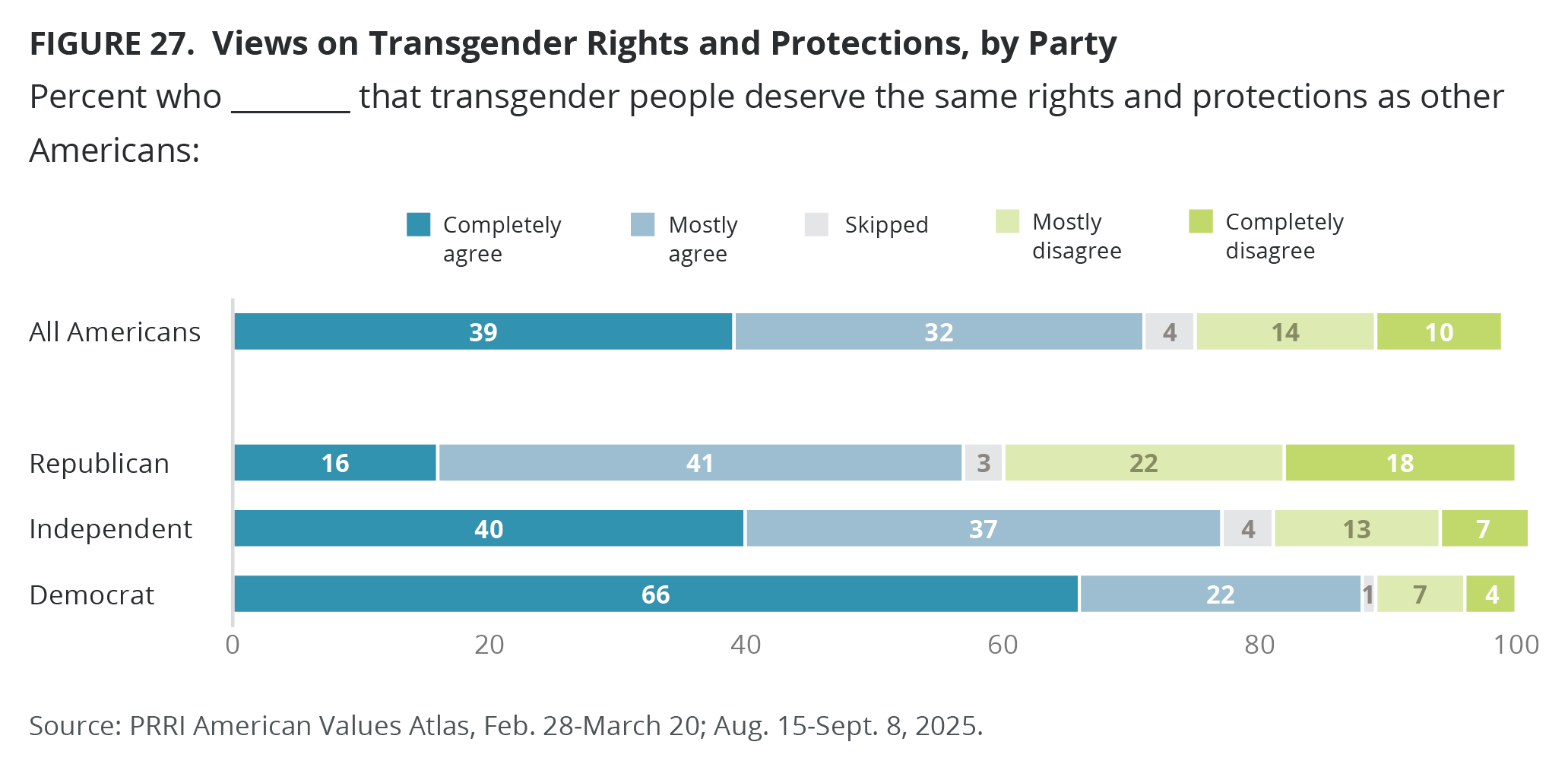
We decided in our latest survey to see if support for transgender Americans, specifically, might yield less support among Americans. Turns out – it does not. We find that 71% of Americans agree that transgender people deserve the same rights and protection as other Americans, although differences align along the usual partisan breaks.
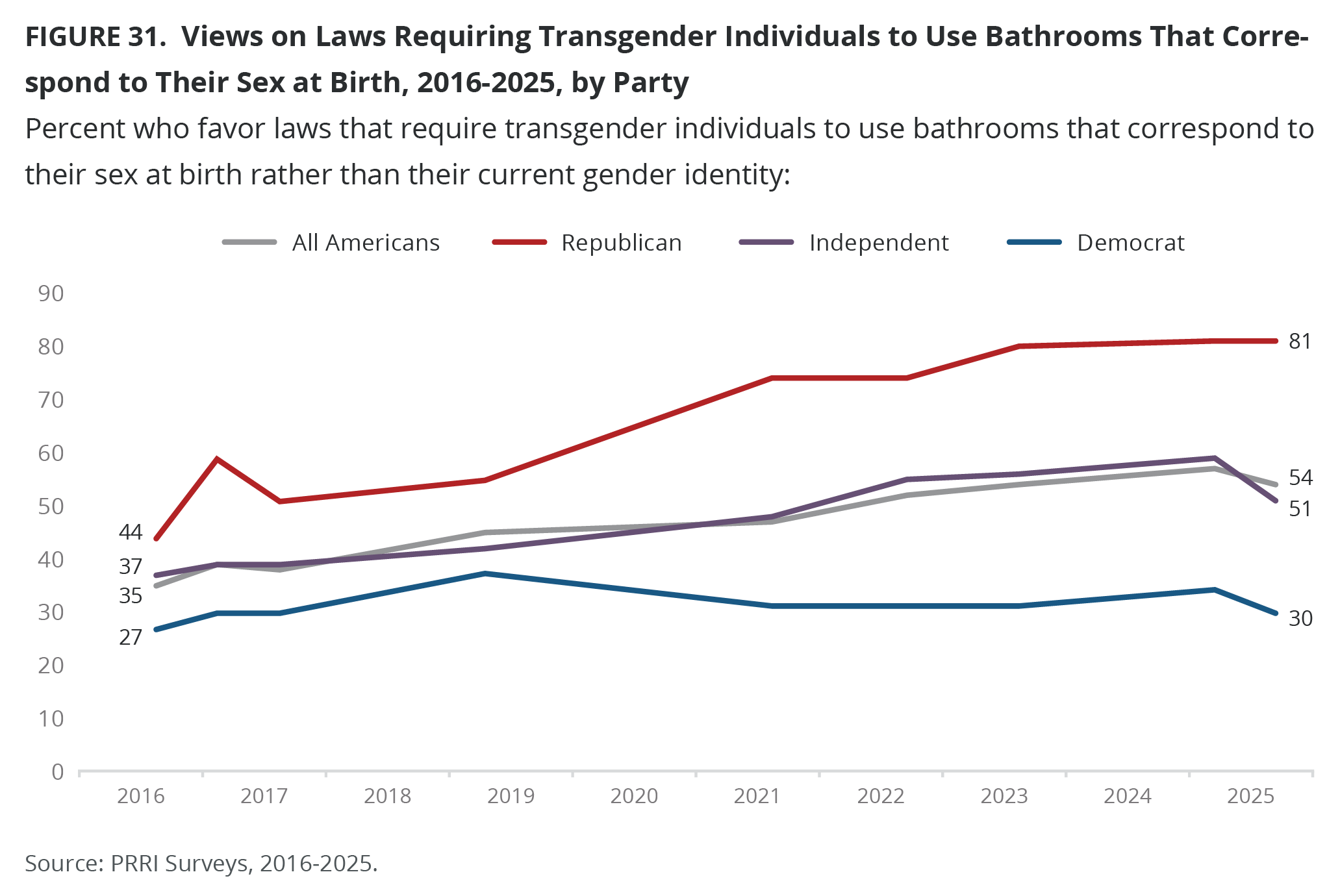
However, a clear disconnect emerges when the conversation shifts to one specific form of public accommodations for transgender Americans: access to public bathrooms. A decade ago, only about a third of Americans supported “bathroom bills” that required transgender individuals to use the bathrooms that correspond to their sex assigned at birth rather than their current gender identity. In recent years, however, transgender bathroom bills have bounced back, with 21 states (all under Republican control) having passed such restrictive bills.
Whether the passage of such bills remains ascendant in the coming years is debatable. Clearly, Republican strategists believe their often misleading attacks on gender identity were a key factor in Kamala Harris’ loss to Donald Trump in 2024, so there is motivation to keep transgender issues at the forefront of their political appeals. Yet, critics of such bills noted that the “transgender playbook” failed to resonate in last fall’s gubernatorial races, as voters seemed far more concerned about the economy and broader concerns about the state of our democracy.
To learn more, read PRRI’s full survey report: Mapping Support for LGBTQ Rights Across the 50 States: Insights from PRRI’s 2025 American Values Atlas
This article was originally published at PRRI’s Substack and is reprinted here with permission.