
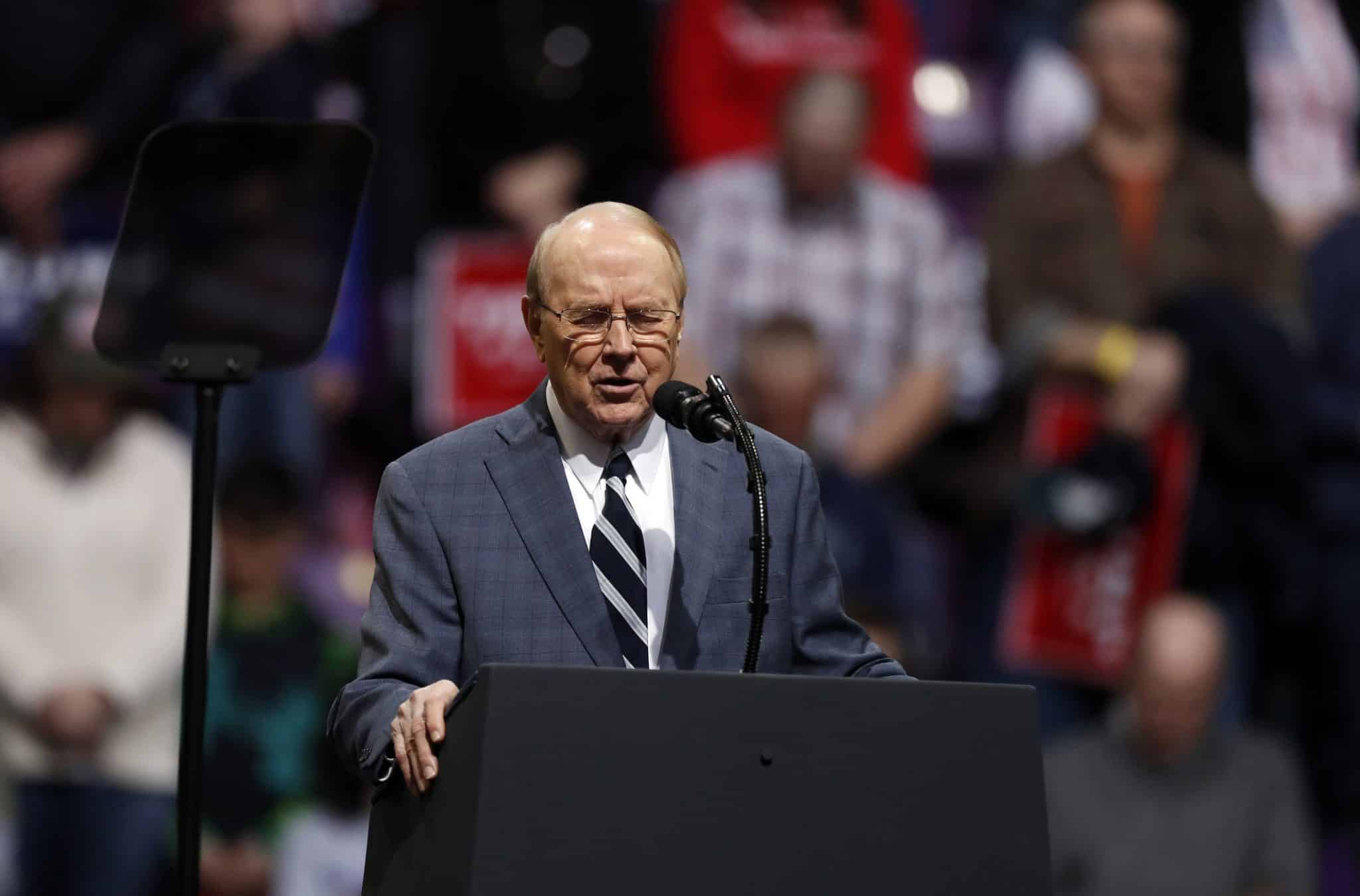
Among the millions of documents related to Jeffrey Epstein released by the Justice Department on January 30, there are many boldface names—some familiar from previous disclosures, some new. While mainstream media have focused on figures like Steve Bannon and Sarah Ferguson, progressive Christian and exvangelical bloggers and podcasters have been talking about James Dobson. His name appears just once in the files, and there is no evidence he had a relationship with Epstein, let alone any suggestion he was implicated in Epstein’s crimes. Nevertheless, understanding why Dobson turns up in a text conversation Epstein had with an unnamed woman is a skeleton key for understanding evangelical responses to the Epstein files—and, perhaps more crucially, the conspicuous silence of people and organizations that claim to protect women and children.
If you don’t know James Dobson’s name, you may know Focus on the Family, the organization he launched in 1977 to promote what he called biblical marriage and childrearing. Though Dobson claimed the organization was apolitical, from the moment he began advising Ronald Reagan in the early 1980s Dobson was one of the most powerful forces in Republican politics. And, right up until his death in 2025, arguably the most powerful evangelical leader in the United States.
By the time he launched Focus on the Family, Dobson was already famous among evangelicals as the author of Dare to Discipline, a book that sold millions of copies and became the standard parenting manual in conservative Christian households. Its central argument is that permissive parenting produces weak, rebellious children. Dobson wrote from an evangelical perspective, but his credentials as a licensed psychologist gave him scientific credibility.
Over the decades, Dobson advocated physical punishment for children as young as 15-months-old and suggested leaving a switch or belt in the child’s room as a reminder to behave. He promoted conversion therapy and called SpongeBob SquarePants “homosexual propaganda.” He advised parents to guard their daughters’ chastity because the “natural sex appeal of girls serves as their primary source of bargaining power in the game of life.” And he taught that a girl remains under her father’s authority until marriage, at which point she answers to her husband.
This ideology made Dobson a central figure in “purity culture,” an evangelical movement that treats female sexuality as a moral and spiritual resource belonging not to women themselves but to their fathers, future husbands, and God. During purity culture’s peak in the 1990s, purity balls—events modeled on debutante balls—brought teenage girls in white dresses before their fathers, where the girls pledged to preserve their virginity and the fathers vowed to protect their daughters’ “purity of mind, body, and soul.” A teenage girl pledging her virginity to her father may seem like the antithesis of a teenage girl being sexually exploited by a wealthy hedonist. But understanding Dobson’s ideology and his power as both a pastoral guide and a powerful political leader illuminates why Jeffrey Epstein might have found his words useful.
In the text exchange where Dobson’s name appears, Epstein is counseling a woman or girl troubled by her inability to stop hurting her father even though she cares about other men’s feelings. Epstein encourages her to read a blog post called “Resentment and Anger Toward a Father,” in which Dobson advises a woman whose father has repeatedly failed her to ignore her own feelings to consider the wounds he may carry from his own upbringing and stop expecting him to meet her emotional needs. The message is clear: a woman hurt by a man should offer forgiveness and understanding.
Sara Moslener, a lecturer at Central Michigan University and an expert on purity culture, isn’t surprised that Epstein shared Dobson’s advice. Both men, she argues, were invested in systems of power in which men control women and girls. “You can’t question authority in high-control environments,” she says, “and under patriarchy, men are the ones with authority. When men misstep, they can be absolved without any show of remorse or promise of change. Men decide who is innocent and who is guilty. And men always receive the benefit of the doubt.”
In a recent blog post, divorce recovery advocate Gretchen Baskerville explains how the Dobson piece Epstein shared is useful to abusers: It trains victims to doubt their own instincts, encourages them to empathize with their abusers, and discourages escape. After sending the Dobson article, Epstein followed up with this message: “I suggest you learn to give. You say thx for advice but could have said… is there something I can do to express my appreciation?” As Baskerville points out this is grooming behavior.
D.L. Mayfield, generally credited with being the first to find Dobson in the Epstein files, has spent years documenting the relationship between purity culture and child sexual abuse, arguing that purity culture not only fails to protect children but also provides a theological framework for their exploitation. While Dobson and Epstein may not have shared precisely the same ideology—Epstein was not an evangelical Christian—they did share a common interest: Both were invested in a world in which powerful men face no accountability and women and girls are trained to stay silent, endure abuse, and accept that they are responsible for their own exploitation.
In 2019, Epstein was arrested on federal sex trafficking charges. He died before his case went to trial, but his 2008 conviction is a glaring example of a man evading responsibility for his actions. Despite evidence that Epstein had systematically abused dozens of girls between the ages of 14 and 17 over a period of years, the state of Florida allowed him to plead guilty to just two prostitution charges and serve 13 months in jail with generous work release. He was also granted secret federal immunity for himself and unnamed co-conspirators—a deal later ruled illegal for deliberately concealing it from his victims.
Epstein’s conviction did nothing to diminish his prestige. Wealthy, powerful men—and a few similarly positioned women—continued to socialize with him and seek his advice. That a convicted sex offender retained his place in elite circles is shocking, but it is also entirely consistent with the ideological world Dobson helped build. He understood, earlier than most, that a network of churches, radio programs, and family-values organizations could be converted into a political machine. What began as pastoral guidance fostered the movement we now know as Christian nationalism—and ultimately the MAGA coalition it would come to animate.
As author and journalist Katherine Stewart has documented, the movement Dobson helped build was always more about political power than protecting families. Its funders, whatever their personal beliefs, are “united in their desire for policies that benefit and justify plutocratic wealth and that hollow out public goods and services.”
“We have an administration and a government that is committed not to finding out the truth about the most appalling pedophilia, abuse, and corruption ring in recent memory, but to protect and defend the perpetrators. That in itself is really something.” – Journalist Katherine Stewart
For years, this movement has disguised its ambitions in the language of culture wars, but, Stewart argues, “Its aims were always larger than that. Today it has taken over one of our two major political parties, and has betrayed every conservative principle worth holding.”
Stewart is not surprised that members of the MAGA movement have shown no interest in reckoning with the Epstein files. “The drive to protect these perpetrators, the alliance with criminals, does not surprise me, and it should not surprise anyone who has been paying attention.”
Moslener says that purity culture, too, has always been political. While controlling girls’ bodies was certainly one objective, another was mobilizing girls as culture warriors. “Purity culture deploys young people as attractive, nonthreatening role models.”
The reason the trappings of purity culture—the purity balls and the promise rings and the #WWJD bracelets—are no longer as popular as they once were is because they are no longer necessary. “The fundamental ideas of purity culture are just part of the mainstream now,” she said.
The evangelical silence on Epstein is easier to understand once you accept Moslener’s premise: that the fundamental ideas of purity culture are no longer a fringe movement but part of the mainstream. A culture that has internalized the belief that powerful men deserve the benefit of the doubt, that women who are hurt by men should extend empathy rather than demand accountability, and that female sexuality exists to serve male interests does not need to contend with the Epstein files. It just needs to say nothing. And in that silence, the movement reveals what it was always really protecting—and who.