“We are America’s mistress,” a streetcorner philosopher told me during my recent visit to Panama. “One day Mr. Trump looked down at us and said, ‘Hey, you have another boyfriend—and he’s Chinese! Get rid of him!’ So we dumped the Chinese guy. We had no choice. That’s what it means to be Panama.”
Last year, under pressure from Washington, Panama abruptly terminated a contract under which a China-based company ran ports at both ends of the Panama Canal. It was the latest illustration of Panama’s uniquely unequal relationship with the United States.
Panama is the only country in the world that the United States created. It has never been a formal colony, but its freedom of action is limited. The presence of the canal has given American leaders a sense that they need to control Panama.
Many Panamanians seem to accept this arrangement the way they accept weather — as simply an immutable part of life. They have reason to be satisfied. Their country has not reached a level of cultural achievement comparable to nearby Colombia, Nicaragua, or Guatemala, but it is far richer than they are. Panama is devoted to business.
Location is one obvious explanation.
When the Latin American liberator Simon Bolivar proposed two centuries ago that the world be joined into a giant commonwealth, he proposed Panama as the logical capital. “What is the isthmus of Corinth compared with that of Panama?” he asked.
The other factor that defines Panama’s national life and history is its tangled relationship with the United States.
Panama was a province of Colombia when President Theodore Roosevelt demanded that Colombia hand over a strip of its territory so Americans could build a canal there. Colombia refused. Roosevelt responded by promoting a separatist rebellion in Panama. He sent 10 warships to prevent Colombia from landing troops to suppress it. Then he recognized his protegees as legitimate rulers of a new country, the Republic of Panama.
READ: From Guatemala to Panama: US Affairs in Latin America
At his next cabinet meeting, Roosevelt asked Attorney General Philander Knox to come up with an argument that would make this act of international piracy seem legal. “Oh, Mr. President,” Knox replied, “do not let so great an achievement suffer from any taint of legality.”
Leaders of newly independent Panama did not want to give the United States control of a 10-mile strip bisecting their country, but they had no choice. Over the decades that followed, American troops intervened repeatedly in Panama to protect client regimes and suppress protests.
In 1964 nationalist students charged into the Canal Zone and tried to raise a Panamanian flag. More than 20 Panamanians and four American soldiers were killed. Rising nationalism, inevitably directed against the United States, seemed to pose a long-term threat to the canal. After long negotiations, the United States defused the growing crisis by agreeing in 1977 to turn the canal over to Panama.
A few years later, world attention focused on Panama as a drug-dealing dictator, Manuel Noriega, came to power and began taunting the United States. President George H. W. Bush responded by ordering an invasion. Noriega was captured, a new president was sworn in on a United States Army base, and Panama resumed its accustomed pro-American identity.
The site of the biggest battle fought during the U.S. invasion, once Noriega’s headquarters, is now a park. A gent smoking a cigarette there on a recent afternoon told me he had witnessed the conflagration that exploded on December 20, 1989.
“The entire neighborhood was in flames,” he told me. “By the next morning, there were bodies lying in every street.”
Was that invasion worth the cost? Beyond that, has American tutelage been good for Panama?
“Thanks to the Americans, it has been possible for me to live a life here,” a 62-year-old Panamanian told me. “You can say they dominate us, but under Noriega, we were in constant fear. The Americans liberated us.”
Not everyone agrees.
On a wall near the park where urban warfare once raged, someone has painted a cry of protest: “No Forgiving, No Forgetting – December 20, 1989.”
Today Panama is a reasonably well functioning quasi-democracy. Stability is prized above all. Political parties and leaders compete, but all accept the tacit submission to Washington that guides Panama’s political and economic life.
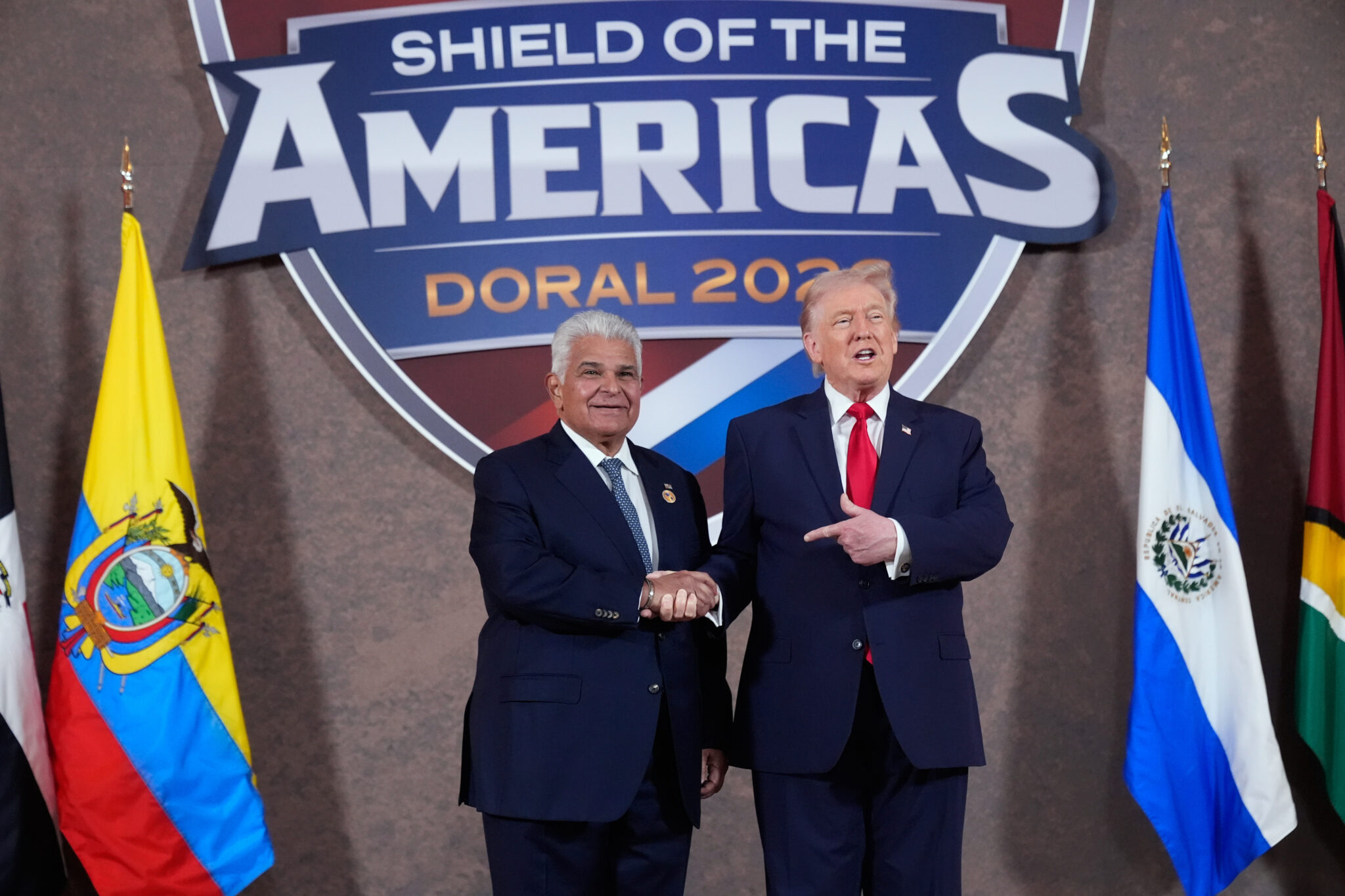
That was easy until President Trump came to office last year. He called the transfer of the canal to Panama a “foolish gift” and refused to rule out military action to seize it. Then he complained that China was “operating the Panama Canal.” That was untrue, but Panama’s leaders got the message: Washington was unhappy. They scurried to expel the Chinese company that had been running two of its ports. Since then, Trump has made no new threats against Panama.
A combination of enterprise, geography, and American tutelage has made Panama a success. The quasi-colonial friendship that binds the two countries serves both well. Panamanians prosper by following a formula they have perfected over the 123 years since Roosevelt created their country: concentrate on making money and don’t annoy Washington.