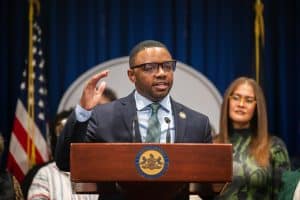
Michael Zeltakalns
Seeking Office: Representative in Congress
Party: Democratic
Primary Ballot: Democratic
District: 1st Congressional District
2026 Democratic Primary Questionnaire Responses
At the Bucks County Beacon, we believe informed voters are the bedrock of democracy. We asked every candidate in the PA-01 primary to clarify their positions on the issues that matter most to our community. Below are their unedited submissions. Most questions included a multiple choice answer, with the choices being Yes, No, or Other/Neutral, along with an explanation for the stance.
1. Healthcare
Do you support a “Medicare for All” single-payer system?
No one should fear bankruptcy because they got sick — but that's exactly the reality our current Congressman voted for. Brian Fitzpatrick cast the deciding vote on a bill that tripled health insurance costs in Pennsylvania. That same bill handed ICE $75 billion for a nationwide detention system. Now you know where his priorities are.
Mine are different.
I served in the military and received outstanding care through Tricare — a government-run program covering millions of Americans every day. It wasn't complicated, and it works. A Medicare-for-All-system can work the same way: coverage as a right, not a privilege tied to your employer or your zip code.
Do you support adding a public option to the Affordable Care Act, specifically as outlined in the CHOICE Act?
I've seen healthcare systems up close in countries around the world — through my military service and my years at the State Department. Americans are getting a bad deal. We pay more than almost any nation on earth and get less access in return. That's a policy choice, and we can make a different one.
I'll be proud to support this bill in Congress.
2 Immigration & Federal Oversight
The Future of ICE
Do you support the abolishment or disbanding of U.S. Immigration and Customs Enforcement (ICE)?
I spent my career protecting Americans. I've seen firsthand what happens when force operates without accountability: it breeds instability, erodes trust, and ultimately weakens the rule of law. I watched that happen in other countries. I will not watch it happen here.
Immigration enforcement must be firm, effective, lawful, and humane — and I will hold every ICE official accountable for meeting that standard, from the agents on the ground to the Secretary of DHS.
Accountability Measures
Do you support a federal mandate for ICE agents to wear body cameras and a ban on “masking” (face coverings) during enforcement actions?
Body cameras and a ban on masking are basic accountability measures, not radical proposals. Law enforcement authority carries immense power, and with that power comes responsibility. Agents who operate lawfully have nothing to hide.
I will fight for both measures to ensure immigration enforcement is professional, lawful, and fully accountable to the people it serves.
Sensitive Locations
Do you support the Protecting Sensitive Locations Act (H.R. 1061), which would codify a ban on ICE enforcement within 1,000 feet of schools, churches, and hospitals, regardless of current administration directives?
Until January 2025, a longstanding policy protected schools, churches, hospitals, and shelters from immigration enforcement. The Trump administration rescinded it on day two. Now families are skipping doctor's appointments and keeping children home from school out of fear. That's not enforcement. That's collective punishment.
Every person present on American soil is owed a basic level of humanity, dignity, and respect. When we allow cruelty toward the most vulnerable among us, we invite cruelty to all of us.
The Protecting Sensitive Locations Act codifies these protections in federal law — where no executive order can touch them. I'll support it on day one.
Qualified Immunity
Do you support the Qualified Immunity Abolition Act of 2026 (S. 3625) to remove the legal shield for federal, state, and local officers?
In my years of government service, accountability wasn't optional. It was the foundation of trust. The same standard applies here.
The Qualified Immunity Abolition Act doesn't punish good officers doing their jobs. It ensures that when officials break the law and violate constitutional rights, citizens can get their day in court.
The Dream Act of 2025
Do you support the passage of the Dream Act of 2025?
Congress first had a chance to act on this in 2001. That's nearly 25 years of failure under both parties while millions of people live in legal limbo through no fault of their own.
The Dream Act of 2025 is a bipartisan bill that sets clear requirements: background checks, continuous residence, education or military service. It is an earned pathway for people who have already proven their commitment to this country.
I will vote yes on day one.
3. Economic Policy & Taxation
Taxation of Wealth
Do you support implementing a wealth tax on the top 1% of earners?
Billionaires deploy armies of lawyers to exploit loopholes and schemes that let them pay less — sometimes nothing — while working families in PA’s First District pay what they owe every April without complaint. What do we get in return? Underfunded schools. Unaffordable healthcare. Stagnant wages. And an endless appetite in Washington for prisons and wars.
That has to end. I support closing the loopholes that let the ultra-wealthy game the system, and ensuring they pay their fair share – not what their accountants can maneuver around, but what they actually owe. The revenue exists. The need exists. What's been missing is the political will to choose working families over billionaire donors.
Corporate Outsourcing
Do you support “tax-on-exit” legislation for corporations that move production to foreign countries?
The 2017 Trump tax law created a special discounted tax rate which rewards multinational corporations hiding profits in the Cayman Islands while demanding full taxes from honest businesses in Pennsylvania.
The law was written by the ultra-wealthy for the ultra-wealthy to escape paying their fair share. Working families in the First District have watched good jobs leave for decades — manufacturing, customer service, tech support — while the corporations doing the outsourcing pocket the savings and then sell those products right back to us. Meanwhile, we get stagnant wages and a tax bill to cover what they didn't pay.
I support the No Tax Breaks for Outsourcing Act — requiring multinationals to pay the same rate on profits earned abroad as they do here at home. No discounts for abandoning American workers. If you want access to the American market, we expect you to invest in the American workforce.
Tariffs
Do you support the use of broad-based tariffs as a primary tool of international policy?
The Yale Budget Lab estimates Trump's tariffs are costing the average household $1,700 a year. Beef is up 16%. Coffee is up nearly 20%. Clothing is up 14%. Even the right-leaning Tax Foundation calls this the largest tax increase on American consumers since the 1980s.
Blanket tariffs don't hurt adversaries, they just make life more costly for Americans. Targeted tariffs have a legitimate role: protecting strategic industries, responding to unfair trade practices, defending national security. That's a scalpel. What we've had is a sledgehammer, and our families are paying the cost.
Trade policy should strengthen American workers — not levy taxes with no strategy and no end in sight.
4. Foreign Policy
International Accountability
Do you believe Congress should pursue formal investigations or legal action regarding alleged war crimes or extrajudicial killings involving U.S. officials?
The principle established at Nuremberg was simple: those who plan, authorize, and order illegal killings bear criminal responsibility. Following orders is not a defense — and neither is holding a Cabinet position.
I served under strict rules of engagement. Those rules exist for a reason. When you remove accountability from the use of lethal force, you don't get better outcomes — you get more killing. I have seen this pattern in other countries. I never expected to see it here.
Congress has both the authority and the obligation to investigate these actions fully and to pursue accountability up the chain of command, to the officials who gave the orders. No one who authorized the killing of unarmed survivors, or ordered military strikes without Congressional approval, is above the law. That principle is not negotiable.
Sovereignty & Oversight
Should Congress act to limit U.S. intervention in the sovereignty of other nations (e.g., Venezuela, Greenland, Ukraine, Israel & Gaza)?
– Venezuela: This administration launched unauthorized military strikes and invaded a sovereign nation without a single vote of Congress. That is not foreign policy, that is lawlessness. I support diplomacy, targeted measures, and the immediate reassertion of Congressional authority over the use of military force in the region.
– Greenland: The embarrassing threats to seize a NATO ally are a symptom of something more dangerous: a deliberate retreat from the collective defense agreements that have kept Europe stable and America secure for 80 years. NATO is not a burden. It is the most successful military alliance in history, and when we threaten allies and signal indifference to that commitment, we undermine the trust that makes the entire alliance function.
– Ukraine needs and deserves American support — and I will not equivocate on that.
I believe American military power should be reserved for the most serious and exigent threats. Russia's illegal invasion of a sovereign democratic nation in the heart of Europe meets that standard. If we don't stop them there, we will find ourselves defending democracy much closer to home. This administration treats Ukrainian territory as a bargaining chip. That is not strength. It is surrender dressed up as dealmaking.
– Israel & Gaza: The scale of civilian death in Gaza is not collateral damage — it is the result of a sustained campaign that has targeted civilian infrastructure, blocked humanitarian aid, and ripped millions of people from their homes. The evidence of what is happening is not in dispute.
American taxpayers have given billions to Israel over decades. That support has always come with conditions — or it was supposed to. I will not vote to fund military operations that violate international humanitarian law, target civilian populations, or obstruct the delivery of aid. Full stop.
I support an immediate ceasefire, the unrestricted flow of humanitarian assistance, and a genuine diplomatic process toward a just and durable resolution — one that recognizes the right of both peoples to security, dignity, and self-determination.
American power must be exercised lawfully, strategically, and consistent with the values we ask other nations to uphold.
5. Climate & Environment
Climate Action
What are your top three concrete policy proposals to address the climate crisis while ensuring economic stability for workers in Bucks County?
First, I support major federal investment in clean manufacturing jobs right here in PA-01. Bucks County has the skilled workforce and industrial legacy to build the clean energy infrastructure of the future — we should produce it, not import it and watch those jobs go elsewhere. The former industrial corridor along the Delaware River — places like Falls Township — represents exactly the kind of brownfield redevelopment opportunity that could anchor a clean energy manufacturing hub for the entire region.
Second, I will fight to protect the Delaware River and the communities that depend on it by securing federal funding for flood resilience, storm-mitigation, modern water infrastructure, to protect homes and businesses from the flooding that's already hitting Lower Bucks. These investments bolster property values and create high-quality local construction and maintenance jobs.
Third, I support expanding federal workforce training programs that help workers transition from fossil fuel industries into clean energy careers without losing income or stability. The climate transition must strengthen working families — or it will fail politically and economically.
6. Leadership & Local Priorities
Party Leadership
If elected, would you support Hakeem Jeffries to continue as House Democratic Leader or someone else? Please explain your reasoning in the context of representing a district like PA-01.
We’re looking for a Democratic Party that fights with clarity and conviction. Too often, I see hesitation where I expect resolve.
I will support leadership that communicates plainly, defends democratic norms without apology, and has the spine to protect our institutions from the people who are actively dismantling them.
Local Priority
Outside of national headlines, what is the single most important local issue facing Bucks County residents today, and how do you plan to address it?
Washington made it worse. Brian Fitzpatrick cast the deciding vote that cut SNAP and pushed 1-in-5 Pennsylvanians off their healthcare plan. I’ve watched this administration slash the programs that keep people fed while handing tax breaks to billionaires — and I watched our own congressman help them do it.
I’m going to Congress to reverse that. No one in our district should go hungry. Full stop.