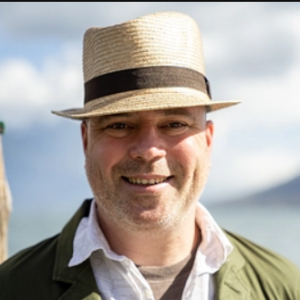
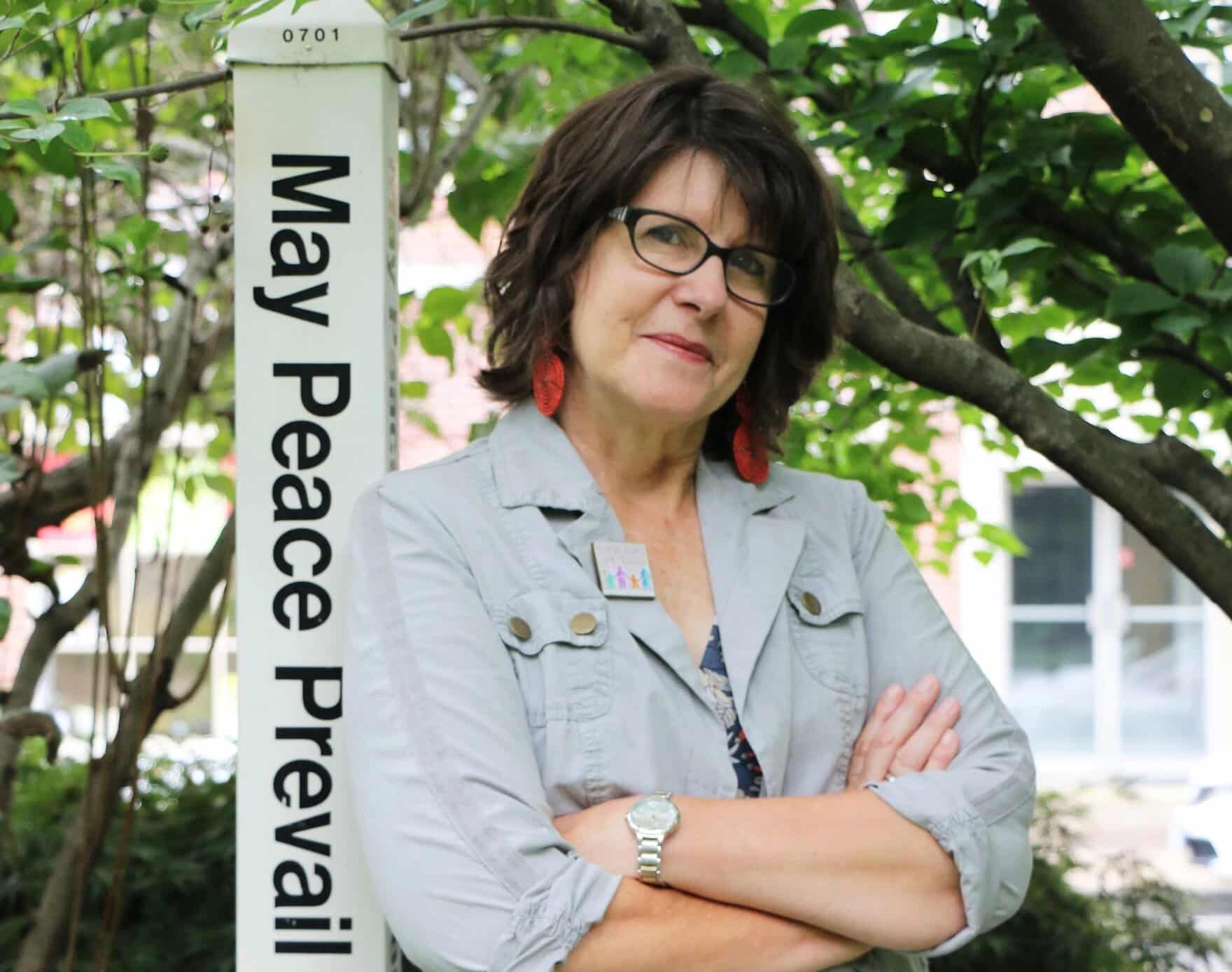
Barbara Simmons serves as executive director of The Peace Center, an educational peace and justice non-profit organization in Bucks County. After retiring from the role in 2019 (after 30 years in the position), she came out of retirement in October 2025 to once again lead the organization after it was announced it was planning on closing—something she couldn’t let happen. Barbara has also been a Professor at Arcadia University’s International Peace and Conflict Resolution master’s program for two decades, teaching Advanced Mediation, Conflict Facilitation and Restorative Justice. She was also founding director of PeaceTalks radio, producing radio documentaries from Europe, Asia, the Middle East, Rwanda, South Africa, Vietnam, Northern Ireland, Canada and the United States, which aired on NPR, PRI and many other stations. Barbara spoke with me today to talk about International Women’s Day, what’s new at The Peace Center, and the organizing work around making Bucks County a more just, inclusive, and compassionate community.
Listen on Apple, Spotify, and iheart
Barbara, every March 8th we celebrate International Women’s Day. What does this day mean to you?
Oh my goodness. You know, we live in a country that is mostly dominated by male leadership. Female leadership is often either ignored, or it’s not as well respected, or it’s dismissed. I’ve watched that my whole life and it’s made me angry and distressed, but that also motivates me to always make sure I’m lifting women up. Because what I see, is that when anybody is considered a second class citizen, they don’t gain the self-confidence needed to put themselves in leadership positions, or if they’ve put themselves in leadership positions, they have had to battle it out with whoever is on that team who wants to dominate, and that’s usually white males. And so, you know, we still have, in 2026 a patriarchal country, a patriarchal world. So having this day, an International Women’s Day, allows us to lift up female leadership, and that’s part of what needs to happen. The more we can lift up female leadership, the more we can work towards getting them into positions of some power.
I recently had a family member post something on Facebook about how anti-Christian it is to have females in power, and I was just horrified by that. There’s an effort using religion—that’s always been there—to hold women back. But to think that feminism is somehow anti-Christian is maddening to me. And those kinds of things are still around. We’re still dealing with these types of beliefs, even with modern women. So, honoring women for a month is the least we can do.
I think Bucks County has been blessed with a lot of strong women leadership, yourself included in that list, along with folks Adrienne King and the Bucks County NAACP, Diana Leygerman in Central Bucks School District, Laura Foster, Jane Cramer, the good folks at the local Indivisible Chapters. So when we’re looking at what’s happening and some of the biggest struggles in Bucks County for peace and justice and inclusiveness, what we’re seeing at the grassroots level is women leading these struggles on the front lines.
You’ve always had that though. In the civil rights movement, you had women standing behind the men, but they were doing a lot of the work that needed to be done in the background. That’s always been the case. Bucks County is luckily a community that honors women’s history month by usually identifying a female leader and holding an event, and I always go to them. We’ve got great female leadership, but if you look at any of our leadership positions, if you look at the CEOs and even the county commissioners, it’s always two men, one woman. You know, at some point, can it be three women? I look at the court. We finally put four women as Bucks County judges, but it was very few women who were judges in Bucks County. I don’t think the fight will ever end until we get rid of patriarchy.
Now International Women’s Day, while rooted in gender equality and women’s liberation, it also had an anti-war and pro-peace engagement. You’ve been a peace activist for decades. Can you tell us a little bit about some of the pro-peace solidarity work and peace journalism that you’ve done through the years?
Sure. So I’ll take the example of the nuclear disarmament movement. One of the female leaders that I was always following and impressed by was Dr. Helen Caldicott. Brilliant woman, pediatrician, but she was seeing the effects of nuclear testing on children, babies, and had to speak out about it.
INTERVIEW: The Radical History of International Women’s Day and the Feminist Movement, with Liza Featherstone
I always see women at the forefront of—whether it’s in the environmental movement or the peace and justice movement, women have been the first to speak up about it. But what happens is, if we have to come to the table, for example, we have to prove ourselves with twice as many facts than say a male will. What was the second part, Cyril? You said peace and justice.
Sure. So I was just hoping you could tell us a little bit about your background in peace activism and peace journalism.
Okay, thank you. So I also want to point out the Women’s International League for Peace and Freedom. That was one of the organizations that I wanted to learn more about the role that they played. So in this work, I have had male leaders and female leaders in peace work, but more female leaders than male. And teaching for 20 years in Arcadia University’s International Peace and Conflict Resolution program, every semester of new students that would come, it would be predominantly female. I think it has to do with the economics. If there was a lot of money in peace-building, there would probably be more men involved in it. And why is that? Why does it come down to money? The pressures that men have to be the person who’s supporting the family, the old notions of males needing to be the main breadwinners, goes back a long time. And now we have an administration that wants to set women back decades.
Well, for me, I really wanted to understand all the skills that are needed to move women ahead and forward based on a lot of knowledge and skill. In other words, why would you choose a female mediator over a male mediator, for example? So, I guess I wanted to be able to have a seat at the table with as many skills as any man sitting at the same table. When it came to my work, I probably put in years of gaining these skills, and it almost didn’t matter. The irony of it is that there was always somebody at the table, and it was usually a man, who was trying to dismiss what I had to say.
I left the Peace Center for a period of time to then try and understand peace journalism because I saw that as one of the areas where, you know, if it bleeds, it leads. Any story, if it bleeds, it leads. There’s gotta be somebody out there telling stories or sharing the experiences of people that have been able to work for peace as war was happening in their country or as violence was happening in their country.
And Barbara, this was PeaceTalks Radio that you’re talking about?
Correct, PeaceTalks Radio. Audio documentaries from around the world on peace journalism. So I went to South Africa several times and I wanted to interview people there that were part of the peace movement. I’ll give you an example of a story that just never really made it to the news. You know, we all know about the work of Nelson Mandela. Nelson Mandela was going to be coming out of prison, so he was meeting with de Klerk, the president, to figure out how to hand the government from de Klerk to Nelson Mandela. And there was a woman who started training mediators in all the neighborhoods in South Africa because she and a team of people were concerned that if Nelson Mandela came, and de Klerk handed power to Nelson Mandela, there would be bloodshed. This woman, Susan Collins [Marks], wrote a book about this. They trained mediators who were able to keep the peace as this huge transition was taking place from a white government to an all-black government. It was one of those movements that I wanted to understand more about.
When I went to Rwanda, I was working with a group of people who were putting into place a program called Healing and Rebuilding Our Communities because the genocide there had left neighbors living next to the people who murdered their family. How on earth do you go about staying in a neighborhood and living side by side with someone who had murdered their family? I wanted to understand more about this. So I did a story about doing mediation with a group of Rwandan women who wanted to be able to keep the peace in their neighborhood. I wanted to do a story about these programs that were community-based, helping neighbors understand forgiveness. Like they would never have justice, but could they have forgiveness? These are stories that I think we need to know because it helps us understand how we create peace out of the chaos. How do we work towards peace when weapons are being aimed at you?
The fearlessness of some of the people that I met with was so inspiring. And if we could know about those kinds of inspiring stories, I think it would give us the—you know, we’re in this loop, this cycle of bad news, just constant bad news. There might be one story of good news with 95% bad news. You walk around feeling awful. You’re feeling like there’s no hope. And if you don’t feel like there’s hope, then you’re not going to work towards peace. You’re just going to put your head down and escape as much as you can. That’s not how we improve the planet.
So these stories were important to me, but the irony is that there’s absolutely zero money to be made in any way, shape, or form. I did it all as a volunteer. When I raised money, it went towards the trips and the production of those stories. So it’s not a sustainable thing. And it’s not anything that any of our traditional legacy news is doing. We barely get international news, let alone any news about peace building. So I think peace journalism is an important area that is just not even being considered right now.
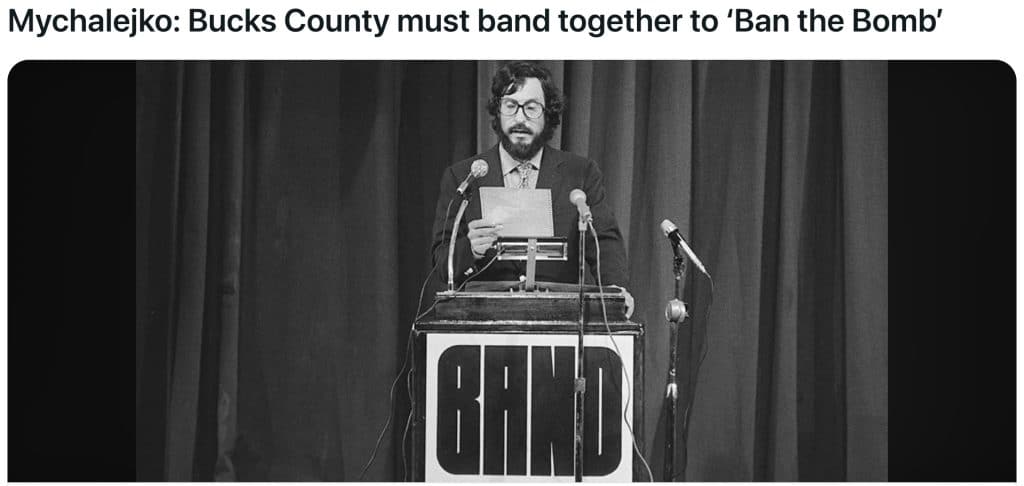
Let’s look backwards again. You had mentioned Dr. Helen Caldicott and her role in the nuclear disarmament movement. Back in Bucks County in the early 80s, there was a group of local progressive activists that started a group called Bucks Alliance for Nuclear Disarmament or BAND. This group eventually transformed into the Peace Center, which you are currently executive director of. You started volunteering at the Peace Center back in 1987. What led you there as a young woman?
I had, at the time, two children ages nine and 11. And I cared about what kind of world I was building for them, what we were building for them. I thought, I can’t just care about my kids. I have to care about the other kids too. Kids across the nation, across the world. I thought, well, I have to get involved. So I went to my first meeting that BAND held, where Peter Kostmeyer—Congressman Kostmeyer at the time—was speaking, and I thought, I have to get involved. I have to be part of the solution. And that’s how I’ve always seen my role on the planet: what part of the solution am I? If I’m not doing anything, then I’m part of the problem and I couldn’t live with myself like that.
At the time, too, I was involved with the Point Pleasant Pumping Station issue, because they were going to be taking 100,000 gallons of water a day to ship up towards the nuclear power plant. And I thought, what a devastating act that would be to take water from the river where we live—where we can go and walk along that river. What’s it gonna do to the river? I was becoming environmentally more aware. And again, trying to figure out: how do I raise my voice so that it’s heard? Anytime you’re raising your voice, even in Bucks County, people are judging you. They’re judging you, that’s just a hippie, you know. Or that person is just a lunatic lefty. They’re so ready to judge a person in their activism. I think that was the other thing I wanted to change. I wanted to show up in a suit, just like PICO officials, to say, not in my backyard. This should not be happening. Nuclear energy is dangerous for our kids, and if this is the price we have to pay, I don’t wanna pay it. So I never showed up in anything other than looking like they did so that they would be less likely to judge me and dismiss me. I still play that role today, you know, all my activism is towards a peaceful world, but I’m always cognizant of who’s in the room and what is it that I need to be saying so that they can hear me versus dismiss me.
Barbara, in the early years of the Peace Center and into the 90s and then early 2000s, how was it engaging with the community? What were some of the issues and topics it was grappling with and you were grappling with?
Well, when we finally had a little bit of movement towards nuclear disarmament, there still was the issue of spending enormous amounts of money for the military and at the cost of affordable housing, health care, and the ability for people to thrive in their community. All those things were a small part of the pie and military spending was a large part of the pie, and it was also contributing to many of the environmental issues that our nation was facing. So I think that what made sense to me is, our world’s not safer if you have this huge military. Our world is safer if people have jobs that pay a decent wage that allow them to either own a home or be able to pay the rent. If they have health care to be able, if they have enough money to buy healthy food versus having to buy the cheapest food. Being able to afford to live in a community like Bucks County—it has become continually less affordable to live in Bucks County or to afford health care or housing. You know, all those issues are still there. But now our government is spending a ton more money on cruel immigration policies. So, you know, do we take a step forward and two steps back? That’s what it feels like.
How did the local media engage with the Peace Center since its inception and then, you know, in the 90s and 2000s and until today? Did they cover your events? Did they give you a platform on the opinion pages? Tell us a little bit about that.
It’s a mixed bag, I will tell you that. It all depends on who was the editor at the time. We would always hold a meeting with several peace activists and the Courier Times, for example. And they would listen and give us a platform. But if you had an editor who just dismissed anything that peace activists were doing, we would lose that platform. I’ll give you an example. In 2017—well, actually it started in 2016 when Trump was elected. We started getting a lot of calls because there were instances of hate and bias and prejudice happening. A lot of it was directed towards students. And, we started keeping track of it. And I wrote an article, an op-ed piece, at the time for a local newspaper pointing out how much this increase in hate has happened in Bucks County. And the editor called me at the time and said, I don’t understand what you’re saying. How could it have increased? So I explained to him what was happening and the kind of phone calls we were getting. And he was not going to print that op-ed piece because he didn’t believe me. So I spent time on the phone with him, then I finally handed it over to one of my colleagues who also was dealing with the issues of hate. I thought maybe he needs to hear it from a different voice. So I put my colleague Kate Whitman on the phone and she ended up hanging up on him because he just was…I don’t understand why he didn’t want to believe what was actually happening. He finally did print the OpEd piece, but it took five phone calls with him to convince him that this was real.
That would not happen in any other line of work, you know, if a mental health professional wrote an op-ed, or if a CEO wrote an op-ed or even a teacher, they wouldn’t have been questioned like that. But our reputation was being called on the table in a way that was really offensive to me. So that’s just an example of how sometimes we would get a platform, and sometimes we would really be questioned. When I was doing PeaceTalks Radio, luckily I had a good relationship with WHYY and NPR was willing to air them, but they don’t pay you for a story. So unfortunately, our voices, whether it’s Indivisible or Immigrant Rights Action or the Peace Center, when we get a voice, it’s because a crisis has happened and they may interview one or two people. So I would say we don’t have the kind of voice that we’d like to or need to.
Yeah, it’s interesting and it’s unfortunate. Because I feel like at the Courier, I would say at least the last over the last 10 years, if not more, there’s been an institutional conservative culture that’s really held it back from fulfilling its journalistic duties to the community.
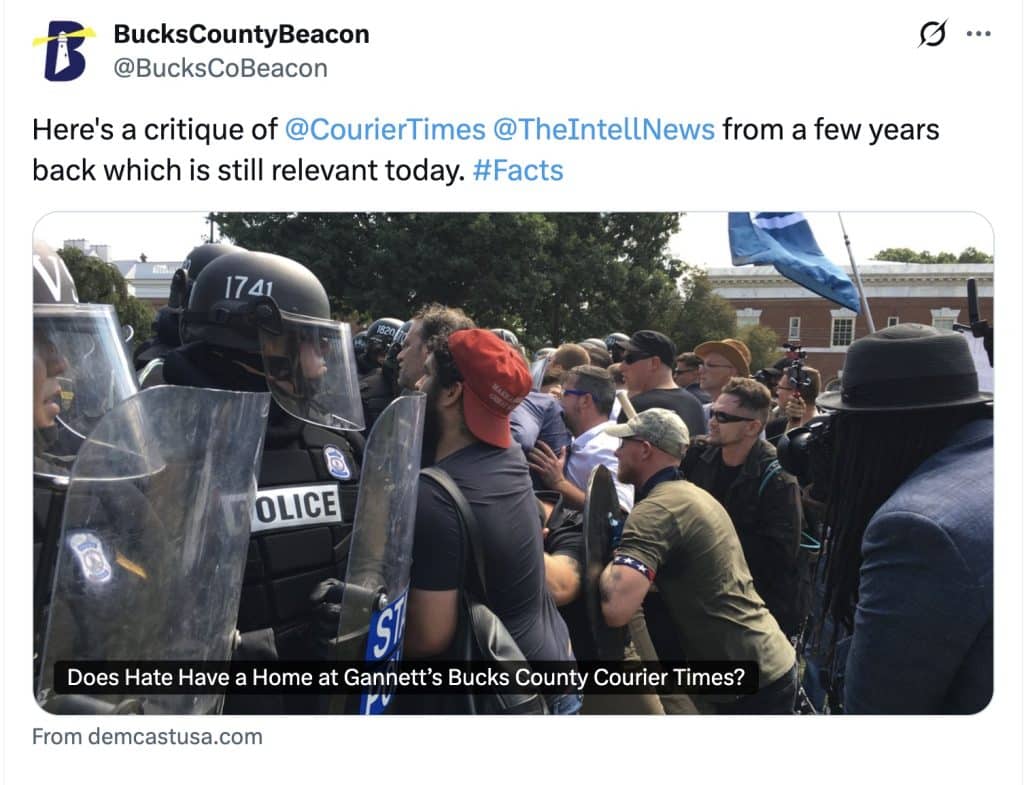
You’re talking about how they were really questioning your data and your analysis around this, but at the same time, they’re publishing articles—and I’ll just use one example—by someone like J.D. Mullane—who wrote a column, and this was in 2019, blaming feminism for mass shootings. [Laughs] I shouldn’t laugh, but it’s just so insane that something like that would be published, no questions asked, never mind there’s no actual data or research to suggest that. Yet, there’s this double standard where any kind of analysis to the left of a knuckle dragging troglodyte is under irresponsible, if not illogical, scrutiny. Things have gotten maybe a little better in certain respects, but like you said, a lot of it is just reactionary. There’s never this proactive engagement with members of the peace community to create a culture where things like that don’t happen. Where hate isn’t like the status quo and where it isn’t just dismissed or swept under the carpet.
Can I just say, the Beacon has filled an important role in Bucks County, with what some would consider the alternative voices, but to me, they’re the voices that are reasonable, thoughtful, and less reactionary. They’re more responsive, but ignored. You’re bringing forward the voices that have been ignored by legacy media.
Well, when I started there, four years ago, that was the point. That’s what drove me to be a platform for peace voices, for voices that were championing compassion, inclusiveness, and democracy.
So, you retired from the Peace Center, at least temporarily. Then in August or September, 2025, the Peace Center was ready to shutter its doors. And you stepped in, you said, wait a second, not so fast. This can’t happen, especially not now. Can you walk us through that?
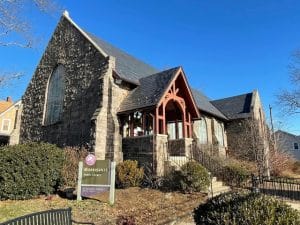
Yeah, I had retired for five years and I was working with other organizations: the NAACP of Bucks County, the Nakashima Foundation for Peace, my local Democratic committee, and other nonprofits. And I had no idea the Peace Center was in trouble. I was a regular monthly contributor and I had not heard that there was a problem until everybody heard there was a problem, and I said, oh my gosh, I can’t let—I came here to the office where I’m sitting now to say: what can I do to help? I can’t bear to see this place close. And it was the 11th hour or, quarter to 12 actually, because they were ready to dissolve. So I called the executive director after I got home and I said, look, I’m willing to step in and see if I can save this place. Then I spoke with their board and put together a proposal. So we’ve created a new board. We’re engaged in strategic planning to make sure we can be sustainable. But this is a time when we are needed more than ever. I knew that I would have to sacrifice, so I take no salary right now. I have no staff—we’re all volunteers here. And, we’re making a difference. In our own small way—until we can raise enough money to hire staff—we’re doing a heck of a lot. So I feel good about keeping the doors open, good about what we’re accomplishing, but we can do a lot more if we can be sustainable. So that’s our goal.
READ: Bucks County’s Peace Center Isn’t Going Anywhere
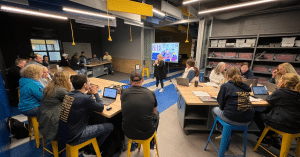
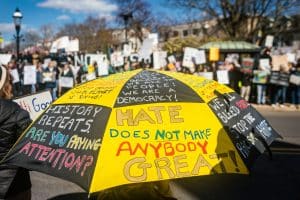
While we’re helping people, whether it’s Quakertown School District, Bristol Borough School District, or the community that’s in conflict, or training peacekeepers how to be safe in a protest or doing mediation when people are in conflict, that is still going on. I start working at about 6:30 in the morning and I don’t finish till close to nine at night, and work on weekends too. But it’s my small way of continuing to be part of the solution.
And it’s a labor of love. But don’t burn yourself out, please. Self-care is important and often gets neglected.
Absolutely. You know, somebody said to me recently, self-care is a strategy. Be strategic. And I take that to heart. I’ve lived a lot of decades now to know that self-care is critical for me. It’s critical for any peace activist—anybody who is working too many hours. You can burn out easily. I’ve had those moments where I’ve burned out and had to take a break. So, yeah, I do see it as a strategy that’s important for anybody that’s doing this kind of work.
So Barbara, just two more questions. First, as we look ahead, what is the Peace Center planning for 2026? What are some of the issues on your radar that you’ll be engaging in? You already had mentioned the instance of police brutality in Quakertown where a plainclothes police officer was choking a high school student protester protesting ICE brutality—brutality that often looks like what she experienced herself, if not worse. What are some of the other things that you’ll be working on throughout 2026?
You know, we are facing a lot of unknowns in 2026. Whether that be safe and free elections, whether it be the administration trying to put down protests—we have to be ready to do some of that rapid response type of programming, peacekeeping programming. So that’s not going to stop, that’s going to continue. We need to support our immigrant neighbors. But when communities are in crisis like they are right now in Quakertown—the immediate crisis has settled down a little bit, but there’s a lot of pain in that community. Quakertown may be happening next in Bensalem or in Milford, New Jersey. We don’t know. We have to be as prepared as possible to help the community deal with the cruelty and the violence that this administration seems to want to inflict on as many people as possible.
And in Quakertown too, there are a lot of people that, like you said, have been hurt by what happened with the student protests. But at the same time, if we’re being honest, the community is still divided over this. You would think that, kids being, I would say brutalized by police, would really shake anyone, regardless of political allegiances or political persuasions. We were talking about the Bucks County Courier Times. The Bucks County Courier Times just published an article today promoting this petition that wants to keep this Quakertown police chief in his position without any consequences, as well as prosecute the teens for just exercising their First Amendment rights.
Well, I had not seen that and that really is extremely uninformative and not helpful at all to healing a community. What I’ve witnessed over the last 10 years, with two Trump administrations, is that there is no accountability and that cruelty has been normalized. Violence has been normalized. So is it no wonder then, that that’s what’s going to be modeled locally? And that is not acceptable. So, we have to keep raising our voices. So when an article like that shows up, I have to wonder, how did they feel about January 6th? How did they feel about the Epstein Files where no one is being held accountable? Are we living at a time when it’s okay to screw up and not have to apologize? And not have to suffer the consequences?
We have become divided. It’s not just Quakertown. It’s happening in families, It’s happening all over our nation. That we have Fox News or Newsmax where there are no facts. It’s just a narrative that supports the people that can continue to not be held accountable. Or you have people watching MSNBC or CNN, and where, where is the international news? That’s also a beef of mine, but of course we’re divided. We’re hearing two different narratives. We’re being fed two different sets of news. And I think a lot of people are even shutting off the news because they don’t feel like they can trust it anymore. Or they’re willing to shut off the news and look at social media and get their news from who knows what. I really worry about how people are able to write an article that would support, without even knowing—even, I say, an adult hurting a child has never been okay in this country. In my lifetime. It’s not been okay for an adult to hurt a child, especially a big burly adult and a 15 year old being put in a choke hold. Nothing about that is okay. And I also, at the same time, I’m holding on to the fact that I want the DA to do an investigation so that we can gather as many facts as possible. But right now, if we look at Quakertown, you have kids that are hurting. They have been impacted by this. The trust has been broken between the police.
Traumatized.
Exactly, exactly. They have been traumatized. But anybody even watching those videos, Cyril, they’re traumatized as well. So their friends, the community members that watch these videos are horrified and traumatized even though they didn’t experience the trauma firsthand. All of us, our focus should be on healing the kids. All our focus should be on helping these kids, and all that witnessed it, come to grips with the trauma. The adults are my secondary focus. The secondary focus would be on the families of those kids who were traumatized. One of the things that we do is restorative justice, and listening circles. That’s how we go into a community and start to bring the temperature down and start to peel away the layers of trauma.
That’s what I see us doing in 2026, is trying to play a role in helping communities deal with the trauma of the victims, and also holding people accountable, but creating a space where they can be held accountable where they want to be held accountable. They’re okay with saying, geez, I overreacted, I’m really sorry. But instead, the president has set a precedent on digging the heels down deeper. That’s the model he has set for anybody, including our police—who, I guarantee you that there are so many police looking at this and saying, oh my god, we need to learn from this. But if you have people that are saying, nope, we’re not gonna hold him accountable, we support police doing this—I really think it’s shocking for people, so they either shut down, they don’t know what to say because they support the police normally, but they’re not supportive of this, or they’re in a state of confusion because they don’t know what to think. You know, they’ve always trusted the police before—like, maybe somebody, you know, screwed up the video. There’s the segment of the community that has confusion. Then of course there’s the segment of the community that says, nope, not in my neighborhood. You know, kids should have stayed in school and that’s it. So you’ve got a variety of perspectives that come to the table: the horrified, the silent but they’re horrified underneath, and those that are digging their heels in. Restorative justice and listening circles have the ability to unpack that, so that’s what I see our role right now.
Personally, two things. One, I think the fact that the police chief’s social media account called Democrats or the Democratic Party a domestic terrorist organization as the Philadelphia Inquirer reported, that’s got to raise red flags. For someone in a position of that kind of responsibility and authority, and nevermind the fact that he’s carrying a gun, thinks that half the people that he’s supposed to protect and serve are “domestic terrorists.” You know, in this kind of thinking, you know, what are these students then that are protesting heists? Are they domestic terrorists? Are they Antifa? And on top of that, like you said the DA is investigating this. I think a lot of people are just kind of waiting with bated breath about what that investigation is going to conclude. I think everyone wants swift justice. I think it is going to take a minute, but it shouldn’t take that long, right? This was like one particular instance. So we’ll see what happens. I think this is a defining moment for District Attorney Joe Khan’s office, and we’ll see what their investigation uncovers.
But finally, Barbara, for people in the community who believe in peace, restorative justice, anti-racism education, and promoting inclusiveness and acceptance—how can people support your work at the Peace Center?
Well, I want to see as many people as possible become members of the Peace Center. For $52 a year, you could become a member of the Peace Center. You can come to a number of events and trainings that we have. We need volunteers to work here, we need people to support us financially, and we need people who are willing to be peace educators. Those are at least three ways that people can support the Peace Center.
They can go to our website at www.thepeacecenter.org or call us at 215-750-7220 and find out what they can do to help. Last night we started a new program for people to bring all this trauma and despair that they’re feeling about our country to a listening post where we just listen to each other. You talked about how people are not holding others accountable. It’s very hard for people to watch criminals not be held accountable and so we all have to be in a place where we can find the best way to raise our voice and raise it in a way that is not reactionary, but more thought through, more responsive. That’s what the Peace Center does. That’s what we’re doing every single day. We’re listening to people and then helping them through getting justice, finding inner peace, through dealing with their upset about what’s happening in this country. Because quite frankly, we are being traumatized on a daily basis by the normalization of cruelty and violence and lying. So it’s no surprise to me that you will have people that think that hurting a child is a consequence of their behavior. And it should never be justified like that. So we have a lot of education that we need to do and I want people to be part of that education.
Thanks so much for coming on and thanks for all the work you do. It’s been an inspiration to me and I know that it’s inspired so many others throughout Bucks County and beyond. Thanks again and please come back soon.
Thanks, Cyril. Take care.
This interview was edited by Alexa Schnur.