
Written by Sarah Anderson and Reyanna James, Inequality.org
A recent poll found that nearly half of people in the world’s richest country are having difficulty affording basic necessities like groceries, utility bills, health care, housing, and transportation.
A new Institute for Policy Studies report shines a spotlight on the role leading corporations are playing in this affordability crisis. The report analyzes the 20 largest employers of low-wage U.S. workers, a group we’ve dubbed the “Low-Wage 20.”
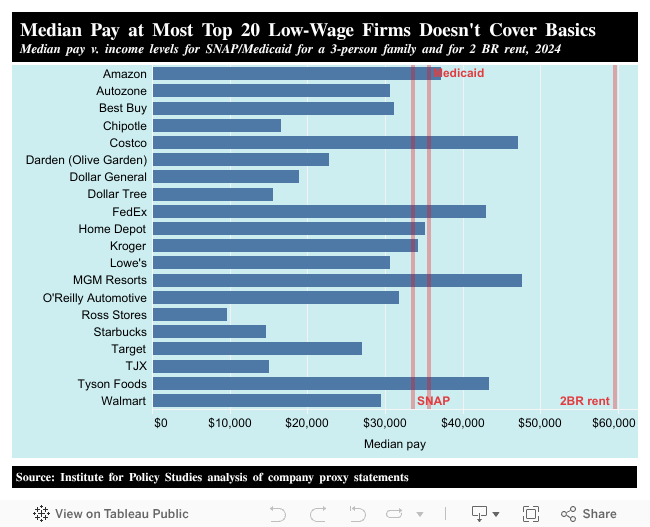
Our analysis finds that at half of these firms, median worker pay actually declined in real terms between 2019 and 2024. For the group as a whole, average median pay dropped 4.6 percent to just $29,087.
Not one single company in the Low-Wage 20 had median pay in 2024 that met the $59,600 income level needed to afford the U.S. average rent for a two-bedroom apartment.

At seven Low-Wage 20 firms, annual pay for a typical worker fell below $25,533, the average price of a used car. Without reliable transportation, workers can’t get to their jobs – not to mention grocery stores and doctors’ offices.
Poverty wages also make it extremely challenging for low-income families to afford to send their kids to college. At 16 of the Low-Wage 20 firms, the typical worker makes less in an entire year than the $44,961 average annual cost for tuition and fees at a private college. Seven of the companies have median income lower than the $25,415 average cost of out-of-state tuition and fees at public universities.
These companies’ low-wage business models have left many of their workers with no choice but to rely on public assistance.
Fifteen of the Low-Wage 20 reported median pay in 2024 below the $35,631 income limit for a family of three to be eligible for Medicaid. At 13 of the firms, median pay fell below the $33,576 family threshold for SNAP food aid.
On the opposite end of the income scale, the CEOs of Low-Wage 20 companies earned average compensation of $18.6 million in 2024. Starbucks CEO Brian Niccol landed the biggest payout, with $95.8 million in his first year on the job. Amazon CEO Andrew Jassy received only a modest $1.6 million in 2024. But thanks to previous massive multi-year pay packages, he’s sitting on Amazon stock valued at about $467 million.
To further pump up executive paychecks, Low-Wage 20 corporations have been spending vast sums on stock buybacks. This financial maneuver artificially inflates the value of CEOs’ stock-based pay while siphoning resources from worker wages and other productive investments.
With the $32.5 billion these 20 firms spent on buybacks in 2024 alone, they could’ve lifted more than a million workers making the Low-Wage 20’s average median wage up to the income level needed to afford average rent for a two-bedroom apartment.
Last year Congress passed historic cuts to public assistance programs, making it even more important that all U.S. workers earn wages high enough to cover their basic costs of living.
To combat wage suppression, policymakers at the federal and state levels should also pass reforms that expand worker rights to organize, penalize employer violations, and ban employer interference in organizing.
Policymakers hold many tools for influencing corporate pay practices. They could raise the federal minimum wage, a move that would have ripple effects throughout the hourly wage workforce.
To combat wage suppression, policymakers at the federal and state levels should also pass reforms that expand worker rights to organize, penalize employer violations, and ban employer interference in organizing. They could also deny corporate tax deductions for expenses related to union-busting activities, such as so-called “captive audience meetings” and anti-union advertising campaigns.
READ: Affordability Is a Vanishing Promise for the Middle Class
Higher tax rates on companies with huge CEO-worker pay gaps would create an incentive to both rein in executive pay and raise worker wages, while generating significant new revenue for public investments. Unions and community groups in two cities – San Francisco and Los Angeles – are mobilizing to put “Overpaid CEO Taxes” on the ballot in 2026.
These local campaigns will boost momentum behind federal bills to impose tax penalties on companies with huge pay gaps, including the Tax Excessive CEO Pay Act and the Curtailing Executive Overcompensation (CEO) Act.
Even in “normal” times, it’s unconscionable for workers at leading U.S. corporations to have to struggle just to get by while their top bosses are raking in mega-million-dollar paychecks. Today, with high costs for basic needs and the gutting of our safety net, policymakers need to crack down on poverty wage business models that benefit only those at the top.
This article was originally published at Inequality.org, a project of the Institute for Policy Studies. It is reprinted here via Creative Commons 3.0.