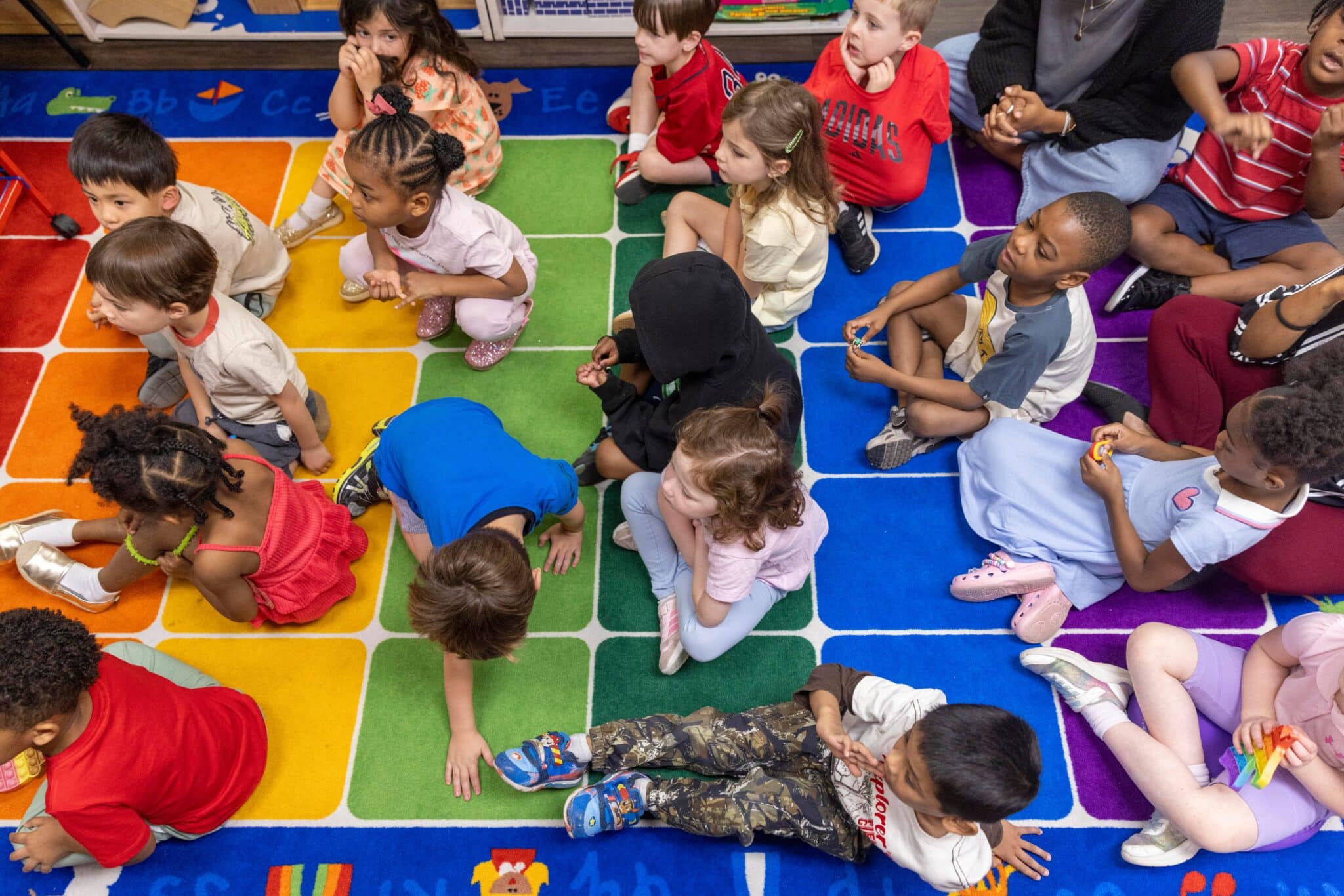
Preschools serve a vulnerable population, tiny humans who are just beginning to find their place in a larger world beyond their own home. It is a terrifying process for parents who may be for the very first time entrusting their beloved child to a non-familial adult.
A new report from the Education Law Center in Pennsylvania suggests that for many families, this time is being made even more difficult by preschools that push out students of color and students with special needs.
The report, “Ending Preschool Pushout in Pennsylvania: Parent Testimonies and a Path Forward”, includes testimony from several parents who have found themselves dealing with the issue.
“Preschool pushout,” says the report, “refers to the practice of formal and informal suspension, exclusion, expulsion, or practices that otherwise prevent” the youngest learners from getting the preschool education programs they need.
The parents
Irelyn is the mother of Xavier, whose autism manifested very early on. He loves music, is learning piano, and is teaching himself new languages — at age five.
A few years ago, when the family relocated, Irelyn sought out a new preschool situation. She met with the director and was transparent about Xavier’s needs, personality, strengths. She wanted the center “to truly see him.” In pattern repeated in many of these stories, the director told her everything would be fine. It wasn’t. Says Irelyn:
Shortly after Xavier started, I was called in and told that he was “no longer a good fit.” There were no solutions offered. No supports discussed. No conversation about what could be done differently. Despite our efforts to advocate for Xavier to remain in the program, we were told the decision was final.
Barbara is the mother of Hannah, an African-American child diagnosed with autism and ADHD. Again, she was told by the preschool that there would be no problems, but,
The school began calling us every other day to come pick Hannah up. On her first day of pre-K, less than two hours after dropping Hannah off, the school called me and told me I had to pick her up. It was so traumatizing for Hannah and for us as her parents.
Pamela is the mother of Alex, an autistic Black child who communicates with an augmentative and alternative communication (AAC) device. They toured the preschool, explaining the many supports that Alex would require, but experienced frustration when the school failed to communicate fully with the family. Says Pamela,
“Because our family is Black, I think the school communicated with me differently and did not share essential information.”
Marge is the mother of Hank, a Black child who is nonverbal and requires prompting and support to eat. He has an Individualized Education Program (IEP), but his preschool never asked for it, reviewed it, or followed it. At one point, the school suggested that he should just attend part time in the afternoons, even though Marge works full time. Hank ultimately could not stay at the school. Says Marge,
“The school’s refusal to accept free training, lack of structure, and disregard for his needs amounted to an indirect expulsion.”
The schools
Parents of preschool students are also young themselves, and may lack experience in dealing with school bureaucracies. That challenge is compounded by the lack of uniform expectations for preschool programs.
Preschool is already stretched in Pennsylvania. Three- to four-year-olds are eligible for publicly funded preschool if their families earn up to 300% of the federal poverty level (for a family of 4, that would be almost $100,000). Just over 50% of Pennsylvania students are eligible, but over 50% of those eligible students (around 78,000) do not have access to a high-quality publicly funded preK program. There are over 3,200 eligible preschool locations, according to the PreK for PA coalition. In 22 school districts, 100% of the eligible children are not served. In 6o Pennsylvania counties, between 40% and 80% of eligible children are not served (Bucks County falls in the 40% to 60% range).
Preschool teachers are paid significantly less than K-12 teachers. The 2025 State of Early Care and Education in Pennsylvania shows the state facing a serious shortage of preschool teachers. Pre-K for PA estimates that the commonwealth needs almost 8,500 more preschool teachers.
Add to this private providers who do not get public funding, and the overlap between daycare centers and actual schools, and we end up with a loose network of providers that are loosely covered by regulations that focus primarily on health and safety. It is not simply an extension of the public education system.
The question of discrimination is covered by the Pennsylvania Human Relations Act, which is clear that there may be no discrimination based on race, color, sex, creed, ancestry or disability. Federal anti-discrimination law backs that up (though the current administration has largely abandoned discrimination protections for anyone except white males). The safeguards are important; research repeatedly shows that Black students are disproportionately subject to disciplinary action in school.
There’s also the Americans with Disabilities Act. It allows parents to request “reasonable modification” and declares that preschools can’t exclude children because of a disability or disability-related behavior, unless their presence poses a direct threat to health and safety or the program would have to be fundamentally changed. ELC-PA offers a 10-page guide to the rights of preschool students, but it can still be hard to sort out how bound a preschool is depending on whether it is private, government-funded, or functioning as part of a religious organization.
Young parents can be reluctant to seem like they are questioning how the school does its business. They may be unsure of what to ask. But a school ought to be able to explain what, specifically, they will be doing to support the child’s growth. They should be able to explain what a child’s day will look like.
The pushout
It is easy enough to spot open discrimination against a student, but pushouts are often more subtle. ELC-PA pinpoints examples of soft exclusion.
Does the school ask you to keep your child home, limit school hours, or wait for support staff? Does the school provide clear explanations for that request? Does the school repeatedly call to request that you come take your child? Does the school provide opportunity for parents to discuss the unique needs and strengths of their child (some time other than when responding to a “problem”)? And does the school listen to what parents tell them about the child’s needs and how to manage them?
Most of all, does the school treat your child’s issues as a problem that they will work to solve, a problem that they want to solve by collaborating with you, or a problem that they expect you to solve on your own?
The essence of a pushout is to make dealing with the school such a bother and inconvenience that the parents will withdraw on their own.
This is not always an easy call to make.
There is always tension between the resources that parents of students with special needs would like to see the school deploy and the resources that the school is actually able to provide. Parents should always advocate for their children, but it’s also reasonable for them to accept that the school has resource limits.
The key questions are: Is the school committed to working with parents and the student to find the best realistic way to meet that child’s needs, to help the child grow and thrive, or is the school treating the child as a problem that can best be solved by getting that child to go away? Does the school offer specific, concrete explanations of what outcomes they want to see, or are parents left to decode poorly communicated concerns about vaguely described “problems”?
Many of the parents in the report reported pro-actively communicating their child’s needs and strengths to the school, and the school waved them away with vague assurances that everything would be okay. Instead, one would hope the parents’ talk would open up a discussion in which school leaders talked about what specific approaches could be put in place to help those children.
Are there solutions?
For parents, ELC-PA offers a Know Your Rights guide and a helpline for families who believe they have been subjected to a pushout.
ELC-PA also calls for decision-makers to listen to parents while coming up with solutions to prevent preschool pushout.
Legislators can also help by expanding the support provided to preschools. Greater financial resources would allow preschool providers to hire more staff, open more preschools, and provide more specialized services for students with special needs. If preschools were not so strapped for resources, they might be less inclined to feel threatened by students who need more of those resources.
The larger lesson
Preschools are able to use pushouts in part because they are not as tightly regulated. Public K-12 schools are not free to simply chase away students that provide a real or perceived challenge (while some regrettably still make the attempt, parents have a clear, legal recourse).
Preschools are an unconnected collection of private businesses that take state funding, and that results in a “system” with huge cracks through which thousands of students can fall — or be pushed. Individual preschools have no obligation to take all comers because those students can go to some other preschool, or no preschool at all.
ELC-PA’s report doesn’t even address the phenomenon we could call pre-pushout, where preschools erect enough soft barriers in order to discourage certain families from applying in the first place. How many families have been told early in the application process, “We’re not sure your child would be a good fit” or “we don’t have any programs to address your child’s special needs.” How many families have looked at a shiny brochure featuring wealthy white children and thought, “I guess not.”
It’s worth noting that the problems of student pushout is not limited to preschools. The charter schools and private schools of the school choice movement also practice discrimination through a variety of techniques, including pushout. Success Academy, a major charter school in New York City, was hit with a $2.4 million penalty in a disability discrimination case stemming from a “Got To Go” list used to target students the school wanted to push out.
Pushouts are particularly disruptive for young children who are just learning about school and finding their place in this new aspect of their world. Pennsylvania and its preschools need to do a better job of protecting our youngest learners.