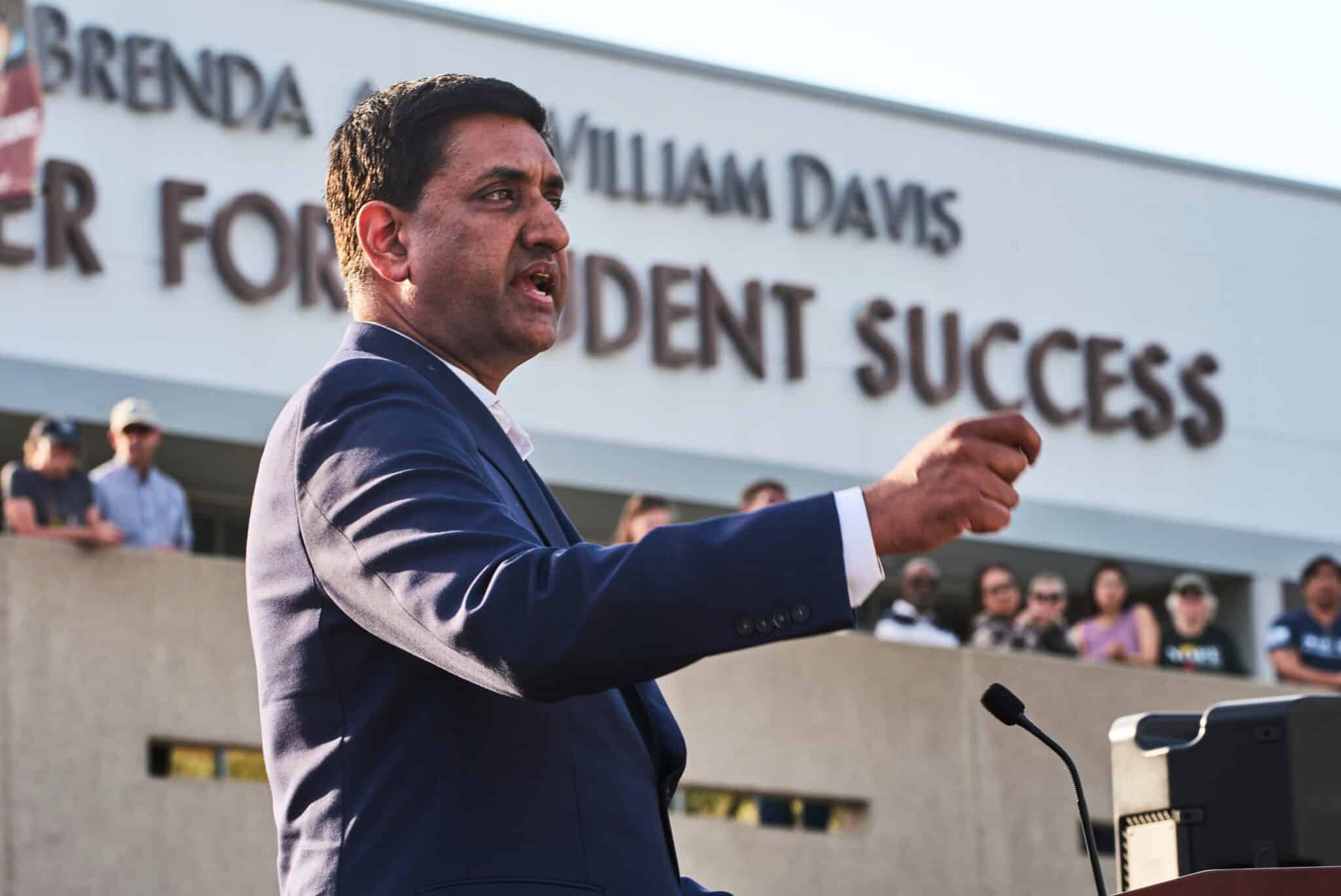
Ro Khanna is a Bucks County native who is a U.S. Representative in California’s 17th District. He is also vice chair of the Congressional Progressive Caucus.
Last month he wrote an article that I read in The Nation, “AI for the People”, which laid out his vision “for an AI revolution that works for the many not just the billionaires.”
He agreed to come on The Signal to talk about why he is an an AI-democratist, his policy vision for regulating this disruptive technology, and why we cannot allow Big Tech oligarchs to build a society where “AI ‘progress’ is defined by their wealth rather than by our democracy.”
Listen on Apple, Spotify, Podbean and iheart.
I read your article in The Nation last month, “AI for the People”, and that put forth a vision for the future in which AI works for everyone, not just billionaires. Now, that’s not going to be an easy path or easy task, but that’s not to say it isn’t achievable. But first you acknowledge that this new transformative technology will be every bit as disruptive and daunting as the industrial and digital revolutions.
What are we already seeing happening and looking forward? What do you believe might be on the horizon?
Well, it’s a technology that will allow machines to do many tasks that human beings were doing. And in some cases, this is going to allow for scale and allow for great leaps forward when it comes to curing cancer, when it comes to curing disease, when it comes to mapping the mRNA genome.
That is things that AI may allow on scale, taking all this data and making sense of it and offering new combinations for treatment. But the problem is that if it becomes a tool for eliminating jobs, if it becomes a tool for having agentic AI, which is just a machine doing things on its own … programming, basically, then it can either do danger or it can take away people’s livelihoods.
And so I have said, I’m not an AI accelerationist. I’m not an AI doomer. I’m an AI democratist. And I articulate seven principles for how we can have AI for the people.
Can you explain a little bit about what you mean by being an AI democratist?
Well, an AI democrat says, OK, we have AI. We’re not going to say, let’s not use AI. That would be like saying, let’s not use electricity. Let’s not use nuclear technology. But we need to make sure that AI is governed by all of us, some rules. And then it benefits the working and middle class. So what does that look like? Well, know, electricity is regulated by the Federal Energy Regulatory Commission, Nuclear Energy, Nuclear Regulatory Commission. Aviation by the FAA. We should have an AI regulatory agency stronger than the innovation and safety division of commerce and really have safety standards and checks and making sure that AI doesn’t engage in surveillance.
We should make sure that we’re taxing AI more than we’re taxing human beings. Right now, AI is getting taxed less than workers. You work as a firefighter, you work as a factory worker, you’re going to pay more on your W-2 in taxes than the AI is going to pay on its tokens and output. So why don’t we tax AI so that they’re paying more when employees are using it than when they’re hiring people? Why don’t we make sure that we have a work for America program? You know, I grew up in Bucks County. So you graduate from Council Rock High School, you graduate from Bucks County Community College, and you can get a job to rebuild the community, to create a new park in Bucks County, to help clean up a toxic site, to be a tutor, to be a teacher’s assistant, to help represent a community group that has an advocacy need, to help make local government more effective. Or you can come to federal government to do big moonshot projects in renewable energy or in having a framework for AI or working on the space project. And we have put to work a million people in this country around a new national mission to rebuild our communities and to rebuild our country.
That’s the type of bold thinking we need for this moment.
You had just mentioned regulations. How do you ensure that we have public regulations with teeth? I mean, are you treating AI like a public utility?
Well, we treat it like we treat electricity or we treat nuclear, or we treat aviation. I mean, all of that as teeth. Right. Every time I fly in United, even though it’s a private company, I know that there’s teeth in the regulations that I thank regulations and I’m on that plane. And I think what we need is an agency that holds these companies accountable and make sure that there are strict fines and strict legal regulations if they break it. Right now, it’s all voluntary. We can’t have a voluntary regime. It’s got to have actual penalties and enforcement mechanisms.
In the principles you spoke about, the seven principles about what a democratic AI should look like, you start appropriately focusing on people and workers. Can you walk us through a little bit about how you propose on protecting people and workers?
Well, several things. One, we have a tax code that taxes AI more than it taxes workers. So right now we tax workers more than we tax AI.
Second, we require human beings to be in the loop when it comes to key decisions. People can’t be going to jail without a human being making a decision. You can’t have a health care prescription without a human decision maker. You can’t have missile strikes without a human being deciding. You can’t have these big autonomous trucks going across the country with inclement weather and difficult cases without a human truck driver on that truck, just like we have pilots on planes. So have a human being in the loop.
Third, let’s have bargaining so that, you know, right now Coinbase laid off 14% of their workforce. But do the workers have a say? Did they get to say in what the severance would be? Did they get a say in what their new jobs could be? Did they get a say in how AI would be used? No, we need to have worker bargaining at companies and workers need to have shorter work weeks or a share the profits if there’s going to be increase in AI productivity.
Would that be a challenge because of a lack of unionization in the private sector?
It absolutely is. I wish we had unions. Of course, the Industrial Revolution gave birth to a strong labor movement. But even in the absence of unionization, we need to have worker representatives who bargain at companies. You can’t just say if they’re non-unionized workers aren’t going to have a say. So yes, unions, that’s the ideal. But short of unions, we need worker bargaining.
You wrote that it’s paramount that we quote, prevent American jobs from being sacrificed in order to enrich oligarchs. Like you had mentioned, we saw that happened in the industrial revolution. And again, more recently in this current era of globalization, which if you go back to the time when you I were graduating from Council Rock High School, which is a little farther back than I’d like to admit, we had NAFTA.
It was 1994, remind me when you’re in same year.
‘94 too. That was when NAFTA was passed.
By the way, do you remember Fairlawn Works, the steel company?
Vaguely.
It was near Bristol, and it was a hugely successful steel mill by US Steel up to the early 90s. I just remember because I knew people who worked there, and it’s totally shut down. think it was a, you know, everyone thinks of Western Pennsylvania as sort of the decline of steel or some of the parts of Eastern Pennsylvania, but Bucks had it too.
Absolutely.
And then one of the things that NAFTA did, besides marking the beginning of this new global economy, it saw massive job displacement. And one of the lessons that we learned was, unfortunately, we failed to help displaced workers whose jobs were outsourced and whose factories were offshored. We failed to find the meaningful work to afford them that same solid middle to upper middle class life that they’ve been living. And NAFTA’s attempted safety net, the Trade Adjustment Assistance Program, had giant holes in it, leaving too many workers to fall right through with hard, painful landings. How do we learn from that past and make sure that we don’t make the same mistakes again with AI?
You want to understand that even if there’s not mass unemployment, like 30% or 20% … there is going to be unemployment with targeted work groups of workers. And that’s what happened with globalization, right? I mean, it didn’t hit everyone, but it hit places like Johnstown, Pennsylvania and Farrell, Pennsylvania and Scranton. And it hit parts of Bucks County, not everyone in Bucks County, parts of Bucks County. And we just said, okay, go move or go get assistance and that wasn’t enough.
So one, we need a federal jobs program. That’s what I was talking about. Work for America. You can help actually get a federal job in the civic service, just like you get military service and come and be part of rebuilding the country.
Second, we need worker bargaining. They need to have a say in what the companies are doing so that they’re not just using AI to automate jobs, but are using AI to improve worker productivity and worker pay.
And third, we need to have an investment in the new industry. What are we going to do for drone manufacturing, for robotics manufacturing, for rare earths, critical minerals, modern steel? What are we going to do for the new tech institute so young folks can get understanding of quality control for AI or understanding how to apply AI to small business, build out trade schools, build out tech institutes to create the modern industry and modern jobs.
You also talk about data centers and that they must serve the communities that power them. We’re seeing, not just in Pennsylvania, but across the country, data center resistance growing in local communities. A lot of people are worried about the environmental impacts, the strain on the electric grid, what that might mean for them and their electric bills, as well as like a lack of transparency between companies and local and state governments because a lot of the details are cloaked in NDAs. So what’s the solution moving forward? Do we start with a moratorium for a pause? Is it greater local government control? What do you propose?
Well, I think there needs to be a new social contract with these data centers. I believe we need to start with skepticism. And the burden needs to be on the tech company to show that there’s not going to be a single dollar that goes up in electricity bills, that they’re going to pay for the electricity load, that they’re going to use dry cooling technology so you’re not going to have water use, that they’re listening to the local community so it’s not an eyesore or something that’s going to disrupt the character of a community, that they are actually contributing public computers to the local school districts, to the local employers, that they’re investing in local jobs in the community beyond the electricians or 50, 60, a hundred jobs they’ll need to maintain a data center. So I think the problem right now is it’s all data centers extraction to these big tech companies as opposed to a partnership where the local community feels consulted and seen, and sees the benefits.
Everything you’re saying makes complete sense to me, but I’m going to assume there’s going to be pushback. So what if appealing to the better angels of these tech oligarchs doesn’t cut it? What then given their massive money, power and influence? How do we combat that?
Well, we need to tax them, I’ve called for a billionaire tax and we should be taxing AI tokens … A token is just the words that it generates and that’s how they bill and that should be taxed to build a jobs program for all Americans. We need to have safety regulations and we need to have regulations on data centers, statewide regulations. OK, you want to build a data center, you can stick the residents with a bill on electricity. You can’t have a water use that takes from the community. You need to have this much public compute. You need to make sure that you’re hiring locally in these many jobs. You need to have this kind of venture capital investment in the community. And if not, then maybe we do need a moratorium at that point if we’ve exhausted and they’re not complying. But my hope is that we can get this working for everyone. I think a lot about the kids I grew up in on Amsterdam Avenue in Bucks County. And we had a plumber’s kids on the street, doctors kids, and a vice president’s kids and nurses kids and it was a mixed income neighborhood, an economically diverse neighborhood. And what would be their future and how do we create good jobs in communities like that across this country?
Have you given any thought to the idea of employing a sort of strategic nationalization similar to what the Pentagon does, but rather than have the, I guess what we’re calling the Department of War now control the industry, there would be like a governing board of representatives from the Department of Labor, Energy, Education, EPA, and maybe stakeholders from civil society?
Well, look, it gives me a little bit of nervousness to have just the federal government controlling all of that just in case you have Donald Trump controlling all of it. So I prefer there being some freedom and competition and free enterprise, but then strict guardrails and a role for a jobs program rather than, you know, this is controlled completely by the federal government.
On Thursday, you toured local factories in Pittsburgh to talk about your New Economic Patriotism agenda. While I’m sure we touched on some of it in this conversation already, can you explain or provide any more details about what that’s about?
New economic patriotism means we need to make the economic renewal of every part of America our highest mission, the economic independence and economic success of every family in this country our North Star. And I have a few concrete proposals for that. One is an industrial investment bank that would invest in critical technology and industries across this country. Invest in modern steel, invest in drones, invest in interceptors, invest in robotics.
Second, a thousand new trade schools and a thousand new tech institutes across America to prepare for the jobs of the future.
Third, a massive investment in the childcare and elder care and home care economy, which are going to be good paying, high paying important jobs to build community. I have a number of these principles, which I believe we should have a Marshall Plan for America. Let me tell you, what do you think would move the needle in Bucks County for kids who are graduating out of Bucks County Community College or Council Rock or folks we grew up with what what type of jobs or initiatives you think would move the needle there
Well, you had already mentioned tech schools and investing in that. But also, I think the price of higher education is just ridiculous right now. I think there needs to be a national program to make colleges and universities more affordable, maybe doing some kind of apprenticeship programs and incorporating that. So I think those are a couple of places…
I agree. I’m for free college, free community college. know, modern economy, health care and education are the two most important things to have a productive society.
First, I appreciate that you are thinking big and bold and like transformative with your ideas and your policy proposals, because I think a lot of voters are frustrated with the lack of political imagination with some in the leadership and how they’ve just kind of like tied themselves to at best, kind of promoting this like incrementalism for change. I think people want bigger, bolder ideas, aspiring to something, even if we’re not sure we’re gonna exactly reach what initially, you know, the path that was initially charted out.
It’s a time to reach for the stars.
Exactly. So I appreciate that, you know, you’re really leading the charge on that.
Is there any AI related legislation currently in the House that people should be contacting their congressmen about?
You know, there are, but Republicans aren’t going to go for it. mean, the blunt reality is Trump has basically been an accelerationist. He says, give the tech companies what they want. So first we got to win back the House. We got to win back the Senate. And we need a new approach before we get real legislation.
And is there anything else that you wanted to bring up that we didn’t touch on in regards to your manifesto for a democratic AI future?
I would just say that the North Star has to be, how does this help working class folks, middle class folks, what is it doing for them?
So obviously we want to help cure disease. Obviously we want to make education more accessible. But what are we doing in terms of creating good jobs? What are we doing in terms of making sure electricity bills aren’t going up? What are we making sure doing to make sure the community’s character isn’t changed? And we want to have a technology and AI that works for people. Americans aren’t Luddites. We’re not people who reject technology, but we need a bold, imaginative vision for this nation. We’ve kind of been stuck in anger and incrementalism, and we’re ready to be inspired.
I do wonder though, if we might see some kind of Luddite style blowback, if an agenda like yours isn’t passed through Congress and pushed. I don’t think that’s beyond the question.
Sure. Yeah, mean, it’s scary. mean, in terms of some of the things, Molotov cocktails in front of Sam Altman’s house and possible violence and real anger, the construction of data centers, which I don’t think is just about the community. It’s about the sense that automation and technology is taking control in ways that we’ve lost control. So I believe that if we just give the AI revolution to the tech billionaires, well, we’re going to have political unrest in this country. But that’s why I’ve got Midwestern values, like you, and I’ve seen the future in Silicon Valley, but I wanted to work for the folks I grew up with in Pennsylvania. And that to me is where the AI for the people comes from.
And finally, just a real simple question. Can you recommend a book about AI that you’ve read recently or that you think people might want to pick up?
There’s so many, but Daron Acemoglu has written a lot on it. He’s a Nobel laureate at MIT and any of his books on excessive automation, on how do we preserve democracy with some sense of economic equality in a digital age, all excellent works.
Well, Rep. Khanna, thank you so much for coming on the podcast. I really appreciate the work that you’re doing for the country and I hope you’ll come back again.
Cyril, really a pleasure.