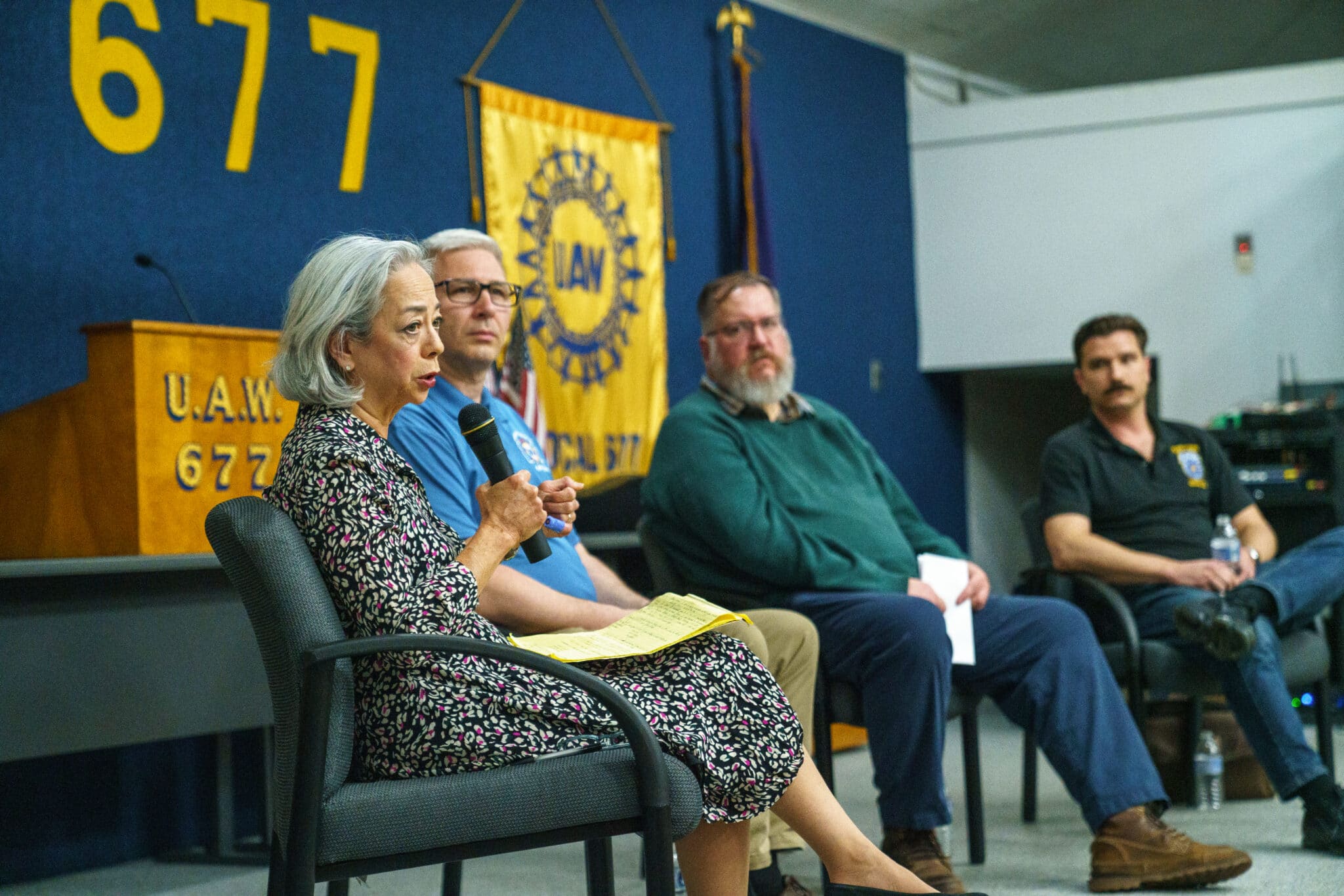
Entering the United Autoworkers Labor Hall in Allentown felt like stepping back in time. The wood panelling on the walls, and the enormous bull horns hanging over the stage, were relics of an earlier time when organized labor was a more powerful political force in the United States. Surrounded by the ghosts of labor’s past, more than a dozen union members and Lehigh Valley residents attended a “A Town Hall on Trade and Tariffs” on Thursday evening. The gathering was organized by consumer advocacy organization Public Citizen as a part of its “Building a Fair Economy for All” five-state tour.
The speakers included Mike Shupp, a Mack Truck worker and President of the United Auto Workers Local 677, Thea Lee, Labor Economist at American University, Dustin Gustella, a leader with Teamsters Local 623 and Arthur Stamoulis, Director of Citizen Trade Campaign.
With UAW banners and American flags as the backdrop, Stamoulis set the stage for what was at stake. “For over thirty years now, we have seen trade deals rigged in the interest of billionaire CEOs and big corporations against working families.” He went on to highlight that “here in Allentown and communities across the country, corporations have used these trade deals to ship literally millions of good paying jobs to other countries so that they can take advantage of ongoing labor rights abuses, weak pollution controls, and poverty wages.”
This process of moving production to other countries is often referred to as “offshoring” and Stamoulis was not exaggerating about the devastating impacts of Free Trade Agreements on jobs in the United States, particularly in manufacturing. According to a 2016 US Bureau of Labor study, a staggering 4.5 million manufacturing jobs were lost in the United States as a direct result of the North American Free Trade Agreement (NAFTA), which was signed by President Clinton in 1993 and was implemented the following year.
This criticism of trade policy from the perspective of American workers is nothing new. Lee, who spent her career working on international trade and labor rights at the AFL-CIO and the Department of Labor, explained that “elite Democratic and Republican politicians … took the side of the corporations and the billionaires … they designed trade policy to weaken the bargaining power of organized labor.” And while she accused President Trump, who she called “the outsourcing billionaire” of “weaponizing the failure of both parties” leading up to his 2016 Presidential election and advancing a tariff policy that is a “chaotic, corrupt mess,” she insisted that “it doesn’t have to be that way.”
So, after decades of fallout from trade policy, how could it be different? The panelists had multiple ideas.
Teamster leader Dustin Gustella argued that the era of free trade must fully come to an end and that “we’ve got to talk to progressives as well and tell them, look, we need fair trade, that involves some tariffs, it involves some protectionism, and some industrial policy.”
Fundamental to this vision is what Stamoulis called “equal pay for equal work.” As opposed to pitting U.S. workers against Mexican workers, something often portrayed in the “stealing our jobs” discourse, all of the speakers acknowledged that US labor must find mechanisms to raise the wages of Mexican workers and improve labor protections so that companies aren’t incentivized by moving jobs there.
While acknowledging the insufficiency of the United States Mexico Canada Agreement (the name for Trump’s renegotiated NAFTA deal), panelists pointed to specific mechanisms that use trade policy to uphold international labor standards as opposed to undermining it. Gustella called USMCA the first “worker-forward trade deal.” Specifically, Lee explained how the “rapid response” clause of the 2020 agreement created tangible economic sanctions for corporations if workers are denied their rights for freedom of association and collective bargaining. USCMA has a dispute settlement mechanism to ensure that a specific production facility can quickly lose their tariff advantages in the face of labor abuses. After three strikes, the whole corporation’s operations in Mexico face economic repercussions on their exports, something that Lee said was already enforced against a General Motors Corporation plant in Mexico.
READ: These 20 Corporations Are Major Culprits in the Affordability Crisis
Lee noted that the policy in place doesn’t go far enough and that it is asymmetrical because these enforcements are currently only applied to Mexico, and not the United States and Canada. Nonetheless, the rapid response dispute settlement system along with the fact that a different provision sets a minimum wage demonstrates that trade deals have the potential to enshrine labor protections, not simply undermine them. Currently USMCA mandates that half of the value of the production of goods must take place where workers are paid minimum wage of $16/hour. Recognizing how inflation and loopholes undermine the effectiveness of this clause, Gustalla explained how trade policy has the potential to raise wage standards, not just domestically but internationally as well. Organized labor and civil society organizations will push for expanding these provisions as the USMCA comes up for renegotiation in July of this year.
On the very same day the panel was held, Rosa DeLauro (D-CT) introduced a new trade policy called the Fair Trade for Working Families Resolution, and while this outlines a progressive agenda on trade policy, Gustella and Lee emphasized the importance of industrial policy, as not only an ancillary to trade policy, but as the centerpiece for a buoying U.S. manufacturing jobs and hence growing a stronger unionized labor force. Thinking through a comprehensive industrial policy requires what Gustella called “a paradigm shift” away from a consumerist mindset and towards a “productivist model.” Lee noted that “consumers without good jobs don’t keep consuming.”
The panelists provided a wide range of examples for what an industrial policy in the United States could look like. These included government investment in building a whole new fleet of school buses, potentially electrified. Or, drawing from models utilized during WWII, building public factories contracted to private firms willing to produce goods that meet social or national needs. Or, in line with common practices in many other countries, supporting extensive government investment in key industries like steel, aircraft production, and semi-conductors with oversight to ensure that these are produced through good union jobs. The labor economist Lee also suggested that procurement policies – when the government uses its purchasing power through obtaining needed supplies – are also a place where the United States could leverage its power to ensure higher labor and environmental standards.
READ: The Only Winners in This Trade War Will Be Trump and His Fellow Billionaires
Mack Truck worker Mike Shupp, now President of the UAW Local 677, brought these large global policy questions right back to the local reality in Pennsylvania. He explained that Mack Truck had previously employed 8,000 workers in the Lehigh Valley but that this had fallen to 2,500 and that “every job that we lose at Mack Trucks affects seven other community related jobs.” While not everyone sees the connections, he emphasized that “unfair trade and tariffs … are currently affecting our workers, our jobs, and our future.”
While one attendee was skeptical about allying with the Democrats to bring about small incremental policy changes (noting that the capitalist system is the root of the problem), others found the discussion to be useful precisely because of the concrete solutions presented. An organizer with the Democratic Socialists of America, Leo Atkinson, of Bethlehem, PA, noted that despite the fact that these topics connect to Trump’s MAGA talking points, and the Democrats’ emphasis on the “affordability crisis,” he emphasized that “these are conversations you don’t hear in mainstream media and in most parts of society right now.” He explained that, as organizers, “we need to give people ideas and hope that things could be better, and those things need to be grounded in reality.”
While the crowd was small, attendees left with a bigger vision of a progressive agenda on trade, tariffs, and industrial policy.
“We need a lot more people in these kinds of rooms,” said Atkinson. “We need to expand the tent, we need to make this conversation more mainstream, we need to make it louder, and we need to make our leaders accountable to us, regular working people.”