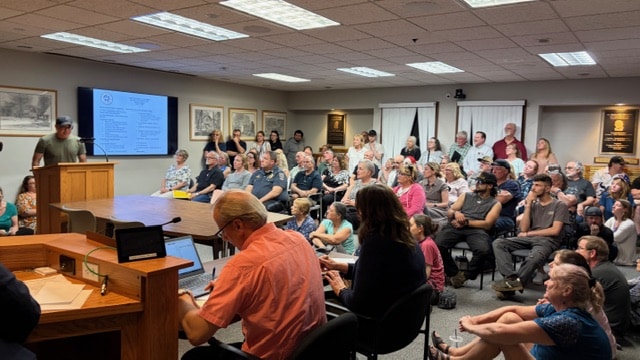
Civic engagement was on full display in West Rockhill Township on April 15 when about 150 local citizens arrived at the township building and packed into and spilled out of a room that usually seats about 40 people comfortably. No, this wasn’t a Tax Day revolt. It was a public hearing on a proposed zoning ordinance to address the spectre of a potential future data center.
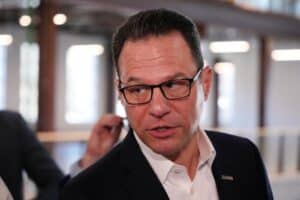
Despite the sprawling footprint of data centers and the burden they put on natural resources and the electric grid, the race for computing power has generated a wave of AI hyperscaler projects across the nation, unnerving zoning commissions and county councils. According to Data Center Proposal Tracker, there are 67 total preliminary, proposed and expanding existing sites in Pennsylvania alone. Governor Josh Shapiro is trying to streamline the process using incentives such as his Fast Track business-friendly permitting process. One of two Amazon data centers in the incentive program will span 250 acres in Lower Bucks’ Falls Township.
The hearing Wednesday in West Rockhill was actually a proactive move on the township’s part to adopt a protective ordinance and to invite the public to be part of the process. Before the 7 p.m. meeting even began, residents stood in front of the township sign next to the road holding “No Data Center” signs. Lucia Simonelli was one of them. The democratic candidate running for Congress in PA-01 defines data centers, her opposition to them being a campaign issue, as corporate greed disguised as innovation.
Later, inside, between the tax collector’s report and the solicitor’s report, Board Chairman Jay Keyser, seeming somewhat bewildered by the enthusiastic turnout, emphasized the purpose of the hearing.
“Anyone that came here thinking we approved a data center, that is not what this hearing is about. [It] is to talk about and adopt an ordinance to protect the township from data centers that do come in or do apply. I just want to make clear everyone understands that, because there seems to be a whole lot of people here for a normal adopting-of-an-ordinance,” Keyser said, gesturing to the overflow of folks on the floor and against the walls.
READ: Bucks County Is the Newest Frontier in the Data Center Boom. Buyer Beware
Sitting with the chairman on the dais were Township Manager Greg Lippincott, Vice-Chairman Hal Schirmer, Supervisor Dave Weiss and Township Solicitor David A. Keightly, Jr. who called the hearing to order and attempted to put to rest any suspicions that a developer had submitted an application for a data center in West Rockhill.
“So there’s nothing going on at 215 Cathill Road or anywhere in the township as far as data centers go,” Keightly said. “This hearing is your chance to let the board of supervisors know what you think about the proposed ordinance.”
The solicitor listed the various courses of action: decline to adopt the ordinance in any form; adopt the ordinance as it currently exists which can then be amended at any time; make a direct change to the current version before adopting it, requiring another hearing until which nothing would go into effect. Before turning the floor over to the public, Keightly summarized recommendations made by the township and county planning commissions and acknowledged the board had received various emails from the public concerning environmental impacts, utility prices, noise levels, and air and water pollution.
Nineteen local residents took their turn at the podium. Whatever their specific concerns, everyone agreed that some form of protection needed to be put in place.
Michael Brodeur, who lives on Cathill Road, read from a long list of recommendations to better protect the township, citing specific sections of the seven-page ordinance. He had questions about height restrictions, power line noise generation as well as construction hours. “You allow construction between seven to six on weekdays but then nine to eight on Saturdays. I’m sorry, I’m a local resident. Why until eight? I mean, I’m home.”
Telford resident Scott Reigle has recycled end-of-life electronics for 12 years and had to laugh at the fact he used AI to do his research on AI data centers.
He shared his findings that reflected staggering figures of water and electricity usage, wondering if it will be all for nothing as there are so many unknowns. “The best thing about West Rockhill is the community and the country and it’s beautiful out here. I don’t know how we end up with one of these, because there’s light pollution, air pollution and things we don’t know. So please consider those when writing the ordinances.”
Michelle Schetter of Sellersville expressed a range of concerns from the cost of new power lines to the impact of thermal changes in surface waters. “I’m sure the board considered these things, but I think that we really need to carefully consider the potential for one of these facilities coming in here and impacting not only the environment, but the community and, well, I just see the number of people out there (pointing out toward the front entrance). But if there’s any way we could maybe even make it so difficult, in our ordinance that we’re proposing, they can’t actually build one.”
“Across the country, data centers are being built in a shroud of secrecy. Nondisclosure agreements are effectively gagging local officials.” – Lawyer Ashley Adams, Sellersville
As a lawyer, Ashley Adams made strong arguments for amending the proposed draft as written. Many of her comments reflected what was missing from the ordinance especially when it came to water.
“This does not mention anything about wells, and how many people are on well water? I know my entire neighborhood is,” the Sellersville resident said. “The development and construction of data centers has been irrefutably linked to increased sediment, cloudy water, and murky brown residue in residential wells in communities near data centers. So, what do we do about that?”
Adams then asked the board to consider putting something in the ordinance about NDAs. “Across the country, data centers are being built in a shroud of secrecy. Nondisclosure agreements are effectively gagging local officials.”
She posed questions about easements on property for electric use before told the board “in drafting these, don’t let us fall the way of fracking towns because that’s where this is going. We moved to West Rockhill—we’re lower county kids, we’re Levittowners—we’re not used to all this open air. We love it.” Considering the ordinance as a whole, she said, “I think this needs to go the extra mile and we absolutely can make it so that this is not hospitable for them to move into.”
Local resident Hiram Rivera began his two and half minute allotted time sharing his personal reasons for choosing to live in West Rockhill. “I just celebrated 23 years with the Philadelphia Police Department, okay? Two years as a firearms instructor. We deal with a lot of stress. When I looked for another place to live, six years ago, I looked outside of the city of Philadelphia…this was the best choice,” he said. In reaction to multiple warehouses popping up within ten miles of his house he said, “Everything that makes West Rockhill is slowly disappearing. And I’m not against development, we just need to do it right. It’s important we continue to stand together just like we are today and then to unify because this is not gonna be the only issue, right?”
Callie Parker from Telford voiced her concern about how data centers create noise in lower frequencies and larger wavelengths. “It can bend around noise barriers; it can be transmitted over much larger distances.” Parker also spoke of the importance of accurate measurements. “You said you would use an acoustic engineer who’s qualified, but it doesn’t matter how qualified he is if we force him to use the wrong tools to measure it.”
Jane Cramer of Sellersville mentioned that Dublin Borough is looking at the same issue. She said she had a copy of what they were considering and was happy to share it with anyone in the community. “We’re all connected and can impact all of this. So I encourage you to talk with folks in other townships and boroughs.”
Other comments made during the public hearing:
- “My main concern is about the sound.”
- “Where does 200 to 300,000 gallons (of water) go daily to get treated?”
- “I don’t understand a lot of it, but what I do understand is, after 55 years in the fire company, we are being pressed to unimaginable limits.”
- “Since we all live here, we want to see our children grow up here in a safe environment.”
The Bucks County Beacon reached out to experts at Food and Water Watch and to the Conservation Voters of Pennsylvania (CVPA) for their views of West Rockville’s proposed ordinance.
READ: Big Tech’s Fast-Expanding Plans for Data Centers Are Running Into Stiff Community Opposition
Megan McDonough, PA Director of Food and Water Watch, stated it could use some work, starting with the setbacks.
“I mean, 150 feet, in the data center universe? We’re talking land developments the size of small cities. One point that’s good is that they are restricting it to an industrial zone. County planning agencies really prefer conditional use, there’s a lot more power there with municipal boards than there are zoning hearing boards with special exception, but at least they have a public process.”
Katie Blume, CVPA’s Political and Legislative Director, thought the ordinance seemed reasonable.
“There are some good components. The ability for a municipality to outright ban something isn’t there. But with the ordinance, as I read it, it’s very similar to a model ordinance that was put out by PennFuture. We have different partners organizations in this space and everybody is taking their lane. Our lane is ‘Let’s make sure we can get as many guardrails on these things as possible’ while we have other partners who are doing things like advocating for moratoriums. Every little bit helps to deal with the speed at which all of this is happening.”
Toward the end of the hearing, Lauren Geitz, a lifelong resident of the area, expressed her concern that a weak policy “will destroy the lives of the people that live here.”
“I am encouraging and asking the West Rockhill Township supervisors to adopt an at least six month or one year moratorium on data centers to pause the development while you establish proper ordinances,” she added.
To reiterate the fact that to do nothing now would put the township at risk, Chairman Keyser said, “Me, personally, I don’t think that we can take the chance of not having something in place, to leave ourselves open. If somebody were to bring a plan in place before we had something adopted, all of you folks are gonna be as upset as I would be,” he said, adding that amendments can be made “and we can incorporate everybody’s comments and concerns in amendments. But, to do nothing, I think, is wrong.”
Joanne Natale, a Sellersville resident, favored adopting a moratorium over the ordinance as advertised. “I like the idea of a moratorium. I understand what you’re saying about it—it can’t happen tonight and something should happen tonight,” she said. “I think the moratorium could buy us time to do it right and thoroughly. There’s a lot of things that were brought up today, let’s do it right.”
Finally, Supervisor Weiss made a motion to approve Ordinance 256 as-is and “to direct our township solicitor to immediately begin preparing an amendment for this ordinance including all of the addition public comments and requests made a the previous planning commission and board of supervisors meetings as well as in tonight’s hearing to be included in a new version of this ordinance to be introduced in next month’s Board of Supervisors meeting.” The chairman added, “any concerns or comments that come in electronically to the staff or the manager are to be incorporated by the solicitor into the amendments.”
“I am encouraging and asking the West Rockhill Township supervisors to adopt an at least six month or one year moratorium on data centers to pause the development while you establish proper ordinances.” – Local Resident Lauren Geitz
The next day, Geitz reflected on the meeting in an email. “Last night showed that public input matters, and I encourage everyone to stay engaged and continue making their voices heard. It was refreshing to see the supervisors receptive to feedback and willing to hear concerns from residents and non-residents alike, in addition to productive and respectful conversations on all sides.” Doubling down on her vote to adopt a moratorium, she stated, “A temporary moratorium would provide the time needed to put stronger protections in place and ensure that any future data centers are held to the highest standards possible.”
The proposed amendments will be introduced at the next Board of Supervisors meeting on May 20 at the West Rockhill Township building located at 1028 Ridge Road, Sellersville.
To engage in the fight against data center development call your Pennsylvania state senators and representatives and demand they enact legislation that favor communities over AI hyperscalers.
To find out more about urging your state senator to pass the Data Center Act (HB 1834), visit PennFuture.org.
To read more about why Data Centers must be stopped, visit Food & Water Watch.