As this primary campaign season has progressed, we’ve often heard that “we all want the same thing, we just might not agree on how to get there.” There’s a reflexive de-emphasis on policy distinctions and discourse over how to get there. But I would argue that articulating how we will govern matters, and while it may be uncomfortable, it’s important to make space to disagree.
After all, democracy is about creating structures to coexist with disagreement, not to mute it. We are complex; we don’t exist on a one-dimensional political spectrum. In fact, we see party allegiance fraying, as a growing number of people become Independents and discover that issues are not so much Left vs Right as the 99% at the bottom vs. the 1% at the very top.
To halt and repair the degradation of our democracy and civil rights, we will need to tap into the unity of being on the same side of an imbalanced power structure. But let me be clear – unity of purpose does not mean complete agreement, or more to the point, the absence of disagreement.
For Republican elected officials, defying Trump’s whims is forbidden. The few who do push back are retired, fired, or primaried. I believe the Democratic Party is still democratic and open to dissenters. But I am disappointed in the persistent avoidance of debate and the passive acceptance of vague policy platforms that focus on what consultants deem impossible, rather than what we can make possible by standing together.
I suppose I understand the strategy of ambiguity; it makes voting for candidates easier when you don’t know precisely what they stand for – or against. But that’s what is problematic with Representative Fitzpatrick: we’re not sure what he believes, and we can’t count on him to govern on the side of working people.
We don’t need more of the same. The working class has been abandoned by the political establishment. Rebuilding trust in our democratic process means allowing voters to hear where candidates stand on issues before Election Day, not just after. We need more than anecdotes and platitudes. We deserve specificity on solving the growing crises of affordability, authoritarianism, disenfranchisement, income inequality, and climate change. We deserve clarity on each candidate’s vision for legislative priorities. It’s not just about our team winning; it’s about what we will do when we hold power. How we get there matters.
Here’s how I believe we can get there.
I believe health care, much like our current system of K-12 public education, should be accessible to everyone, regardless of employment or socioeconomic status. Medicare for All is a policy truly made for everyone. Do I expect Medicare for All to be possible in the next two years? No, of course not. That’s why I support federal legislation to facilitate the creation of universal health care on the state level, for states that choose it. This makes sense as a stepping stone. Our country is large, opinions vary, and our health care system is built on localized networks. Political buy-in can be built state by state. We can learn what works and what doesn’t, and pave the way to a future in which no one has to pay a monthly premium, suffer denial of coverage, or lose their life savings to medical debt.
I believe in the promise of emerging technologies like AI, but those who profit should not unduly influence those who regulate. I advocate for a moratorium on AI data center expansion so we can equitably equip all communities with the information and tools needed to keep utility bills low, create safeguards for AI, prevent job loss, protect the environment, bring clean energy online, and upgrade and modernize the grid. I also understand that adding large loads to the grid is not inherently bad – in fact, it could be good. We are positioned to solve this problem, but not without better investment in and utilization of our infrastructure first.
I believe in peace and diplomacy, and that our nation’s strength lies in directing more resources to Veterans and USAID rather than to the unaudited Pentagon. I believe in respecting and adhering to international law, and because of this, there is no place for unconditional support to any foreign government. I believe that we must speak about immigration in terms of solidarity and hope, and that ICE, built on a rotten foundation of fearing and dehumanizing our neighbors, must be abolished.
READ: Lucia Simonelli Wants PA-01 Democrats to Vote Their Hopes, Not Their Fears
And I believe that climate change should be kept front and center, no matter how much dark money doesn’t want us to talk about it because it is a humanitarian and affordability crisis that touches us all.
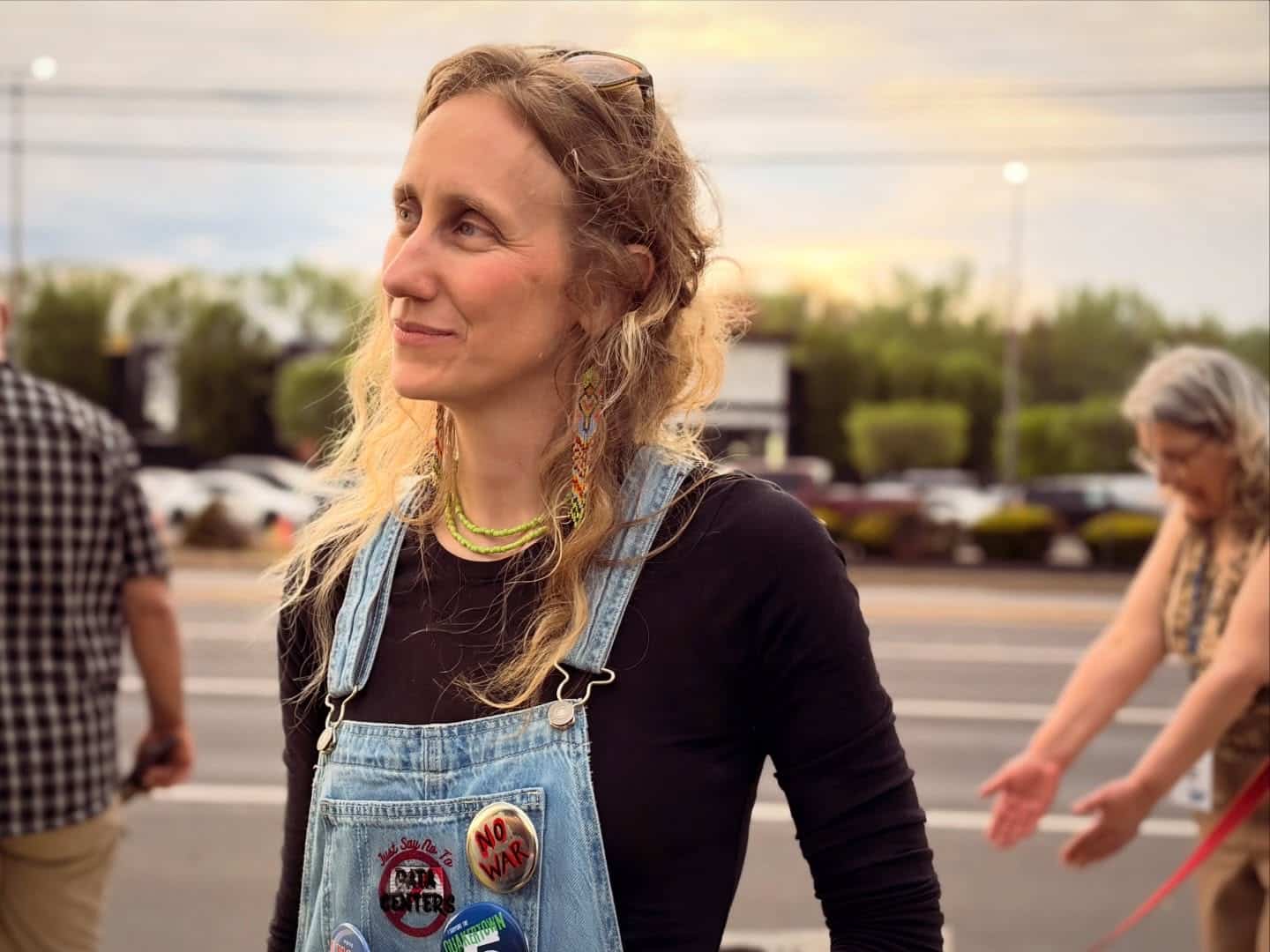
I was raised in a working-class family that lived paycheck to paycheck, sometimes without health insurance. I had the gift of supportive and hardworking parents and the privilege of access to public services, including education. Because of this, I was able to earn a PhD in mathematics. I’ve taught mathematics around the world, and I’ve worked on federal climate policy for the past seven years, including for a time as a science advisor in Congress. My experiences qualify me for this Office. But there is no canonical way of being qualified, just as there is no canonical way of earning your right or “turn” to be a candidate. There is also no ‘right’ way to be a Democrat, although I’ve been dismissed as an “outsider” by some local party members (even overtly through an aggressively exclusive sample ballot).
But if being an outsider means being more connected to our community than the political elite, if it means thinking critically and independently about policymaking, if it means being willing to stand up for the working class or marginalized groups even when it’s deemed unstrategic by the political establishment, and if it means not needing to be insulated from the discomfort of disagreement or tough questions – then it’s time for an outsider.
The status quo of unfettered greed and corruption, and the lack of political courage in our elected leaders, has worked for the billionaires at the top. But it isn’t working for us. In this unprecedented moment, we need something fundamentally different. I’m your outsider – your “unendorsed candidate” – and I am ready to fight alongside this community to bring good change and build a better future.