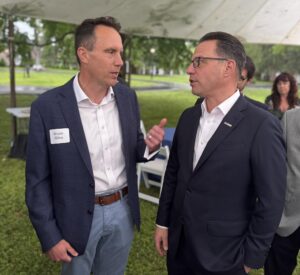
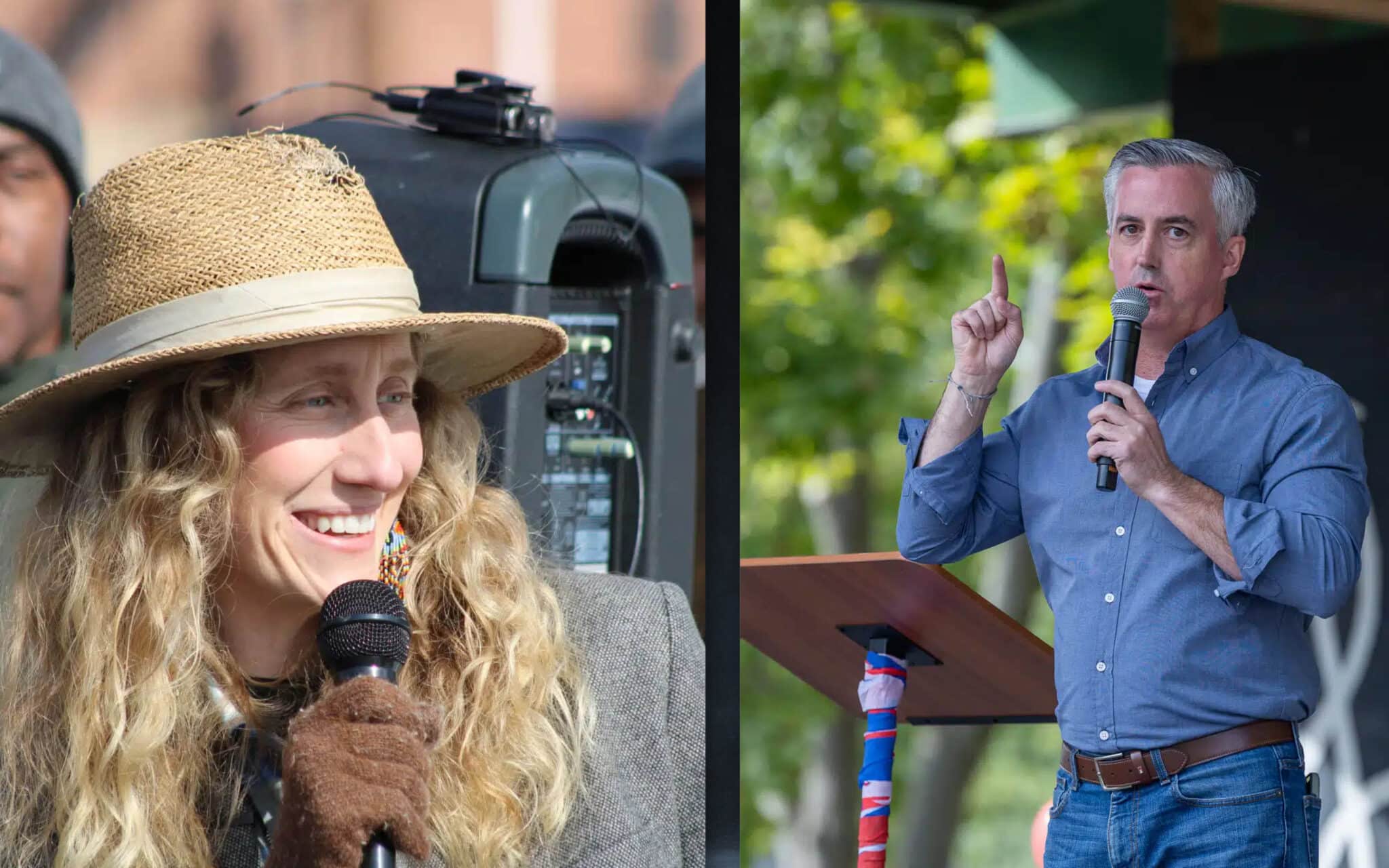
I could barely find a seat at the League of Women Voters – Bucks County’s PA-01 Democratic congressional primary candidate forum Monday at the Middletown Township Municipal building. I couldn’t find a spot to stand either, so I ended up having to sit on the floor in front of the stage to enjoy the discussion between candidates Bob Harvie and Lucia Simonelli.
And the room wasn’t just packed, it was buzzing with anticipation.
Like other attendees, I was excited for the opportunity to see the two candidates at the same event. “I think an open primary brings a lot of diversity of thought, and energizes and engages the public like tonight,” said audience member Lisa Gladden Keyes, who hails from Solebury. I agreed with Gladden Keyes, as well as others I spoke to, who all enthusiastically agreed we needed more chances to hear from both candidates. One Harvie supporter also questioned why he hadn’t taken part in other debates/forums. I wonder the same, though I actually have my own theories as to why.
Put side by side, Harvie and Simonelli’s varied strengths were on full display. I found that their approaches to opening, answering questions, and closing really reflected their visions and approach to politics and campaigning. Harvie leaned on his record throughout the evening, offering examples of how he had historically handled hot-topic issues in the county as township supervisor and county commissioner. He mentioned Trump and Fitzpatrick consistently, and focused on his differences from Fitzpatrick.
Simonelli’s progressive ideals and clear plans for the future were the main subject of nearly all of her answers. She brought up her government and policy experience, discussing her work in policy research and advising, but did not focus her responses on her background. Audience member Carol Adams described their different approaches, prefacing that she “thought they both did a fabulous job.”
“I felt that Bob spoke from a local position, and I felt that Lucia spoke from a more federal-minded [one],” she added. “Her responses I felt were broader, and deeper. I lean more toward Lucia. I feel she was thoughtful about what needs to be done.”
This isn’t to say Simonelli’s responses lacked specificity.
Simonelli, as well as Harvie, referenced plenty of specific policies and issues. Both discussed existing policy and its impact on the issues, and both spoke about policy they’d support going forward. However, when it came to the discussion of future policy goals, I’d say that Simonelli won that category. Harvie primarily spoke about policy rollbacks (pushed by Fitzpatrick and Trump, as he reminded us), where Simonelli pointed out systemic issues and forward thinking policies moving beyond the status quo.
Something that stood out to me throughout the event was Simonelli’s willingness to name progressive issues and goals in a way that revealed exactly what Harvie wasn’t saying. Health care was perhaps the biggest example of this pattern. (Simonelli supports universal health care, and Harvie does not.) Harvie primarily reiterated the issue addressed in the question, referencing small businesses and local examples of the current state of health care. Alone, his answer seemed sufficiently progressive and impactful.
“We need to allow the federal government and other insurers to negotiate prices. We need to make sure that we’re prioritizing people over profits. […] I believe that health care is a human right.”
Good enough, right?
He talks about the values the audience cares like health care being a right while slipping in details that evidence his opposition to universal health care — details that may go over the head of those who don’t know his stance. He talks around the issue.
“You know, universal health care would be great. I think most people would agree with that. Is Bob Harvie for universal health care? I don’t even know.” – Edie Sadek
This strategy would be successful if not for Simonelli’s clear response:
“The vision I see for health care in this country is universalized health care.” Immediately, the gaps in Harvie’s answer become more stark.
Simonelli poked more holes here, too.
“We need more than just extending ACA subsidies because that’s exactly what Representative Fitzpatrick also stands for. We need something more ambitious because that just creates another problem for three years from now.”
Though health care is perhaps the policy issue where they differ the most, the two candidates are, in fact, quite different. At the level of a Democratic primary, those differences matter. Maybe that’s why Harvie hasn’t shown up to more debates. It’s not a malevolent choice, but a strategic one: Harvie’s campaign benefits from isolation of his messaging. He is a smart democratic politician with a convincing tone, who without the presence of challengers, could convince a democratic primary voter that he is progressive enough, or not too progressive.
In the parking lot after the event, I spoke to Harvie supporter and Lower Makefield Committee Member Edie Sadek, who didn’t see much of a difference between the candidates. “I don’t think that they would do that much different things. She’s probably a little bit more leftist.” I responded that they probably differed the most regarding health care.
Sadek replied, “You know, universal health care would be great. I think most people would agree with that. Is Bob Harvie for universal health care? I don’t even know.”
Harvie himself walked over during our conversation. I’m unsure if he heard the question about universal health care, but he joined in as Sadek said, “I mean, I would say that you guys agreed on quite a few…”, with Harvie replying, “Yeah there’s not a lot of…” – as both trailed off. But what was unsaid seemed clear to me. Sadek assumed that Harvie and Simonelli agreed on quite a few issues, and Harvie agreed and went further, claiming there wasn’t much … something, likely difference.
I’d disagree.
The differences between Harvie and Simonelli are significant enough to have clear implications for their policy preferences and their approach to major issues. When put side by side with Simonelli, the shortcomings, or lack of clarity of some of Harvie’s stances, become evident. Perhaps that’s why the lack of debates and forums this primary season.
READ: Progressive Economic Populism Can Help Democrats Win Elections
Simonelli’s pointed responses also made it more obvious when Harvie didn’t quite answer the question. I spoke to Doylestown’s Lolly Hopwood, an audience member and Simonelli supporter who was “a little bit frustrated with Bob, that he seemed to be dodging questions, honestly.”
I noticed some question dodging too.
For a politician, he was fairly straightforward with his answers. But next to Lucia, who pulled no punches, the moments he failed to offer concrete policy solutions to issues were more glaring.
The people I spoke to who were considering or planning to vote for Harvie generally planned to do so strategically, and had more progressive beliefs than him.
Going into the forum, some audience members wondered whether online contention between Harvie and Simonelli supporters would translate into real-life tension. I don’t think that it did. Sadek agreed that “they seem to be congenial with each other,” though she “expected something very different.”
As a viewer with a critical eye, the only thing I noticed was that when thanking the hosts and moderator, Harvie did not thank Simonelli, while Simonelli thanked Harvie. It’s up to the viewer what that might mean. I have to assume it wasn’t an intentional move. Harvie is a politician with whom I may not align, but he is a respectful community member who has worked in public service for years. By all means and according to most people I spoke to, Bob Harvie is a good guy. In fact, after speaking to audience members, I’d conclude that most people would call Harvie first and foremost, a good guy. One actually said that “Bob’s a great guy,” while another noted, “He’s not a bad candidate. I like him personally.”
Most people I spoke to praised both candidates, but politically aligned more with Lucia. I do think that I unintentionally ended up on the Lucia side of the room, and that most of the people who stuck around after the event were her supporters. According to my sample, she “won” the “debate.” Whether this represents the whole crowd, I really couldn’t say. The people I spoke to who were considering or planning to vote for Harvie generally planned to do so strategically, and had more progressive beliefs than him. I spoke to only one person who had concrete plans to vote for Harvie.
The biggest concerns I heard about Simonelli were her perceived chances of winning – a narrative the Harvie camp undoubtedly would like you to believe. Some worried about her lack of Bucks County Democratic Committee endorsement. Others, sadly, that she is a woman. One was facing a conundrum, worried that a vote for Simonelli in the primary may make Harvie look like a weak candidate in the general election. But all agreed, in the general election, they’d vote for Democratic candidate, whether Harvie or Simonelli. Solebury’s Gladden Keyes assured me of her confidence in the party uniting come fall:
“That seems to be a concern of some people in this room, but I don’t think it’s lost on anybody that the thing is, we need to win in November.”
We do need to win in November.
Attending this forum made me confident that in order to win, we need a progressive, and someone who has clear, bold goals and plans beyond undoing Fitzpatrick’s bad policy, or returning to the status quo.
Personally, I think our best chance is Lucia Simonelli. I don’t believe you can fight a moderate Republican with a moderate Democrat. I think that a congressperson should go into the position with goals bigger than what we think they’ll be able to achieve.
And I think that, upon winning the election, Simonelli will know exactly what she’s going to do next.