Written by Sarah Huffman and Katie Malone
“Behind the Ballot” is a collaborative reporting project from Technical.ly and the Bucks County Beacon investigating the people, technology and systems behind election administration in Bucks County ahead of the 2026 midterms. The series examines what safeguards exist, how they are implemented and what voters can verify for themselves, with support from the Fund for Investigative Journalism and the Philadelphia Journalism Collaborative.
Poll worker training in Philadelphia is built around a balance election officials say is essential: protecting voting systems without making the process slower or more intimidating.
That includes learning how to use voting machines, electronic poll books, hotlines and backup equipment when something goes wrong. Those safeguards matter most in places where delays can have a bigger impact, including lower-income neighborhoods, majority-Black divisions and communities where voters may need language assistance.
Ed Cummings has watched this play out for almost a decade as a machine inspector in Logan Square. Election tech security processes are generally invisible to voters, he said, but making sure that happens means first-time poll workers can face a steep learning curve.
“Voters really don’t see all the safeguards that are in place. They’re not exposed to all that,” Cummings said. “I don’t think it turns off the voters at all. It’s a fairly easy thing.”
While it’s rare, even minor technical problems can have major consequences on Election Day.
Last year, a software malfunction in Cambria County forced greater reliance on paper ballots and led a judge to extend voting hours. A jammed ballot disrupted voting at one Somerset County location. Blair County also reported voting machine issues that year.
Those moments are where poll worker training bridges the gap between secure election systems and voters’ ability to cast a ballot without unnecessary delay. It appears to be working. Only 7% of voters surveyed by NPR, PBS News and Marist Poll earlier this year said that problems at their polling places were the biggest threat to safe and secure elections. Two-thirds of the respondents are confident in the integrity of the election at large.
“I haven’t heard anyone say that specifically,” David Evans, a judge of elections in North Philly’s Ward 32, said about disenfranchisement and election tech. “So, my inclination is no, they talk about a lot of other things, but not that.”
Tech upgrades reshape the poll work
Philadelphia, Delaware and Lebanon counties were supposed to test internet-connected e-pollbooks — the sign-in sheets at each location — in this month’s primary. But the pilot program was postponed to next year because of remaining technical questions and low participation from Pennsylvania counties.
The internet-connected e-pollbooks would’ve allowed election officials to monitor voter turnout throughout the day and send more resources to busier sites. It would also allow mistakes, like misprinted pollbooks, to be resolved faster.
“If there is a polling place that is facing lines, we can surge resources to that location to help mitigate those lines,” City Commissioner Seth Bluestein said. “Technology has helped significantly in that aspect.”
READ: What to Expect in Pennsylvania’s Primaries
Generally, poll workers pick up the changes pretty quickly, according to Bluestein, adapting to new technology like e-pollbooks relatively easily.
“Poll workers are, on average, older than the general population, which can make implementing new technology difficult in theory, but they handled the electronic pollbooks really well,” he said.
Rhona Gerber, a poll worker for more than 20 years in Fitler Square who also oversees other locations as Judge of Elections, agrees. In her experience, voting technology has only made things simpler.
“Someone who doesn’t have my knowledge of how to use technology may have more of a challenge than the folks who work my polling place, because we all know how to use technology,” Gerber acknowledged. “For us, the technology is better; it makes it easier for us.”
Poll workers trained to troubleshoot
The Philadelphia City Commissioners’ website includes English-language training resources, including a full guide that explains election materials, lays out procedures for opening and closing the polls, and walks users through the voting machines and electronic pollbooks.
For poll workers whose first language is not English, the city works with adult-learning experts to develop training that uses plain language, visuals, and hands-on instruction, according to Catrina Vera from the Office of Chairman Omar Sabir.
Philadelphia also trains bilingual interpreters to assist voters with limited English proficiency, Vera said. But most poll-worker training materials remain in English, she added, “since poll workers need to communicate with voters and election staff.”
Jacky Tran, a machine inspector and translator in Chinatown, said he goes through training to understand how the voting machines work so he can help voters at the polls. He also translates materials for non-English speaking voters.
There are also guidelines for what to do if the technology breaks. Poll workers are instructed to call the a hotline and troubleshoot over the phone, Bluestein told Technical.ly. If that doesn’t work, technicians will visit the polling sites and try to fix the equipment or provide replacements.
READ: What You Need to Know About Mail-in Ballot Voting for the Pennsylvania Primary Election
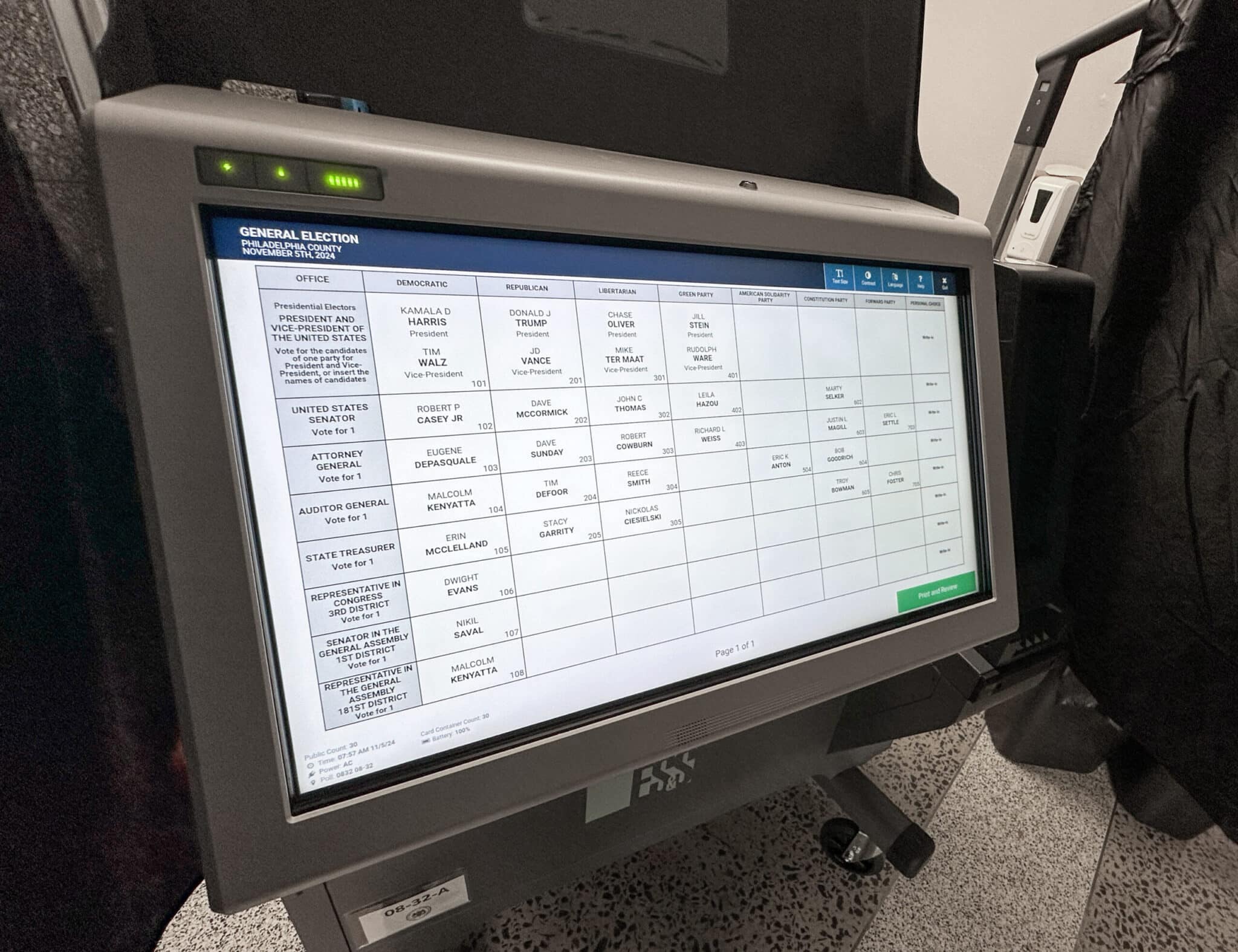
Of the two required training sessions for poll workers, one focuses on technology, including the e-pollbooks, the voting machines themselves and network in a box, which is a closed internet connection for these systems. Trainers emphasize that the voting machines are not connected to the internet, Bluestein said.
That matters because election cybersecurity isn’t just about preventing hacking. It also means limiting the ways equipment can be accessed, making sure poll workers know what to do if something malfunctions and how to ensure there’s a paper or procedural backup if there’s a glitch.
A voter may only experience that preparation as a short check-in or a machine inspector offering help. But for poll workers, the training is about preventing a technical issue from becoming a voting access problem.
Technical.ly submitted a Right-To-Know request for documents related to Philadelphia’s poll worker training, but the city extended the response deadline and had not provided records by publication time.
The biggest barriers aren’t technical
Tech or security questions aren’t necessarily turning voters away, but updates aren’t solving disenfranchisement either.
Normally, the technology is pretty easy for voters to use, said Gerber, of Fitler Square. If someone has trouble, machine inspectors are there to help. The e-pollbooks have helped speed up the check-in process at polling sites, and if there’s a long wait, more e-pollbooks can be distributed, per Commissioner Bluestein.
“What’s good about the electric book,” said Evans, of North Philadelphia, “is it will tell you where to vote. … If the person comes in and thinks that this is their polling place and it’s not, it will tell them where it is.”
READ: Pennsylvania’s Delaware County Bans Poll Workers From Using Election Prediction Markets
Security concerns may have some factor in feeding distrust, and adapting to new tech can sometimes cause disruptions, but they do not appear to be the main reason voters stay home. What really discourages people from voting are factors like language barriers, the presence of ICE at polling places, limited time and transportation, and a lack of outreach.
Plus, maybe a bit of apathy.
“When I asked people why they don’t vote, they say that … the electeds are going to do what they want anyway,” Evans said. “They don’t see the correlation between their lives and voting.”
That disconnect, he said, is exactly what election workers and outreach groups have to overcome: showing voters that the offices on the ballot shape the conditions of daily life.
“Everything that touches our lives, the house we live in, the air we breathe, the food that we eat,” Evans said, “comes down to elections and voting.”
This article was edited by Technical.ly’s Danya Henninger.