State Senator Nikil Saval wanted to be a novelist. So, why is he a lawmaker?
Lots of reasons – starting with the terrorist attacks on 9/11.
As a student at Columbia University when American Airlines Flight 11 and United Airlines Flight 175 struck the North and South Towers of the World Trade Center, the terrorist attacks, attendant racism and subsequent rush to war in Afghanistan and Iraq started Saval on his path to the Pennsylvania Senate.
That said, writing is Saval’s passion. Researching, stringing sentences together and the lessons of being a good writer started shaping the man long before those dark, horrific events in 2001.
“I think I’ve always wanted to be a writer,” Saval explained. “I wanted to be a novelist ever since I knew that writing books – novels, in particular – was something that you could do.”
Not just novels, the senator likes short form writing, too. “I like magazines.” Even as a child, “I started magazines – in elementary school and in high school.”
“Writing is just for me, just a way to get the truth.”
Saval uses this background to inform his work as a state senator.
Saval believes his education (PhD from Stanford in English Literature) along with his work writing for the periodicals like the New York Times and n+1, a magazine he helped create, have made him a better politician. “More practically, the training as a nonfiction writer in particular … was to ask questions and to ask lots [of them].”
As senator, Saval says he’s done that. “I have to find the right people, ask the right questions, and be honest about what I don’t know. And so that,” related to his work representing the people of Philadelphia, “I think, has been the most important part of being a writer for me.”
Reading Saval’s 2014 book, Cubed, one might wonder what on earth he’s doing in the Pennsylvania Senate. Every respected authority on books, from The Nation to Salon to the New York Times Book Review to the Guardian (and countless others) glowingly validated Saval’s remarkable writing style – even as the free-market friendly The Economist’s endorsement reminds the reader that the book’s discussion of the 20th and 21st centuries’ white collar sweat shops – corporate America’s low and mid-level offices – passed muster when it comes to dollars and cents.

On the pages of Cubed, a reader might find the core basis of Saval’s political ideology. In the book, Saval traces the evolution of the office. He points out the similarities between office workers and factory workers – long hours and insufficient pay, even as those differences; neck ties and proximity to power – serve the purpose of dividing America’s labor forces.
Instead of blue- and white-collar workers realizing their common cause, office workers dressed like the corporate elite, self-identified with those in the ivory tower and intellectually disconnected themselves from the factory workers in the United States and later around the world. Even as their positions remain the same – work hard and get comparably little in return.
“The invention of telecommunications allowed offices to be separated from factories and warehouses … Consider a mail-order company and its warehouse. Bosses and errand boys no longer had to conduct transactions in person.”
Saval points out that office workers may have toiled in more commodious surroundings, but like their manufacturing counterparts, they formed an assembly line of paper shufflers that served a purpose – until they didn’t.
Reviews of Saval’s Cubed point out that Saval’s understanding of the white-collar labor force is only outpaced by his talent in describing it. “But now all the lowly work was increasingly taken up by women; the pay for these jobs was also degraded (and degrading); and there was never a question that women would be able to move up the company ladder in the way men could … So, within the office itself, a class division sprang up that fell neatly along gender lines.”
Not surprisingly, gender issues in Saval’s writing preview his work in the PA Senate – and he’s the prime sponsor of SB150, the PA Fairness Act amending “the Pennsylvania Human Relations Act to include ‘sex, sexual orientation, gender identity or expression’ to the current list of prohibited types of discrimination.”
Saval’s book explains how, isolated from their employer and placated with an implied superiority to manual laborers, the office worker shuns the idea of solidarity with their co-workers. By the mid-2010s cubicle workers – hence the title Cubed –remain unlikely to join organized labor and agitate for benefits that might improve the plight of every customer service operator or tech support specialist working for low wages, few benefits or in perpetual temporary status.
Reading Cubed provides insight into Saval’s belief that every worker – regardless of their workplace – needs a labor union to represent them.
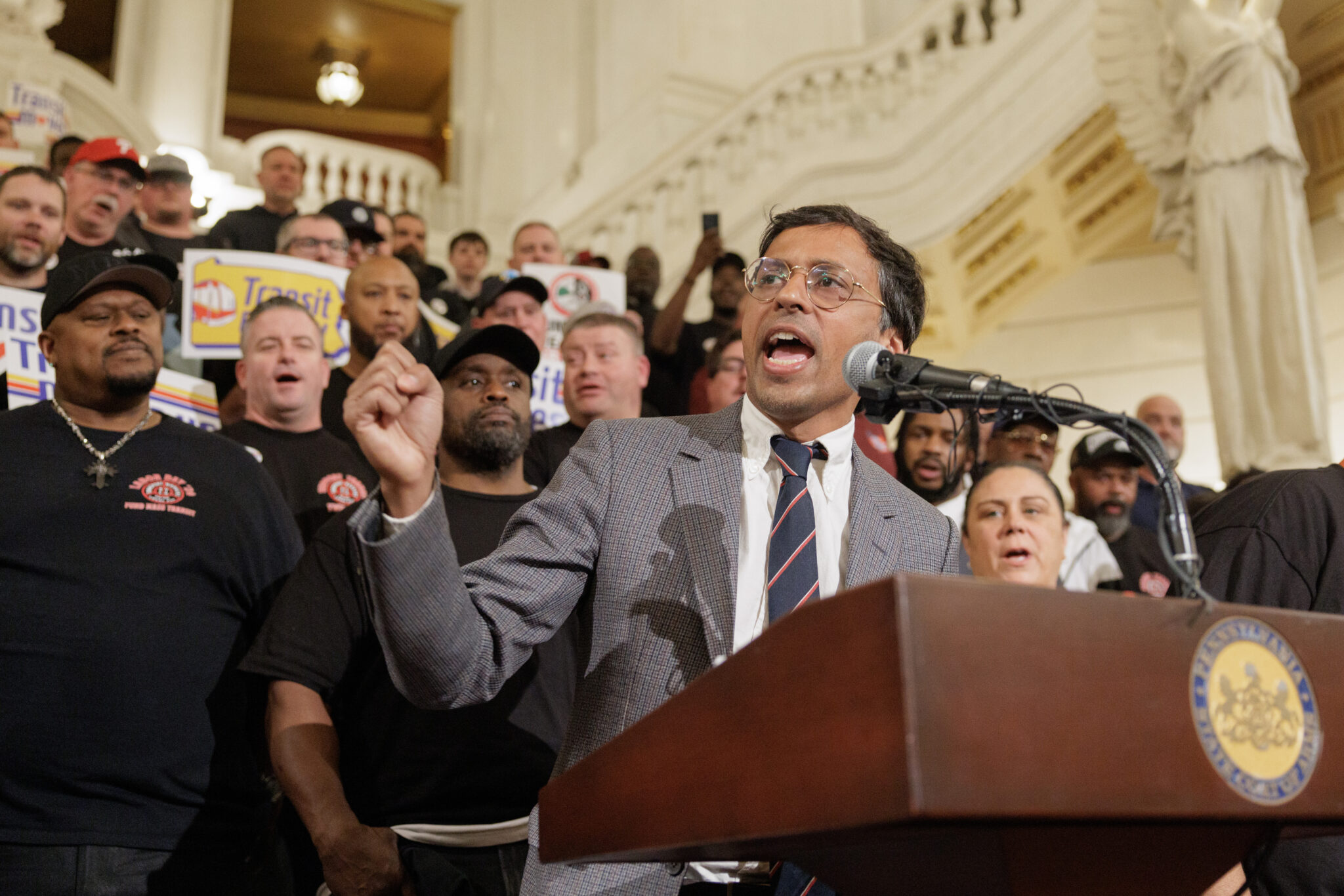
Fast forward to this week, as Saval supported IBEW Local 614’s strike against PECO (Philadelphia Electric Company) – the first such action in the company’s 145-year history. The strike resulted in a win for the line workers and others represented by the International Brotherhood of Electrical Workers.
Election to public office has allowed Senator Saval to directly impact the work author Saval had been writing about for years.

1st Senatorial District
Oct. 13, 2023. Photo by
James Robinson | Pennsylvania Senate Democratic Caucus.
Saval grew up in California. A birthright citizen born to Indian immigrants, Saval chose Columbia University because he believed, “New York is where in the United States, you become a writer. And the publishing industry is there.”
When the planes hit the World Trade Center, he learned more than he’d expected about how the United States views immigrants – especially in the wake of tragedy. “New York City was a hotbed of FBI surveillance … and there were a lot of terrible things happening.”
The terrible things frightened him. “I definitely was scared. Because you would hear about attacks on South Asians, of course.”
In the aftermath of 9/11, Saval felt the weight of organized discrimination. Micro aggressions by a muscle-flexing government included longer screening times for travel. Seemingly innocuous to those not directly affected, these measures sent a very clear message that was not lost on Saval.
On a macro level, the United States targeted regions and people that bore no responsibility for the terrorists’ actions. “I was sort of shocked into a recognition that politics was happening around me, and I was so deeply unnerved and horrified by the rush to war, that I think I was changed by that ultimately.”
The changes helped him define systemic problems he hadn’t identified before. They helped him pinpoint actions that needed to be taken. “I didn’t know at the time that I would be changed in such a way that would get me more and more involved in politics, but that was fundamentally what changed me. The United States invading, I think – certainly Iraq.” Although he continued that targeting Afghanistan as a whole was wrong, “I think both invasions were on pretenses.”
Saval knew the rush to war would have consequences – consequences that concerned him. He worried, “What it would mean for the people there.”
The U.S. response struck to the core of his identity as a person of color whose family is from South Asia. “There was a part of me that suddenly understood the racist nature of this form of imperialism.”
READ: Why Is There No Anti-War Movement in the US?
Nevertheless, Saval persevered. He stayed in New York and finished at Columbia. Went to grad school, obtained a PhD at Stanford, back in his native California, and became a professional writer.
But it wasn’t until Trump’s first campaign, which emboldened racists across the nation, that Saval was physically attacked.
While out walking, a man crossed into Saval’s path and assaulted him. “He was shouting these kind of anti-Hispanic slurs at me. And so, in some sense, I could be like, ‘Well, you’ve actually got it wrong,’” the senator related the details dryly, pointing out, “Racism isn’t always very finely discriminating.”
But it was Vermont Senator Bernie Sanders’ first campaign for president that helped Saval orient his initial steps into politics. “When he spoke, he spoke his mind. [Here’s] a candidate who was clearly responsive to answering social movements.”
Sanders’ willingness to address society’s shortcomings appealed greatly to Saval. It spoke to his own desire for activism, but proffered a political solution in addition to protest.
“I’d been involved in the anti-war movement against Iraq and Afghanistan. After Iraq and Afghanistan, I was involved in the labor movement, with Unite Here, the hospitality workers union in San Francisco and Philadelphia.”
Saval went on, “You know, all of those things were inspiring to me. I thought that only happened in Latin America.”
Saval knows that what he found as inspirational has begun to spread through the country.
“Now, I think since then that [the Sanders campaign] has helped seed and grow so many people who follow a similar model.”
Saval knows he’s part of that. “I would see it as, of course, they’re like myself, they’re Democratic socialists, a lot of them, not exclusively, but a lot.”
READ: Democratic Socialists Surge in Mayoral Races Across the Country as Anti-Trump Fervor Rises
For those who don’t identify that way, but think similarly, Saval sees the message breaking through as well. He sees “broadly progressive people running for elected office, who are trying to find different ways to reflect popular sentiment.”
Saval pointed out that one need only look to the highly successful work done by his contemporary, New York City Mayor Zorhan Mamdani, to know that Democratic Socialism works – whether or not people identify that way.
“I mean, the majority of people have always been with us on the issues that matter and the issues that we campaign on, whether that’s the [economic] renewal or housing justice or workers’ rights.”
The senator is proud of the work he and his colleagues have done in Pennsylvania despite not having the majorities they need to pass some of the bills he prioritizes most. Bills like SB1089 which would make it illegal to criminalize homelessness – protecting people from incarceration or harassment, just because they have nowhere to live.
Saval sees expansion and reform inside his own political party as key to future success. He praised the Democrats for abandoning their Dixiecrat, pro-segregationist roots. “And, and at the same time, it’s an increasingly wealthy party.”
Because of this, “ the Democratic Party is estranging in its own way, because it is electorally a hugely successful fundraising operation … and less characterized by working class voters.”
Here the disconnect is reminiscent of the office workers in his book. Middle-class voters who identify more with the wealth-class than their far closer relative, people in poverty.
Where will his political career lead him? Saval knows politics has a purpose in the world, and at just 43-years-old he has room to grow into that purpose. He likes the nobility of the cause. “Politics is just enabling people to live their fullest lives.”
In the meanwhile, Saval was reluctant to speculate on any future legislative or executive career paths. He’s dedicated to doing the work as the Chair of the Philadelphia Senate delegation and Democratic Chair of the Senate’s Urban Affairs and Housing Committee.
When asked what three things he’d like to secure for the people of Pennsylvania, Saval answered quickly and without hesitation: “Everyone would be housed. Everyone would have a union. And we would eliminate fossil fuels and have renewable energy.”