
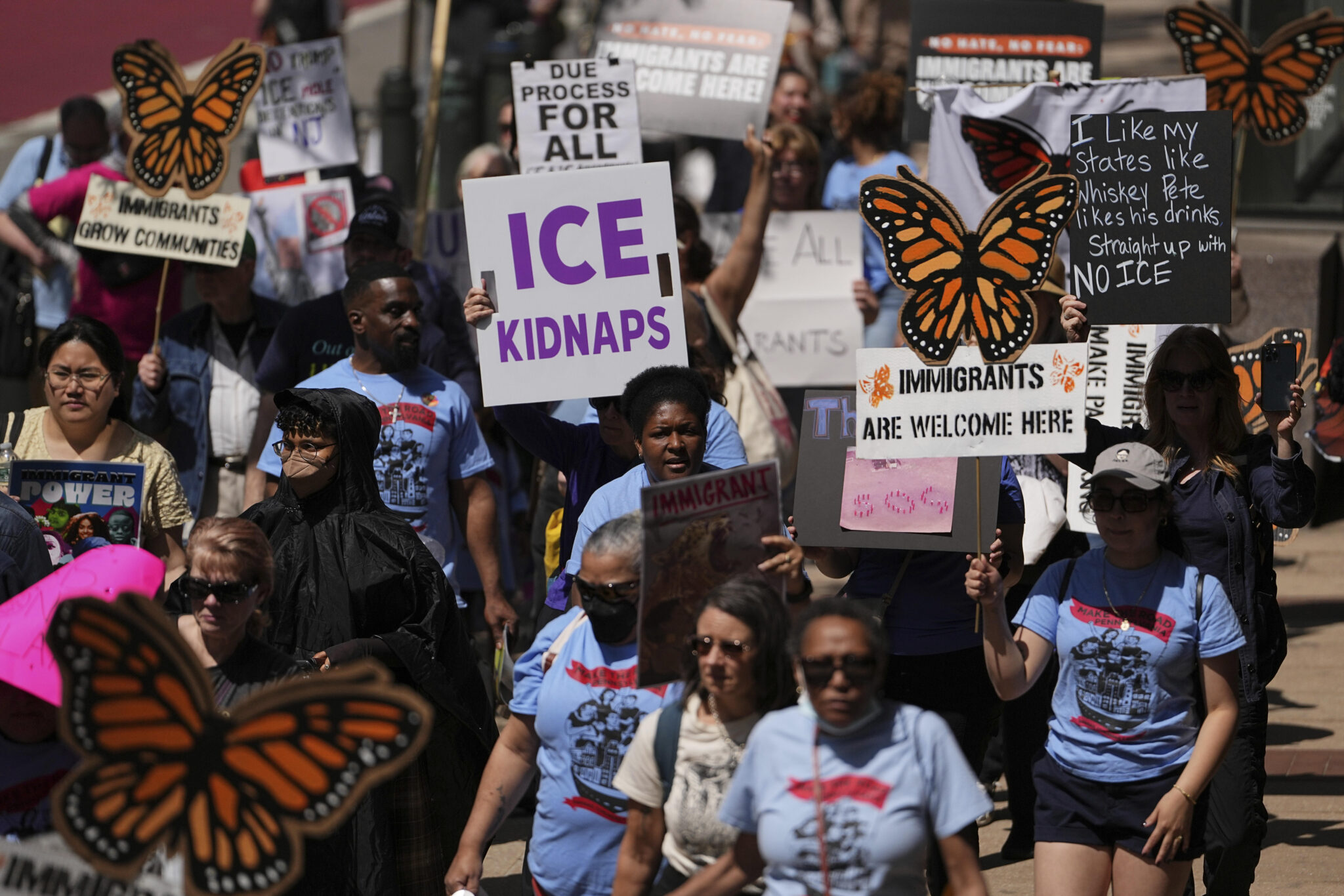
As more states seek ways to limit immigration enforcement, a Stateline analysis shows one tactic has had an effect: making it more difficult for local law enforcement to hand over people they are holding in city or county jails to federal immigration authorities.
The analysis found that states with strict non-cooperation policies — Oregon, Connecticut, Massachusetts, New York and Washington state — have the lowest rates of immigration arrests in jails.
The highest rates were generally in states that limit or bar so-called sanctuary policies. Those states include Wyoming, West Virginia, Mississippi and Alabama.
New Mexico, a border state, also was one of the five states with the highest local jail arrest rate despite having some statewide policies limiting cooperation. The state ethics commission sued the state corrections department in July charging violations of a state law banning most cooperation.
However, early threats from the Trump administration to target sanctuary states for more street arrests had uneven results through March 10, the latest data released by Immigration and Customs Enforcement and obtained by the California-based Deportation Data Project. The analysis includes arrests since Jan. 20, 2025, the first day of the second Trump administration.
READ: The Sanctuary Movement and Immigrant Solidarity from Reagan to Trump
President Donald Trump announced March 5 he would replace high-profile Homeland Security Secretary Kristi Noem, and that Markwayne Mullin would take over March 31. Mullin has pledged a more low-key approach to ramping up immigration enforcement.
Stateline’s analysis doesn’t reflect a new wave of arrests starting in June that has pushed arrests to new highs, or new airport arrests in recent months cracking down on people with expired visas. But the data does show an administration struggling to get arrest numbers up everywhere, said Jacob Kang-Brown, a criminologist who did a similar analysis in October for the Prison Policy Initiative, a Massachusetts-based think tank that seeks to reduce incarceration.
Last year border czar Tom Homan said he would “flood the zone” with extra street enforcement in sanctuary cities. States without sanctuary policies, such as Florida, would be treated differently, he said. “We don’t have that problem in Florida, where every sheriff is working with us,” Homan said.
But Kang-Brown said cooperative states did not get a break from street operations and raids.
“They don’t stop doing stuff in the community just because they can get in the jails. It was very widespread arrests around the country, even in states that collaborated enthusiastically and were pushing ICE for even more enforcement, like Florida,” Kang-Brown said.
In the Stateline analysis, Florida’s rate of street arrests ranked 40th, about the same as Washington state, which has restrictions on immigration arrests at jails, and higher than Connecticut, which has similar restrictions. Connecticut Democratic Gov. Ned Lamont rejects the sanctuary label, calling the restrictions “clear rules for cooperation with federal immigration authorities.”
Some states with policies restricting jail transfers to ICE did see high rates of street arrests last winter amid attacks on what the administration often calls “sanctuary politicians” in those states. Maine, Minnesota and the District of Columbia were among the 10 states with the highest rates of street arrests as a share of noncitizens, and many of those arrested did not have criminal records.
Operation Metro Surge, concentrated in Minnesota’s Minneapolis-St. Paul over the winter, ended in two killings by federal agents and hundreds of millions of dollars in business losses.
But cooperative states also saw high rates of street arrests: Seven of the 10 states with the highest rates of street arrests as a share of noncitizens were ones with cooperative policies. The very highest was West Virginia, where there were only 17,100 noncitizens counted in 2024 but hundreds were arrested in a single “surge team” operation in January.
After criticism from the Trump administration, some states have backed off some of the more far-reaching sanctuary policies, but others have been emboldened by the unpopularity of Trump’s mass deportation agenda.
Stateline’s analysis underscores the fact that local jails, and how they handle ICE detainer requests to hold inmates for immigration arrests, are a powerful tool.
ICE often criticizes cities and states with sanctuary policies for releasing violent criminals, but only a small fraction of arrestees are violent criminals and a large number have only immigration violations.
“Generally if someone poses a real threat to safety, public safety or national security, that detainer is generally respected,” said Colleen Putzel-Kavanaugh, an associate policy analyst for the Migration Policy Institute, a Washington, D.C., think tank specializing in immigration research.
But, she added, “if someone got a ding on a speeding ticket and otherwise has a clean record, then there are some places that are not going to hand that person over or hold that person for ICE.”
ICE made a record 51,000 arrests in July but hasn’t released detailed information by state since March.
For all ICE arrests combined, the highest rates were in Wyoming, West Virginia, Mississippi, Alabama and New Mexico, all having more than 300 arrests per 10,000 noncitizens through March.
The street arrests pulled in more people without criminal records — 81% of the Washington, D.C., street arrests were for immigration-related offenses only and the share was about two-thirds or more in 14 other states with statewide sanctuary policies.
Some states have tried to strike a balance, allowing jail transfers to ICE for a list of crimes, including charged crimes as well as convictions, and for court orders of removal, which can be issued for some immigration offenses.
In New Jersey, the state legislature backed off some proposed changes that would have made it harder for ICE to make arrests in local jails. The law as signed in March maintained controversial exceptions for immigrants with removal orders and for immigrants facing charges and well as convictions among a list of serious crimes.
Passage of the law came after the Trump administration in March highlighted the case of a New Jersey man charged with sex crimes against a child younger than 15 years old, calling it a “New Jersey nightmare” and claiming the man might have qualified for release under state policies at the time, despite a detainer request. Court records indicate the man was never released and remains in an Ocean County jail after pleading guilty pending sentencing in September.
READ: ICE’s Plan to Give Officers Electric Shock Gloves Draws Outrage and Fears of Misuse
In some states, including Maryland, the Trump administration and local sheriffs have challenged policies against extending local jail time or responding to immigration detainers. Courts have ruled that such detainers are voluntary requests that states and cities may turn down legally, and there are preliminary injunctions in California and Washington state against withholding some or all federal funding because of it. Those injunctions are under appeal.
A similar lawsuit by the administration against New Jersey cities was dismissed in June.
That hasn’t stopped the Trump administration from hectoring state and municipalities it sees as overly lax on detainer policies.
“Sanctuary policies continue to disregard U.S. immigration law and put communities at risk by releasing illegal aliens prone to criminal activity into our communities,” said Robert Guadian, the Washington, D.C., field office director for ICE’s enforcement and removals office, in an Aug. 6 statement. Guadian complained that two young men had been released from a Maryland jail in Prince George’s County after criminal charges were dismissed. They were later arrested by ICE in separate traffic stops.
Delaware’s legislature in June approved a bill, now awaiting Democratic Gov. Matt Meyer’s signature, with exceptions only for certain crime convictions.
Even as the Trump administration has been frustrated by legal attempts to force more compliance with detainers, it’s been more successful with encouraging participation in the 287(g) program that allows local officers to investigate immigration themselves and help turn prisoners over to ICE. The programs are in 39 states, but are heavily concentrated in Texas and Florida.
“ICE is actually paying the salaries of some local sheriffs or law enforcement, and that’s a huge savings for their jurisdictions,” said Putzel-Kavanaugh, of the Migration Policy Institute. “For a local town or sheriff that could be huge.”
The tension between federal immigration authorities and local jail authorities has been around for decades, noted Graber, of the Immigrant Legal Resource Center. Local and state authorities have the best possible awareness of local crime, she noted, and fingerprints from their arrest get transmitted automatically to immigration authorities to choose candidates for arrest and deportation.
“ICE has been pursuing the local law enforcement’s broad reach into communities and their ability to surveil the public at a much greater level for a long time,” Graber said. “That’s why they want instant information about every person who’s arrested.”
Stateline, where this article was originally published, is part of States Newsroom, a nonprofit news network supported by grants and a coalition of donors as a 501c(3) public charity. Stateline maintains editorial independence. Contact Editor Scott S. Greenberger for questions: info@stateline.org.