
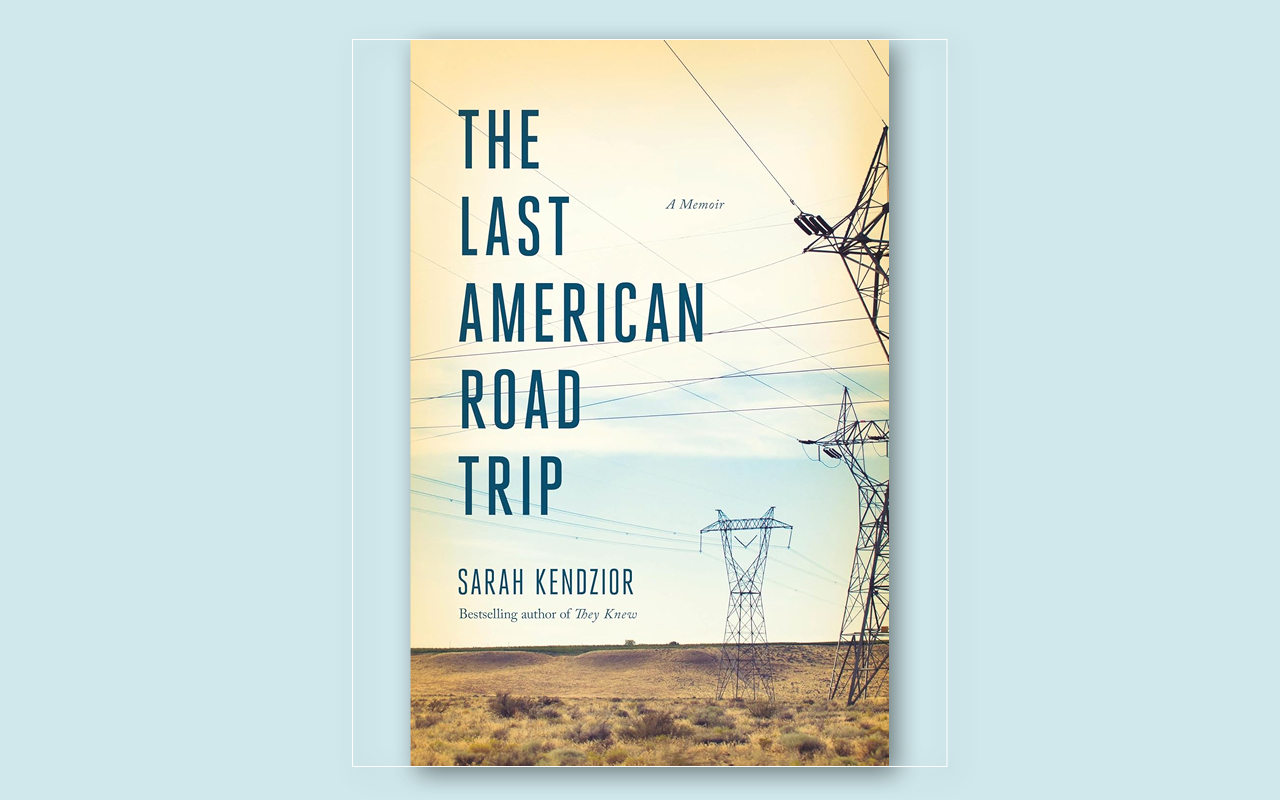
We have an obligation to the truth, for our families, our children, and our country. But it comes at a cost. Such is the message in Sarah Kendzior’s nuanced, poignant and frequently heartbreaking The Last American Road Trip: A Memoir.
Over the years, I have sought out authors who understood their own times. In the process, I have read All Quiet on the Western Front (1928), The Man in the Gray Flannel Suit (1955), and The Electric Kool-Aid Acid Test (1968), Bonfire of the Vanities (1987) and Insane Clown President (2017).
Sarah Kendzior’s The Last American Road Trip is that kind of book. Throughout, it presents a series of journeys, some rooted in the physical world, in the Ozarks, Death Valley, the Great Lakes, Route 66, and many state and national parks that the author and her family visited over the years. Other journeys are conceptual as Kendzior reflects upon the history, literature, and politics –even geology makes an appearance—of an America transitioning from “being a flawed democracy to a burgeoning autocracy.”(1)
Each step of the way, the author seeks out a balanced narrative by offering readers America’s terrible legacies as well as its most encouraging potential. Her home state of Missouri is filled with them. It is the birthplace of both Mark Twain and Jesse James. Twain is a national treasure, whose writings did not spare his topics from the truth, or provide future generations a chance to appreciate irony. When Kendzior and her family visited his childhood home in Hannibal, Missouri, “Twain’s arch condemnations of human gullibility line signposts on town streets as tourists embody the very idiocy he mocks.”(51) Jesse James, in contrast, was a thief and a murderer, encapsulated by a mythology in his lifetime that never stopped evolving after his death in 1882.
Neither man escaped being commercialized for profit, but Jesse James’s process differs for important reasons. His is a classic example, like Bonnie and Clyde, “of criminal culture marketed as counterculture.”(87) James rode with Confederate raider William Quantrill and likely participated in the massacre of abolitionist civilians at Lawrence, Kansas. Yet, none of that matters to a segment of society that views his crimes as an act of rebellion against illegitimate authority. Visiting James’s grave in Kearney, Missouri in 2022, Kendzior found it adorned with flowers and a Confederate flag. (263)
READ: New Book Explores the ‘Dark Passions’ Fueling American Politics
To the citizens who left the flowers and planted the flag, James “taps into a particularly American pain combining genuine economic precarity with a vicious, often racist lust for impunity.” (263) As a symbol, the legendary criminal funnels resentment, outrage, and the desire for agency. It is one of the reasons why so many criminals become permanently embedded in American folklore, some more romanticized than others. It is why James shares the same cultural DNA as Al Capone or the Arkansas state officials involved in the Iran-Contra scandal. (118-119) Or even current corporate political and perpetrators of scandals that make these historical actors seem quaint. It is why Kendzior plainly says: “I am not afraid of the unknown. I am haunted by the known.” (18)
Notwithstanding her many bleak forays into the past and present, Kendzior offers a variety of antidotes to our current American condition. During her many road trips, the author found sanctuaries in deserts, forests, and caverns. The simple beauty of these landscapes offered a refuge from cell phone doomscrolling. They were places to daydream. (128)
She finds remedies in simple kitsch and weirdness; the Cadillac Ranch in Texas, the five-ton concrete head of Ronald Reagan in Branson, Missouri. There is solace in the sheer absurdity of these places. They are a distraction and a reaffirmation of creativity and individualism outlasting cultural homogenization.
Most of all, Kendzior finds comfort in her children.
They are, at once, her inspiration and mission in life. Like any other parent, rediscovering the world through young eyes is its own cure, something to be mentored and protected. It is an opportunity to provide small opportunities at authenticity. Kendzior notes early in the book, “My children love the flea market. They have grown up attacked by algorithms, but in the flea market, they are free.” (27) Simple experiences offer the possibility of substantial rewards for a young life.
But there are limits to the truth. Cultivating intellectual curiosity and a healthy skepticism about authority are admirable goals, within limits. In an exchange with her daughter, Kendzior explains here ambivalence:
“But I don’t know if the truth makes you free. It makes you free of other people’s lies, but what comes after that? What you do with the truth when it’s ugly and sad and no one wants to hear it, that’s the part I don’t know how to handle.” (110)
These concerns are not trivial when it comes to the most obvious manifestations of climate change, or American institutions that “greet their own disillusion with a shrug,” or the most recent school shooting. We want out kids to learn without collecting too many early scars. (49)
READ: Meming Our Way Toward an Undemocratic Future in America
It is hard to determine whether or not Kendzior is optimistic about America. Her early discourse on Dobbs v. Jackson Women’s Health Organization (2022) is rightfully filled with rage. “Our lives are cheap to them because we don’t have enough wealth to buy our freedom. Instead of wealth, we have an inheritance, but it is the wrong kind. Our inheritance is ignominy ordered from the top down, state murder marketed as collective suicide.” (24)
In contrast, Kendzior finds hope in an unlikely place, the Oklahoma City Bombing Memorial. The victims of the deadliest domestic terror attack in our history did not deserve their fate. They were not part of a vast government conspiracy to deprive people of their rights any more than the Capitol Police on January 6th. What makes the Oklahoma City Memorial significant is its response to tragedy. The site allows visitors a place for peace and contemplation. Most importantly, it helps us to remember individual potential taken by premeditated violence. “It is impossible to visit and believe that America is beyond redemption. Because good Americans never forget the victims. They never abandon them, even in the darkest hours, even when there seems no light ahead, because they are the light.” (214) The Oklahoma City Memorial points us toward a future that we still have the ability to control with our own compassion and mercy.
In the end, The Last American Road Trip embodies both hope and despair but helps the reader understand that we may still find answers in unsettled questions. “There is no inevitable autocracy or inevitable democracy. There are no red states or blue states. There are only purple states, purple like a bruise, and people trying to survive in a broken-promise land.” (2)
We owe each other the truth with the understanding that it will involve work, and time, and patience, none of which will be particularly easy. But persistence and faith in ourselves is a start.