

Some people are trying to rewrite the history of Souderton’s free-speech lawsuit, which was finally settled last week. The story did not begin with the ACLU. It began when Souderton Area School Board Member Bill Formica’s social media posts sparked widespread community outrage—and the board refused to address the concerns residents raised.
While serving as a school board member, Formica authored a series of racist, sexist, xenophobic, and homophobic posts, including posts that disparaged teachers. The controversy drew large crowds to board meetings, where residents called for accountability. The board said it lacked the authority to remove Formica, and one meeting ended amid public objections. At the meeting, Formica supporters led by Kaitlyn Derstine gathered near the entrance in what they called a prayer circle. The court’s account of the lawsuit describes the supporters gathering near the entrance while protesters were directed to a public sidewalk farther away.
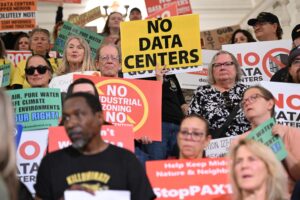
The district had been told that attendance would be high on the night of the September 2024 meeting, but it refused to move it to a larger venue, as it had for the previous meeting. More than 100 community members gathered outside the district office, with district police officers on watch. Some were waiting for family and friends who had managed to get inside to share updates. They were not trespassing; they were gathered outside the building. Unlike other meetings, the blinds were closed and the outdoor lights remained off, leaving residents outside literally and figuratively in the dark. This was the setting for the encounter that led to the cease-and-desist letters, as the board continued to stand by Formica.
Then came the September 2024 parking-lot encounter involving board member Kim Wheeler and her daughter. The district accused three residents of threatening them and sent cease-and-desist letters barring the residents from school property. The residents disputed the district’s account. The surveillance video, obtained through a Right-to-Know request rather than released voluntarily by the district, contradicts the district’s description of the encounter. The district lifted the bans after the footage emerged. The footage has no sound, so it cannot settle what was said. But it raises a basic question: why were residents threatened with arrest and excluded from school property before the video was reviewed?
The dispute did not end when the district lifted the bans. In 2025, settlement talks included a proposed confidential apology to Wheeler’s daughter. The ACLU says that after the board rejected a joint public statement, the district’s attorney asked the court to bar plaintiffs from discussing the case —j ust eight days before the May primary — and sought a promise that they would not pursue criminal complaints related to the events. The plaintiffs rejected those restrictions.
On February 2, 2026, the court ordered the district to maintain its rescission of the cease-and-desist letters, livestream and archive board meetings for at least five years, and provide a designated demonstration area. It also required the district’s insurance carrier to pay $63,000 in plaintiffs’ attorney fees and costs. The order enforced core promises on an equitable basis; it did not decide the truth of the competing accounts of the parking-lot encounter.
The court later struck the requirement that plaintiffs apologize. Its September decision said the First Amendment limits a court’s ability to compel an apology and found the record did not establish a valid waiver of that right. The written decisions do not say whether the judge watched the surveillance video. They do show that the apology ruling turned on the First Amendment and the settlement negotiations—not a trial deciding exactly what happened in the parking lot.
“It is the school board that owes the community an apology,” said plaintiff Jane Spigel, president of Souderton Area for All. “The board misused district resources to retaliate against its critics and then delayed settlement of a lawsuit solely to demand an apology for the teenage daughter of a school board member for events that the district has repeatedly mischaracterized.”
Souderton’s case has also become a statewide example in the conversation about public access and accountability. In its August 2026 Transparency in Public Schools: The Sunshine Act & the Right-to-Know Law guide, Education Law Center-PA cited the district’s lawsuit while explaining that members of the public cannot be excluded from school board meetings because of their views. The guide described the case as pending; the lawsuit has since been settled.
So how much did the Formica controversy — and the district’s response to Kim Wheeler’s embellished account of the encounter — cost taxpayers? The public order identifies $63,000 in plaintiffs’ attorney fees and costs. That is not a complete accounting of the district’s legal expenses or other costs tied to either controversy. Taxpayers deserve a clear answer about the total cost, who authorized the cease-and-desist letters, and why the video was not reviewed before those letters went out.
We said in 2025 that this kind of response to residents demanding accountability could not become normal. The lawsuit may be settled, but the public’s demand for transparency and accountability is not.