The Bucks and Montgomery County Democratic Parties have rigged the nomination procedures to short-circuit the democratic process. On February 17, candidates working to be on the ballot in May will begin collecting signatures from their party’s voters. For Democratic candidates vying for Pennsylvania’s 1st congressional district, which is currently held by incumbent Republican Brian Fitzpatrick, they will need 1,000 non-overlapping voter signatures to get on the ballot during the primary. They have three short weeks to collect 1,000 signatures (usually aiming for 2,000 for ample cushion in case signatures get disqualified) from a district that encompasses all of Bucks County and a portion of Montgomery County.
On February 21, only four days after candidates begin this enormous task, the Bucks County Democratic Committee will meet to vote on its slate of endorsed candidates whose names will appear on the “goldenrod.” This slip of paper, named for its distinct color, will be distributed to voters at the polls. This cheat sheet will direct the party faithful to vote for the candidate that the party believes can win the election. On February 18, just one day after the petition signing period begins, Montgomery County’s Democratic Committee will meet to do the same.
Here is the problem.
It is a widely accepted fact that no candidate has ever won a primary whose name did not appear on the goldenrod. So before the candidates have even qualified to run in the primary, a small group of people, who were not elected by the people to make such a decision, decided that Bob Harvie is going to represent the party in November.
Who is this small group?
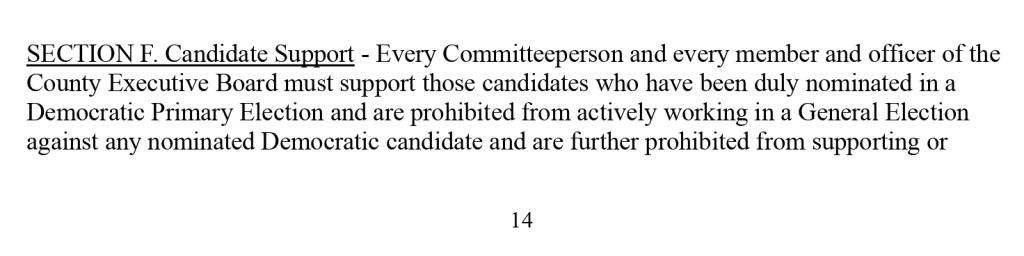
They are the powerful leaders in the party who decided on the one person they believe deserves to run. Steve Santarsiero, who is the executive chair of the County Democratic Party, personally endorsed Bob Harvie as the party’s candidate more than a year before the party’s official endorsement meeting. They are the powerful party establishment folks who acceded to this choice and donated to Harvie. Finally, the most culpable of this small group are the committee members who heeded the early endorsement by Santarsiero and, like lemmings, are expected to rubber stamp the choice that was made for them more than a year ago. Of course, there are procedures to ensure compliance. For one, the endorsement vote is not by secret ballot, which would shield any committee person from bucking the party line and voting his conscience. The Bucks County Democratic Committee Bylaws also punish any committee members who assist any unendorsed candidate with removal from their office and a 2-year ban on future office [*see Publisher’s Note below]. Even before the endorsement meeting in February, committee chairs have reportedly prevented candidates from speaking at their monthly meetings, even muting those who showed up. The use of the voter outreach software was specifically revoked according to one of these outside campaigns. And the usual petition signing events that are organized by every municipal division of the party will be closed to these non-endorsed, non-Bob-Harvie candidates. All party assistance will be prohibited to these non-endorsed, non-Bob-Harvie candidates. This is no accident of timing. The endorsement meeting is specifically designed to put a nail in the coffin of the campaigns of the non-chosen candidates, if all other efforts fail.
This scenario is no exaggeration.
The failed straw poll in PA’s 16th state Senate District was intended to do exactly the same thing, as reported by local journalist Jess Rohan. Again, Steve Santarsiero and the Bucks County Democratic Committee tried to circumvent voter participation by holding a backroom straw poll involving 75 committee members for a district of 200,000 residents. The move was intended to pick the Democratic nominee without having a primary decided by constituent voters. Indeed, Santarsiero was quoted saying, “the last thing in my view that we need is a primary.” Senate candidates were asked to abide by the results of the poll and drop out if they were not selected. In the end, 31 committee members voted for the winner, with 16 committee members abstaining due to the undemocratic nature of the vote. Of course, Santarsiero immediately endorsed the winner. The process was revealed only after emails and videos of the vote were leaked to the media.
The major argument for such machinations has always been money. Committee chairs argue that the candidate who has amassed the most money has the best chance of defeating the opponent. However, when one person is chosen by the leadership early on and then publicly endorsed, where would all the campaign donations flow? Even the early personal endorsement of your chosen candidate is tipping the scales of the nomination process unfairly. Should the nomination process truly be democratic where the leadership develops strong candidates and engages the public in a robust discussion of issues, the party can only benefit in the general election. The electorate will feel engaged and heard. More talented and diverse folk may consider public office and whoever wins the primary in May will certainly draw considerable attention from voters and donors alike.
PA-01 is fortunate to have such a large number of talented and decent human beings running for office. Tom Taft, who had a finance role at Germantown Academy, is committed to the nurturing and education of our youth. Lucia Simonelli, who is a policy expert in energy and technology issues, is someone willing to learn to produce the best solutions. Tracy Hunt, who has litigated against large corporations, is not afraid to take on the moneyed establishment. Rob Strickler, a software product manager, has been the loudest voice against money in politics. They share common Democratic values and their cooperation with each other demonstrates their passionate commitment to representing the voters of this district. They are asking Bucks and Montgomery County Committee members to abstain from the endorsement vote, just as some of the committee members did in the recent straw poll.
Money should not be the main criteria to determine who should be the party’s nominee. And party officials should not argue that the general public can’t be trusted to pick the candidate that can win the general election. These are the calculations that produce candidates that alienate the voting public and result in low voter engagement. More importantly, when this happens the party is undermining the democratic process.
*Correction: An earlier version of this article stated that congressional candidates need to collect 2,000 signatures for their nomination petitions. The required number is 1,000.*
*Publisher’s Note: The BCDC bylaws state that members and committee people are forbidden from working in a General Election who were not duly nominated in the Primary Election.*