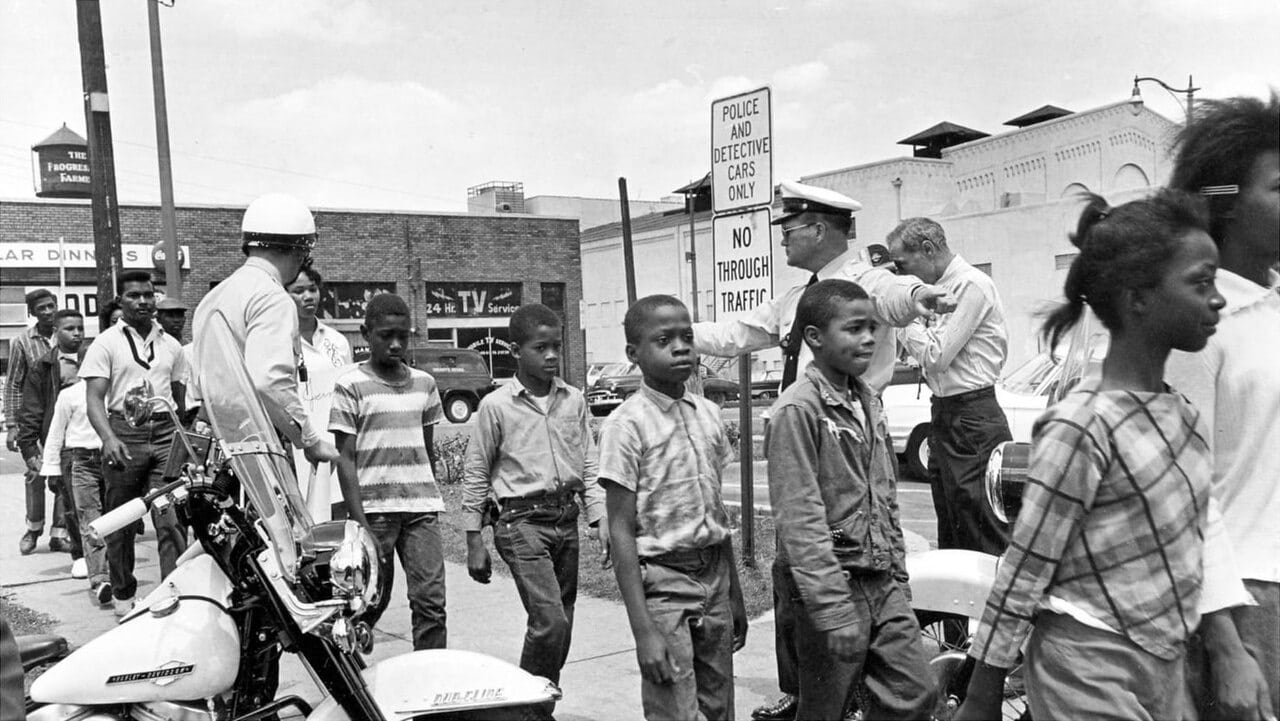
“My name is Mamie King-Chalmers and this is my photo. I was one of the young adults that fought in Birmingham, Alabama, in 1963.”
Like countless Black children in Birmingham, King-Chalmers had grown up under a repressive regime of state violence designed to disempower and exploit Black residents. And like so many of her friends and neighbors, she fought relentlessly to destroy that system.
That fight for liberation — 9 years after the Brown ruling, 6 years after the Civil Rights Act of 1957, and a century after the civil rights acts and the Fourteenth and Fifteenth amendments to the Constitution that purported to guarantee voting and civil rights to all Americans — culminated for Mamie King-Chalmers in the Birmingham Children’s Crusade.
We tend to treat movements like the Children’s Crusade as vindications of American democracy and the values enshrined in the founding documents and legislation of the United States. Black suffering, the story goes—whether under slavery, Jim Crow, or Mass Incarceration—was incidental and temporary, part of the inevitable march to freedom. Worse still, those confronting state violence have often been transfigured in public memory into passive petitioners of the benevolent state. As the Birmingham Children’s Crusade and so many other movements illustrate, nothing could have been further from the truth.
Black organizers of the civil rights era didn’t organize against “racism.” They organized to sabotage the laws and institutions of a white nationalist government. As in Birmingham, they became ungovernable.
As I asked in the wake of the 2024 presidential election, “Who held the firehoses in Birmingham? Who wielded clubs on Edmund Pettus Bridge?” Somehow, many of us have forgotten, but Black Americans had no such luxury. They understood how the system worked, who it targeted, and what must be done to make it inoperable.
As we approach “America at 250” under a lawless regime and in the midst of a growing authoritarian crisis, this ugly American history of state-sponsored repression, plunder, and violence should make us question the values and ideas that allegedly define the American project. The U.S. government has, from the local to the national level, facilitated a system of subordination that shifted resources and rights from racialized and especially Black communities to the benefit of white America. Dr. Martin Luther King, Jr. called this dynamic “The Other America.” We might just as easily call it colonialism or apartheid.
But this system isn’t permanent or inevitable. That, too, is a lesson of the Birmingham Children’s Crusade. Like Mamie King-Chalmers and so many others, this diagnosis of the repugnant condition of American democracy ought to inspire us—all of us–-to attack and transform this system. And as the history shows us, that transformation is not only possible, but urgently necessary.
Beginning in April 1963, the Birmingham Campaign that culminated in the Children’s Crusade mobilized longstanding local Black organizers with roots in the Depression-era Black Alabama communists. There, Rev. Fred L. Shuttlesworth had founded the Alabama Christian Movement for Human Rights (ACMHR) after the state of Alabama had outlawed the NAACP in 1956 for refusing to turn over its membership lists and branch records in the wake of the Brown ruling. Facing repeated bombings and assassination attempts, Shuttlesworth remained defiant, and after years of boycotts and campaigns, launched a joint Birmingham Campaign with Dr. King and the Southern Christian Leadership Conference (SCLC) in the spring of 1963.
Launching their campaign on April 3rd, ACMHR released a statement on the aims of the movement. “The history of Birmingham,” they wrote, “reveals that very little of the democratic process touches the life of the Negro in Birmingham.” Instead, they observed, “we have been segregated racially, exploited economically, and dominated politically.” They argued that this system of political and economic exploitation hinged on violence, “not only that inflicted by the hoodlum element but also that inflicted by the blatant misuse of police power.” The movement, then, targeted the government not only for its repressive policies that drained labor, wealth, and vitality from Black communities, but also for its encouragement of white vigilantism and mob violence.
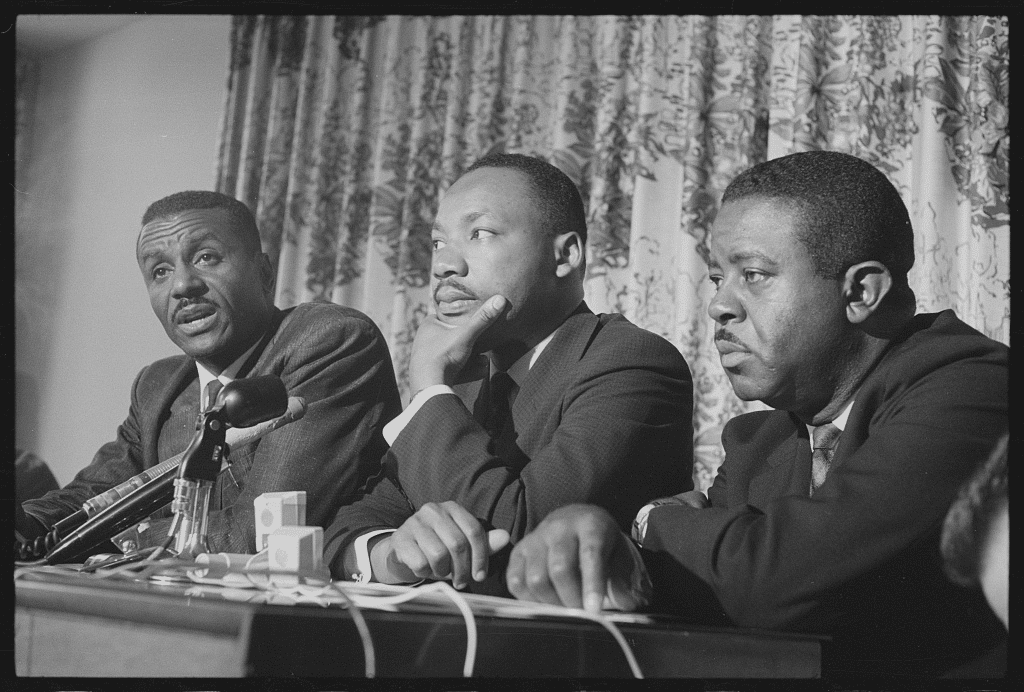
The arrests of Black activists over the ensuing weeks, including Shuttlesworth and King, generated little national coverage or sympathy. It was then that King wrote his famous “Letter from Birmingham Jail” rebuking “the white moderate, who is more devoted to ‘order’ than to justice” and who “believes he can set the timetable for another man’s freedom; who lives by a mythical concept of time and who constantly advises the Negro to wait for a ‘more convenient season.’” Time had not and would not produce liberation, King noted, a conclusion he would repeat in the weeks before his assassination, denouncing the idea “that there is something in the very flow of time that will miraculously cure all evils.”
In this environment, we should understand the Children’s Crusade — a militant direct action designed to upend local commerce and governance that lasted nine straight days — as an attack on the state and its systems.
In her explanation of her participation in the rebellion, Mamie King-Chalmers recalled the debt peonage under which her great grandfather lived as a sharecropper, who told her “I can’t leave because this man own me.” Her own experience in domestic service—being paid pennies on the dollar of her promised wages—led her to conclude that the system itself had to be destroyed:
You couldn’t go in the restaurant and order food, you had to stand on the sidewalk and they’d take the order. You could get on the bus at the front of the bus, put your money in the coin box, get off and go to the back door, and the bus driver would drive off and leave you standing there. Who you was gonna call when they control and own everything? No one you could report them to.
This was nothing less than a system of plunder, one that converted Black labor and tax dollars into white wealth and opportunity.
While we conveniently tend to remember the problem as individual racists today, King-Chalmers had no such illusions. “Who you was gonna call,” she demanded. “No one you could report them to.” Every white American was empowered to pillage their Black neighbors and employees by a racist government. That was the source of their power and the scourge that Black organizers understood must be destroyed.
Just twelve years old at the time of the uprising, Freeman Hrabowski felt “it was exhilarating to march for such a worthy cause, but frightening to encounter menacing police dogs and to spend time in jail with other children that spring.” Despite the experience of violence and arrest, he explained, “we believed… that we were very much a part of the Movement, and it was cathartic to learn that we could be agents of change.”
Gloria Washington Lewis Randall, only fifteen years old in 1963, remembered “being jailed after leaving Sixteenth Street Baptist Church, making it to City Hall, and being thrown in the paddy wagon with all guys!” After she was transferred to the fairgrounds, where Black children were held in masse, she was “sent to the County Jail, for taking part in trying to stop one of the police officers from raping one of the girls.” “I was kept in a sweat box for days upon days,” she testified, for having tried to prevent police from raping another child, “and kept in jail over a month before my family located me! They [the police] kept saying I was too young to be there, but they tried to lose me.”
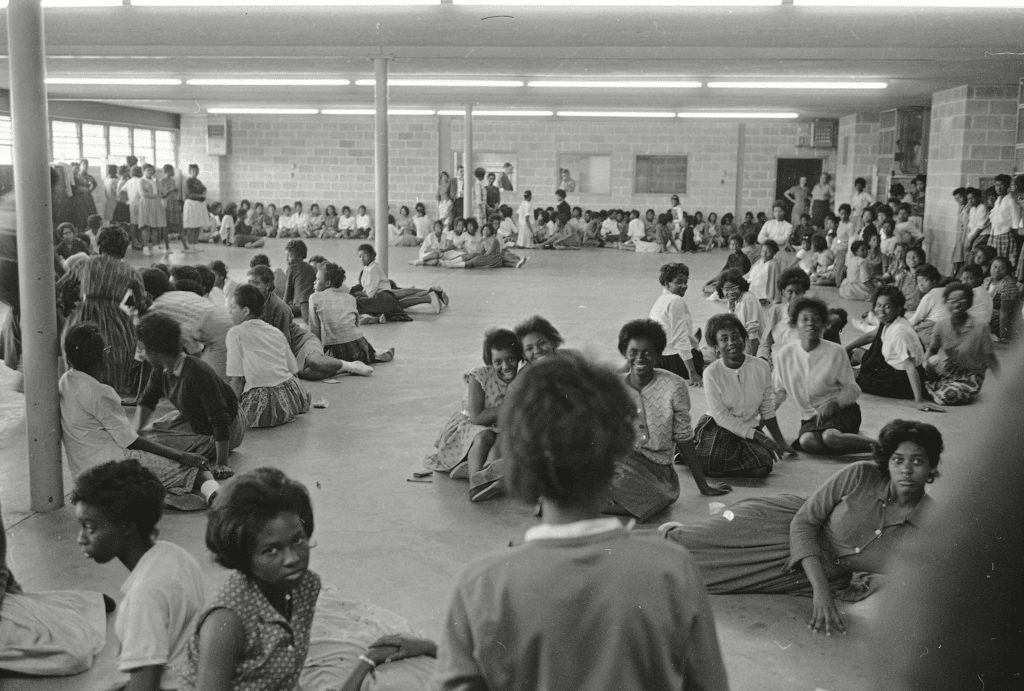
The Black children who led the direct action in early May 1963 understood exactly what they were fighting against. In fact, they understood it as part of a larger struggle—an extension of the boycotts and picketing that had characterized the early part of the Birmingham Campaign. As Shirley Holmes Sims, a senior in high school during the campaign, explained:
In the spring of 1963, all of the Black people stopped shopping in the department stores in downtown Birmingham. It hurt a little because I enjoyed shopping; however, I stopped for a cause and that cause showed the other people we were just as equal as they were and our money made their money grow.
Sims would be expelled for her participation in the Children’s Crusade, missing her prom and graduating only after a court order.
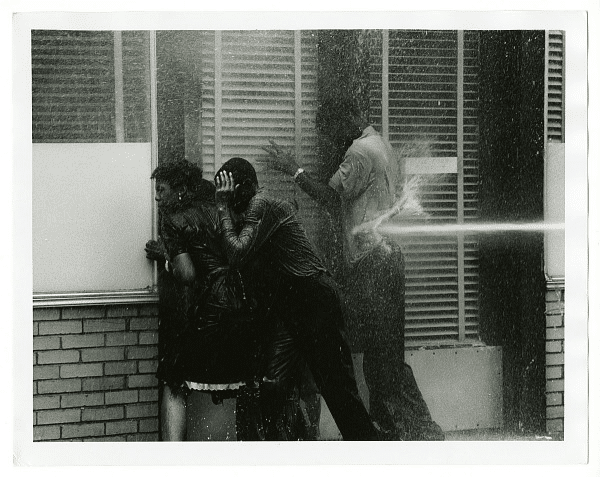
Amid footage of the brutal assaults by police dogs and water cannons, Walter Cronkite lectured audiences, “Sometimes the negroes were not able to contain their anger, to remain nonviolent, and they fought back.” While we should treat police reports about demonstrators with a healthy dose of skepticism, it’s especially important that we note the embrace of repressive state violence for what it is: not democracy, but fascism.
READ: White ‘Moderates’ and Despotism: An Example from the Archive
Over the course of the demonstrations, Birmingham police tried unsuccessfully to put down the rebellion with beatings, attack dogs, fire hoses, and mass arrests, incarcerating hundreds of schoolchildren over the course of the uprising. But the footage and recordings that news crews captured during the campaign drew attention to the apparatus of state violence that transformed a middle-class Black community into a war zone. The ensuing public pressure from this national attention forced the Kennedy administration, which had attempted to placate segregationists while hiding behind moderate civil rights rhetoric, to support what would become the Civil Rights Act of 1964.
While we may be tempted to look at the ensuing civil and voting rights legislation of the 1960s as a vindication of the state and its systems, Black thinkers and organizers understood this process very differently. As Dr. King explained in ”The Other America,” it was the pressure of “militant massive non-violence” that forced a reluctant state into action:
I never will forget when we came through Washington in 1964, in December coming from Oslo. I stopped by to see President Johnson. We talked about a lot of things and we finally got to the point of talking about voting rights. The President was concerned about voting, but he said Martin, I can’t get this through in this session of Congress… And then he went on to say that if I push a voting rights bill now, I’ll lose the support of seven congressmen that I sorely need for the particular things that I had and we just can’t get it. Well, I went on to say to the President that I felt that we had to do something about it and two weeks later we started a movement in Selma, Alabama. We started dramatizing the issue of the denial of the right to vote and I submit to you that three months later as a result of that Selma movement, the same President who said to me that we could not get a voting rights bill in that session of Congress was on the television singing through a speaking voice “we shall overcome” and calling for the passage of a voting rights bill.
It may be tempting, too, to hide behind the language of “promises and contradictions” to explain the unwillingness of the American government to actually advance and enforce its rhetoric of rights and equality, but this is simply a tactic designed to deflect responsibility for systemic violence away from those actually in charge of managing it. It is profoundly unserious to claim, as we must if we are to believe this nonsense, that those in power are either ignorant of the impact or powerless to change the systems that they themselves govern.
In 2013, on the 50th anniversary of the Birmingham Children’s Crusade, Harold Jackson, who was only ten years old at the time of the uprising, reflected on its legacies. “Racism birthed the educational and health disparities that continue among blacks,” he argued, “but the right economic policies, even if applied in a color-blind fashion, could be their cure.”
Reading between the lines, Jackson reminds us that state policies created a sprawling system of inequality. Yet rather than taking aggressive action to right these wrongs, the United States has engaged in little more than hand-wringing as white conservatives and their auxiliaries on the beats, streets, and in the courts have dismantled the paltry gains of the civil rights era. They are, at this very moment, working to make it impossible even to learn about the actual history of state violence and plunder in this country.
It doesn’t have to be this way.
A livable, equitable and just society is possible. But as the Black children and organizers of 1963 Birmingham remind us, that way forward lies together, in defiance, in the sabotage of fascist governance, and in solidarity towards mutual liberation.