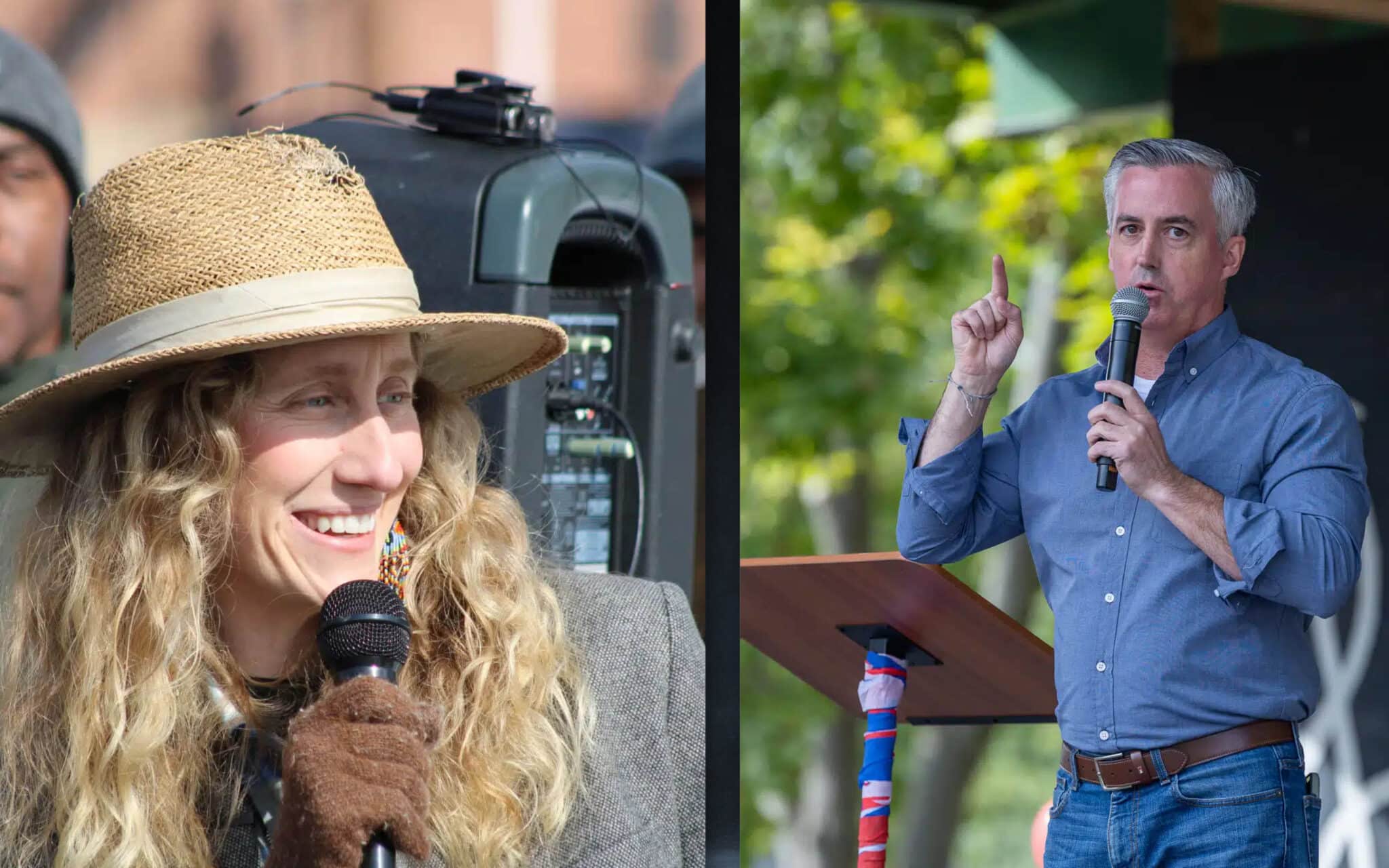
More than 68,000 Democratic voters in Bucks County turned out for Tuesday’s primary election and voted for the two candidates vying for the nomination to unseat PA-01 Republican incumbent Brian Fitzpatrick. After the votes were counted, 65% voted for the party-endorsed candidate Bob Harvie compared to the 34% upstart progressive Lucia Simonelli received after a little more than 6 weeks of grassroots campaigning. What does this result tell us?
It actually speaks well for our democracy, and is a surprisingly positive outcome for inspiring candidates like Simonelli.
A primary election should be the time when parties test the waters and learn what resonates with voters. It is not the general election, when the stakes are binary and the overriding goal is simply to elect the party nominee. Primaries are where differences — and even disagreements — should be allowed and encouraged. A primary is not a coronation. It is an opportunity for voters to provide feedback, for parties to refine their message, and for platforms to be calibrated around what actually connects with the electorate.
That result sends a strong message from the electorate. Many voters — including party insiders — are looking for change. They are looking for leadership that not only speaks about Democratic values, but also proposes concrete policies and programs capable of delivering on them. Many are tired of maintaining the status quo and recycling the same governing tactics with only a change in party label.
In early 2025, when Bob Harvie announced his candidacy for the Democratic nomination for the PA-01 congressional seat, I thought, “Okay, maybe he has a chance,” and promptly sent in my contribution.
As the year went by, I watched the Trump- and Fitzpatrick-bashing campaign strategy unfold, but I heard little in the way of new ideas or excitement about what Democrats actually planned for the future — especially considering Trump would still be in office for another two years. Around that time, I noticed a new entry into the race: a young mathematician with a PhD who is a climate scientist, and former staffer for respected Rhode Island Senator Sheldon Whitehouse. To me, that background reflected disciplined, logical, forward-thinking leadership combined with legislative know-how.
Many voters — including party insiders — are looking for change. They are looking for leadership that not only speaks about Democratic values, but also proposes concrete policies and programs capable of delivering on them.
When she appeared at candidate forums, she brought a voice, perspective, sound reasoning, and a pathway toward actually delivering something meaningful for the public. It was refreshing and inspiring. I was impressed and decided to support her in the primary because she offered Democrats a genuine alternative for leadership in an increasingly dysfunctional Congress.
Approximately 350 party committee members and officials voted to endorse Bob Harvie on February 21, yet Lucia still managed to gather more than 1,700 signatures despite the party endorsement, becoming the only other candidate on the Democratic primary ballot for the May 19 election. From that point on, party resources were fully dedicated to the endorsed candidate, while efforts seemed focused on minimizing or ignoring the fact that another legitimate and qualified Democratic candidate was also running.
Voters should be armed with sufficient information to make informed decisions. Candidate forums are one of the best vehicles for accomplishing that goal because meaningful debate strengthens not only voters, but ultimately the eventual nominee as well.
When one candidate forum finally took place, it laid bare the contrast between the two Democratic candidates. Their positions and understanding of what we need from a congressional legislator could not have been more different. Over the course of 20 questions covering health care, the environment, immigration and ICE, education, AI and data centers, and committee priorities, the distinctions became unmistakably clear.
The forum provided an important public service by allowing voters to see firsthand that candidates cannot simply be assumed to share the same priorities because they carry the same party label or receive the party’s seal of approval.
Lucia, through sheer determination and with very limited resources, ran a grassroots, volunteer-driven campaign. Among voters who got to know her, support for her was overwhelming. In less than two months, through hard groundwork and social media outreach alone, she won 34% of the primary vote.
That result sends a strong message from the electorate: Many voters — including party insiders — are looking for change. Many are tired of maintaining the status quo and recycling the same governing tactics with only a change in party label.
What I learned is that politics is messy, and democracy is not always efficient — but we all need to keep an open mind, continue learning, and think critically. We are where we are as a country because too many people no longer apply critical thinking and instead follow populist leaders or party leadership, a problem visible in both parties.
I also learned that local media matters, and that simply remaining “neutral” in reporting can sometimes become counterproductive when voters are denied meaningful context or comparison.
READ: Lucia Simonelli Wants PA-01 Democrats to Vote Their Hopes, Not Their Fears
Most importantly, I learned that there is a real appetite for change and action. In such a short period of time, we saw that energy begin to rise. One-third of primary voters chose someone new — someone not endorsed by the party establishment.
As someone who has actively supported Democrats for the past 20 years, I believe we need to encourage and welcome new entrants into politics. We need fresh ideas, new perspectives, and leaders whose greatest qualification is not party longevity, but their willingness to serve, think critically, and challenge assumptions.
I hope the party takes the lessons of this primary to heart. I also hope that voters recognize that their voices are their strength and that they need to raise the volume not just on Election Day, but year round.
Voters are our hope, and they are our future.