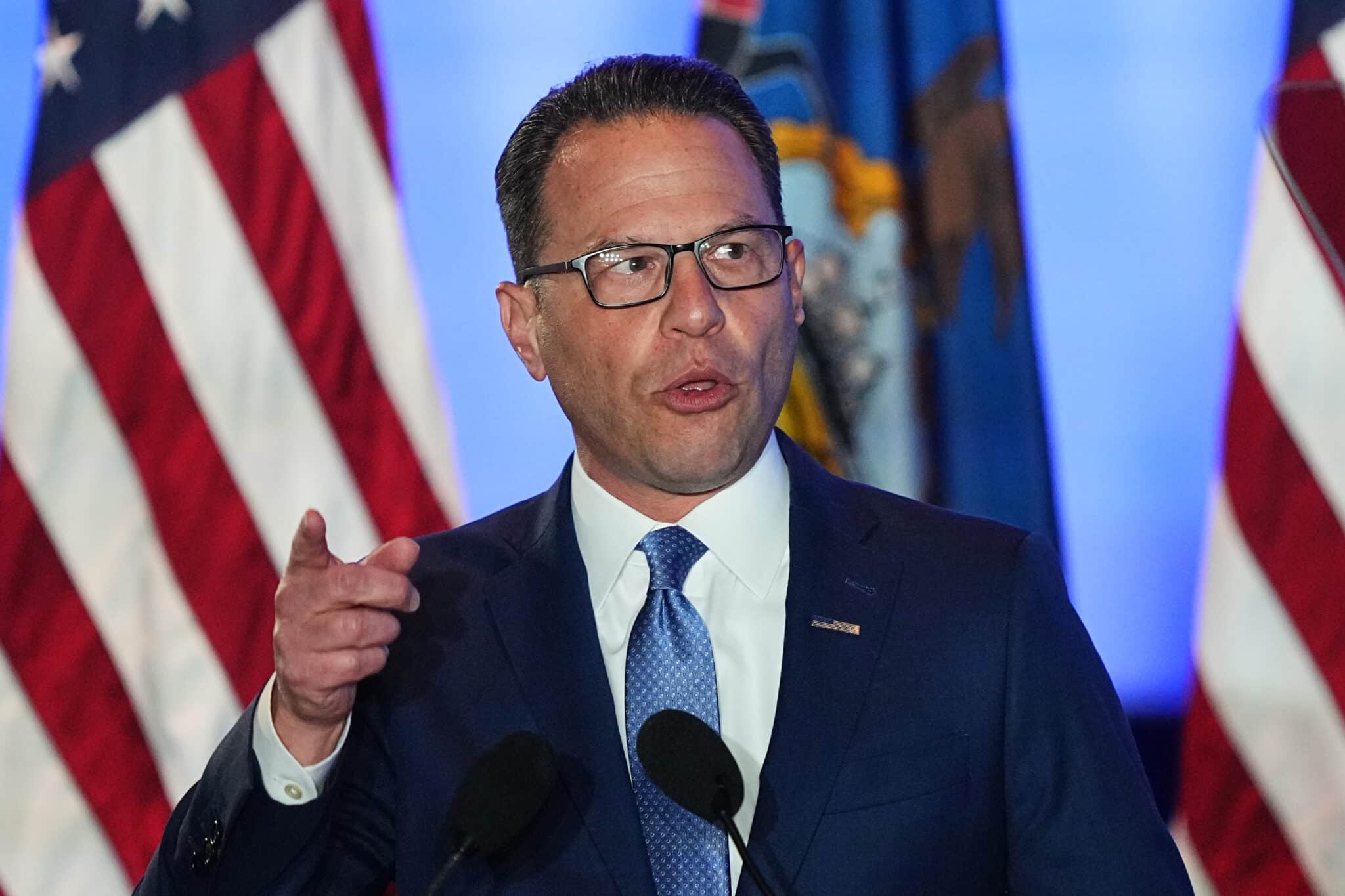
Democratic Governors Jared Polis of Colorado and Kathy Hochul of New York have both agreed to join in Donald Trump’s pet program for schools, and now eyes are turning toward Pennsylvania Governor Josh Shapiro, urging him to bring the state under the Trumpian education wing.
He should not. Here’s why.
The federal voucher program
When the GOP passed Trump’s so-called One Big Beautiful Bill, they included the Education Choice for Children Act, the first-ever federal school voucher program. When she was Education Secretary, Betsy DeVos tried hard to make “Education Freedom” scholarships work, but failed; now they are back with a new coat of paint.
The program is a “tax credit scholarship” program, offering an unprecedented dollar-for-dollar tax credit for up to $1,700 donated to the program. Those collected dollars would in turn be used to fund education vouchers for students in participating states.
Why a tax credit scholarship
Tax credit scholarships were created as a work-around for school vouchers. School vouchers are used primarily for paying tuition for private religious schools. In many states, there are both legal and political barriers to giving state tax dollars to private religious schools. Supporters of tax credit scholarships argue that since the money bypasses the government, no taxpayer funds are spent on private schools; the money has been laundered clean of any government association.
This is a distinction without a difference. Imagine the following scenario.
Your spouse sends you to collect the $100 that your brother owes you, and tells you that you had better not spend any of that money on beer, because you need it for groceries. So you go to see your brother and you make a deal—he can just give you $50 and two cases of beer, and you’ll call it even. Quiz question: when you get home and explain to your spouse that you didn’t spend a cent on beer, will your spouse smile and say, “Right you are. I have no reason to be upset.” Also, you will still be $50 short in your grocery budget.
READ: The GOP House Budget Bill Also Takes Aim at Public Education with Its Private School Voucher Scheme
That’s why most states with tax credit scholarships (including Pennsylvania, but we’ll get back to that) have a limit on how many tax credits can be claimed: because every tax credit issued to fund the vouchers leaves a corresponding hole in state revenues.
There is no upper limit on the amount of tax credits the federal program will allow. The federal program has one advantage over state programs; while states must balance their budgets, the feds will be able to just add the revenue shortfall to the budget deficit.
Not every state is fooled
If that seems like a somewhat transparent scam, know that not every state has bought into the tax credit scholarship concept.
The Kentucky Supreme Court threw out that state’s attempt at a tax credit voucher, noting exactly where the tax credit argument fails. “The money at issue cannot be characterized as simply private funds,” they wrote, “rather it represents the tax liability that the taxpayer would otherwise owe.”
Kentucky’s constitution, like many others, specifically forbids the spending of taxpayer funds on private (religious) schools. So the court found “the funds at issue are sums legally owed to the Commonwealth of Kentucky and subject to collection for public use including allocation to the Department of Education for primary and secondary education,” and reallocating them to private school tuition is unconstitutional.
What’s a scholarship granting organization?
When people donate to a tax credit scholarship program, someone has to collect that money and dole it out to the students who enroll in the program. That someone is a Scholarship Granting Organization (SGO).
Pennsylvania has hundreds of SGOs, most associated with one particular private school.
SGOs are allowed to keep a cut of the voucher money. Pennsylvania allows for a large 10% of the funding.
Many organizations are setting up national-level SGOs in anticipation of the federal voucher program. Estimates of the amount of money that will be pumped into the program run from $24 billion to upwards of $50 billion. A 10% cut of that represents a pretty hefty pile of money; it’s no wonder that many folks are positioning themselves to grab a slice of that pile.
The American Federation for Children, a group previously run by Betsy DeVos to advocate for school “choice” programs, has set up an SGO, teaming up with Odyssey, an outfit that promises “an automated, end-to-end school choice platform.” The Center for Christian Virtue, a group long active in Ohio with the goal of replacing public schools with private religious schools, has announced it will set up an SGO to go national. There are even small-scale individuals trying to get into the game, like MyChurchSGO, which has promoted the federal program as “God’s New Gold Mine.”
Pennsylvania’s tax credit programs
For over 20 years, Pennsylvania has a pair of tax credit scholarship programs, Educational Improvement Tax Credits (EITC) and Opportunity Scholarship Tax Credits (OSTC). The state has given up over $2 billion in revenue that was directed to those programs instead of the state. As a long-running program, Pennsylvania’s tax credit voucher program provides plenty of examples of how these programs fail the public.
That $2 billion represents funding lost to Pennsylvania taxpayers, and yet, as outlined in a report from Education Voters of Pennsylvania, we know very little about how the money was spent.
Who has actually been served by the vouchers? Have they been served well? In Pennsylvania, we do not know. Would the federal vouchers do a better job? Indications are not promising.
Vouchers do not “rescue” poor students
One of the arguments for vouchers is that it allows poor students the kind of choices usually available only to wealthy families that can choose to live in wealthy neighborhoods.
The usual “rescue the poors” voucher bill will tie eligibility to some percentage of the federal poverty level (for example, the 2025 voucher proposal in PA set eligibility at 250% of federal poverty level). But ECCA sets eligibility to any household income under 300% of area median gross income. So if you live in Scarsdale, where the median household income is $238,478 per year, then you can earn up to $715,434 a year and still be eligible for a voucher for your child.
In the Bucks County area, the median income is $119,400, so federal vouchers would be available to any household earning up to $358,200. According to county figures, only 16% of Bucks County households earned over $200,000; virtually every family is eligible. This is not a program aimed at “rescuing” poor families. EdTrust estimates that roughly 90% of all families in the U.S. would be eligible.
In fact, where states have voucher programs, the vouchers are overwhelmingly used by students who were never in public school in the first place. Vouchers provide a new entitlement for private school families.
Supporters may say, “So what? The program makes school choice available to everyone. Isn’t that great?”
The federal vouchers will not make choice available to everyone
One consistent feature of all voucher programs is that they hold inviolate the school’s “right” to discriminate against whatever students they prefer not to serve.
Pennsylvania is typical. When Ed Voters of Pennsylvania dug through a list of OTSC schools, they found that all had policies that allowed them to pick and choose students. None of the discrimination was quiet or subtle, but was instead a matter of the school’s written policy.
Voucher-receiving schools indicate they will not provide services for students with special needs; to use the vouchers, families must waive their student’s Individualized Education Program (if the school will accept them at all).
Private schools may discriminate on the basis of religion. Linville Hill Christian School requires one or both parents to be born again Christians. Heritage Christian School of West Perry requires families to attend a “Bible-believing church.” Many schools reject LGBTQ students.
And many schools reserve the right to reject students for not being the right fit. Mt. Moriah Christian School states plainly “Mt. Moriah Christian School reserves the right to dismiss any student at any time as we may deem necessary.” Red Lion Christian School reserve the right of not explaining why a student has not been accepted.
At the same time, studies have found that in states such as Iowa, school vouchers have led to tuition increases at private schools, keeping the school financially out of reach of non-wealthy families.
As Kayla Patrick and Loredana Valtierra wrote for the Century Foundation:
It’s the private schools, not families, who ultimately decide who enrolls, and they do so outside the accountability systems that govern public education and public dollars and ensure every student has equal opportunity to learn.
It’s also important to remember that students in the state’s rural areas have far fewer choices available. There are roughly 2,200 private schools in Pennsylvania; some of them are Amish schools, some are alternative schools, some are relatively tiny, and they are not distributed evenly around the state.
Vouchers do not provide superior results
Study after study after study shows that voucher programs do not produce better academic outcomes. Scholar Josh Cowen has studied voucher programs for years, and has concluded that the effect of vouchers on test scores is “on par with what the COVID-19 pandemic did to test scores.”
There are multiple reasons for this, but one major factor is that voucher dollars incentivize the creation of fly-by-night operations. These schools, set up to profit from taxpayer funding, are far more likely to accept students than an exclusive operation like The Hill School.
Trump is not offering “free federal money”
It is an interesting new spectacle to see that folks who brag about kicking people off of food assistance, support elimination of medical coverage, and argue that it’s “not possible to pay for daycare” now arguing that states should take Trump’s offer of free federal money. But this new funding is not free; as shown above, it creates a revenue loss that must be either made up with tax increases, service cuts, or a greater federal deficit.
Vouchers will not benefit public schools
The argument has been made that the federal vouchers may give taxpayer funding not just to private schools. Because the specific rules governing the vouchers haven’t been written yet, much of this argument is speculative. But it seems unlikely that students would receive “scholarships” to the public schools they can already attend for free.
Public school students might be able to use vouchers for tutoring or after-school programs, but this would be an exceptionally inefficient way to fund such programs, considering that 10% of the funding would be lost to the SGOs administering the programs. It would be far more effective for the government to simply collect the taxes they were owed and use that revenue to fund after-school and tutoring programs directly.
At the same time, public schools that lost students to the vouchers would face the prospect of losing per-pupil funding even though they would still carry stranded costs (building, transportation, etc).
A back door entitlement
There’s a reason that supporters of the federal vouchers don’t want us to use the word “voucher.” School vouchers remain unpopular with voters. No state’s voters have ever approved a voucher program; every voucher program in the country has been created by legislators doing an end run around the voters. In the 2024 elections, the three states that held a vote on vouchers found the voters—including voters who were overwhelmingly pro-Trump—rejected school vouchers.
But some legislators are determined to create this new entitlement for private religious schools and the families who attend them. “If you will abandon the public school system,” goes the pitch, “we will write you a nice check.” The federal taxpayer-funded school voucher program is seen by the privatizing crowd as a chance to do an end run around the voters in blue states and the Democrats they have elected.
Pennsylvania is particularly attractive. Shapiro has often been voucher-friendly, and Pennsylvania billionaire Jeffrey Yass has invested piles of money all across the country to make vouchers happen. Voucher programs always grow incrementally once the door is cracked open, and this federal voucher proposes to take a sledgehammer to the doors of states that have been resistant. What does the future hold? If a future administration reverses ECCA, will state government be pressured to make state taxpayers pick up the slack?
But opting in to Trump’s tax sheltering, money laundering, deficit building, education privatizing scheme is a bad idea. Here’s hoping that Governor Shapiro says no.