Two staff members at Delaware Valley University provided their perspectives on the college’s history of experiential learning in a new book on the subject.
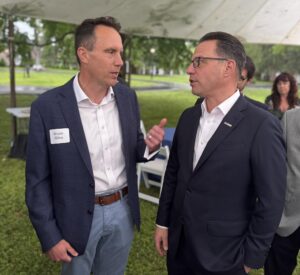
Dean of Student Support Andrew Moyer and Director of Student Professional Development Laura Craig collaborated on one of the book’s chapters. Co-editor of the book Jeffrey Breese invited the pair to provide their insights into Delaware Valley’s commitment to and history of experiential learning.
High Impact & Experiential Learning as Enhancing Quality on Campus — written by 31 different higher education professionals and published by Vernon Press in February 2026 — examines the role experiential learning plays in strengthening student outcomes at higher education institutions.
Experiential learning at Delaware Valley
The chapter Moyer and Craig worked on focuses on the university’s foundation — rooted in experiential learning. Delaware Valley University was founded in 1896 as the National Farm School, based on founder Joseph Krauskopf’s idea of “science with practice.”
Today, the university is committed to experiential learning through The Experience360 Program focused on “integrating classroom knowledge with real-world experience.”
“I always appreciate the opportunity to assess and reflect on the power of the E360 Program,” Moyer said. “Working on this chapter reminded me, once again, that we are preparing students for their future success through high-quality experiences as a student.”
Delaware Valley is part of a small number of colleges that require experiential learning in their curriculum. Students can participate in experiments at the campus’s 1,000-acre living laboratories or learn in the field with one of the university’s partners, like Warwick Farm Brewing.
“The fact that DelVal has truly been doing this from the beginning is noteworthy. Even though the market has many more institutions that require experiential learning, it’s relatively few who require the same thing for everyone,” Craig said.