Alexis de Tocqueville, the French political philosopher who traveled around America in the 1830s, famously observed that Americans were a “nation of joiners.” He was struck by something he did not see in Europe: the instinct of ordinary people to come together — in civic associations, religious communities, fraternal organizations, and local clubs — to solve shared problems, cultivate shared fate, and build shared lives.
For much of the 20th century, that instinct held. In the 1950s, Americans belonged to local Leagues of Women Voters, bowling clubs, the Elks, the VFW, PTAs, faith communities, and so much more. These were not just social outlets. They were the connective tissue of a functioning democracy, the places where neighbors became citizens, and citizens became community. We learned to disagree and compromise. We learned to trust each other, and that we had good intentions even if we held different ideas about how to achieve similar goals. This foundation is vital for a functioning democracy.
But this connective tissue has been fraying. Since the 1970s, membership in civic organizations has declined steadily across the United States (Putnam 2000). We have become, in the words of Robert Putnam’s landmark study, a nation that “bowls alone.”
The consequences have been profound and personal. The United States Surgeon General declared loneliness a public health epidemic in 2023, finding that roughly half of American adults report measurable levels of loneliness (U.S. Surgeon General’s Advisory, 2023). A 2025 Rand/Connection Institute study found that Americans’ sense of social connectedness has reached historic lows (Holt-Lunstad et al., 2025). At the same time, political polarization has deepened, eroding trust not just in our political opponents, but in our neighbors and in our public institutions (Pew Research Center; Dean 2024). Anxiety and stress about the future of the nation are on the rise across every age group (American Psychiatric Association 2024; American Psychological Association 2025).
It is a troubling picture. But here is what the research also tells us: there is a solution. And it is simpler, and more local, than you might think.
Study after study has found that the single most effective antidote to feelings of despair, disaffection, and despondency is not money, or exercise, or education, or employment, though all of these help. It is connection. And the most reliable path to meaningful connection is engagement in your community: showing up, in person, alongside your neighbors, for a shared purpose (Holt-Lunstad et al., 2025; Fenn et al., Journal of Youth Studies, 2024).
Fortunately, Election Day is coming. And democracy needs volunteers.
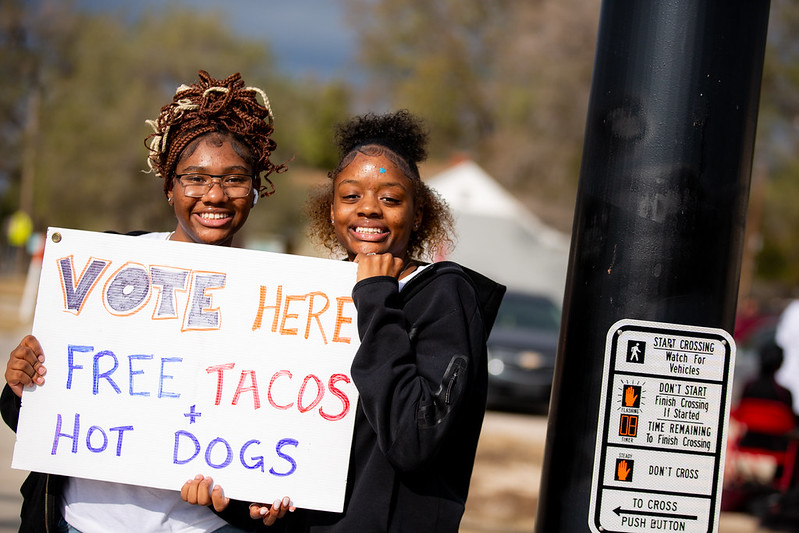
Across Pennsylvania, there are more than 9,000 voting precincts and each one needs at least five people to staff it on Election Day. And that’s just inside the polls. This does not count the poll monitors and greeters outside polling locations, the volunteers who drive voters to the polls, the people who give their time to observe the certification process, or the advocates who show up year-round to Board of Elections meetings to push for pro-voter policies, just to name some of the many volunteer opportunities that exist around Election Day.
Every one of these opportunities happens right in your neighborhood and in your county, among the people who share your streets and your schools and your grocery stores. When you volunteer at your local polling place, you are not just serving democracy in the abstract. You are meeting the person who lives three blocks away. You are learning the name of the neighbor you have waved at for years but never actually spoken to. You are becoming, in the most real and practical sense, part of the fabric of your community.
These micro-connections — the small, repeated, face-to-face interactions that happen when people share space and a brief interaction — have real and measurable effects on our mood and, in the aggregate, on our health and wellbeing (Sandstrom 2026). They are the building blocks of the trust that makes neighborhoods function, that makes democracy possible, and that makes life feel less isolating, more joyful, and more meaningful (Sandstrom 2026).
De Tocqueville understood this two centuries ago. The research confirms it today. And the opportunities are right in front of us.
So here is our invitation: join us. Learn how to support our democratic institutions, one neighborhood, one precinct, one conversation at a time. Volunteer as a poll worker, a poll monitor, a driver, an observer. Show up to your county’s Board of Elections meeting. Register voters at your local library or community festival.
You will be making democracy stronger. You will be making your community more connected. And the research is clear: you will be making yourself healthier and happier in the process.
Democracy doesn’t sustain itself. It sustains itself because people show up. We hope you will be one of them.