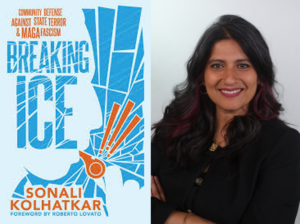

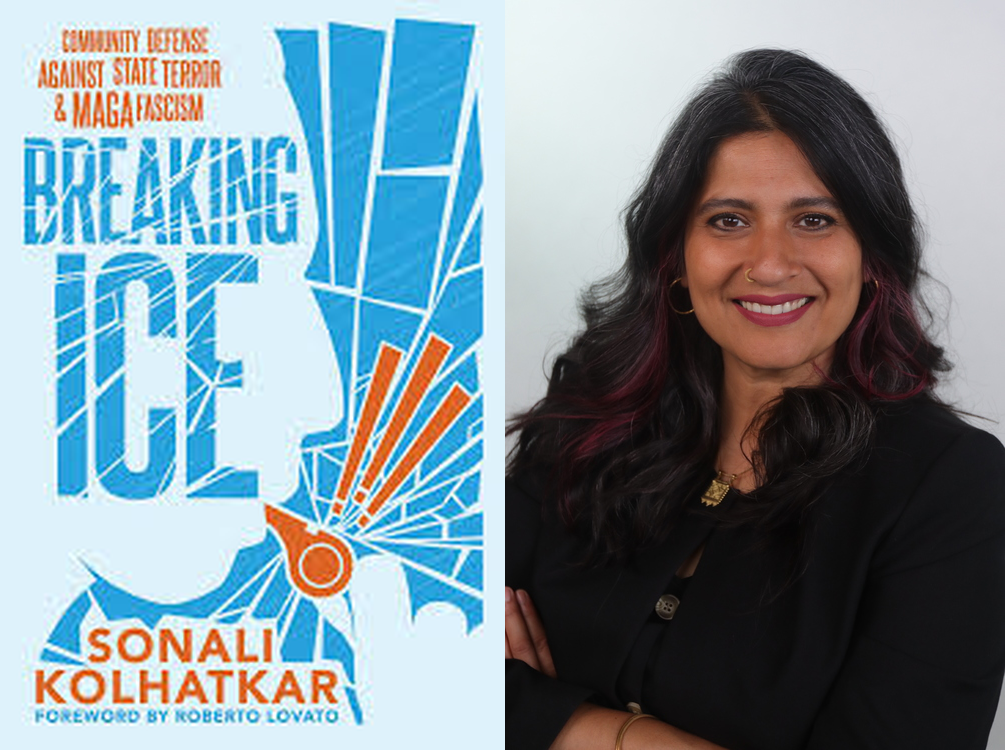
Sonali Kolhatkar is an award-winning multimedia journalist. She is the founder, host, and executive producer of “Rising Up With Sonali,” a weekly subscriber-funded television and radio show that airs on Free Speech TV and Pacifica stations and affiliates around the U.S. Her books include Rising Up: The Power of Narrative in Pursuing Racial Justice (City Lights Books, 2023) and Talking About Abolition: A Police-Free World Is Possible (Seven Stories Press, 2025). Sonali spoke with me to talk about her latest, a timely resistance playbook which was published in September. It’s titled, Breaking ICE: Community Defense Against State Terror and MAGA Fascism.
Listen on Apple, Spotify, Podbean and iheart
Before we start discussing your new book, do you mind if we spend a few minutes just to talk a little bit about you? Where are you and your parents from and when did you come to the United States?
I am originally from India. That is to say, my parents are Indian citizens. They were born there, but I was born and raised in the United Arab Emirates in Dubai. They moved there very soon after they got married and lived there for 51 years. So I went to high school there, I was raised there, born and raised there, went to high school there, and at age 16 I moved to the United States by myself to go to college for university at the University of Texas at Austin to study Physics. And it was the early 90s, hard to imagine now because I just dropped off my oldest to college. And so I’m reliving a little bit of that. But yeah, I was I was quite young when I came.
And what was your experience like, your immigrant experience like then in college?
It was a culture shock for sure. I had lots of preconceived notions about the United States. Everything I knew about the U.S. was from movies. My family had this set of encyclopedias in our living room, and I remember pulling them out and looking through them and looking up Texas and I thought it was hilarious that there was a place in Texas called Waco, which I realized later was Waco. But I was mistaken often for being Latina. So people would stop me in the street and sometimes talk to me in Spanish. And I quickly understood like what that was all about. But it was it was tough. That said, people were very friendly and it ended up being like a wonderfully formative experience. And Austin used to be a fantastic city til the billionaires and tech bros ruined it. But it was it was a very interesting, very eye-opening, very, very much a culture shock and an understanding in a very real way of like the U.S. that we see presented in pop culture versus the real America, if you will, and a piece of it, because it’s a very big country. There’s lots of cultural differences and Texas has its own sort of unique culture that I that I got to know over five years of living there.
And then you finally became a U.S. citizen in two thousand nine, but that wasn’t an easy road for you, was it?
No, it was very complicated, as it is for everybody who comes into this country trying to quote unquote do it the right way. So I came in on an F1 student visa and eventually when I graduated I got a job, but before I could get a job I had to get a work permit waited in long lines, got the work permit, was working, got married while I was on the work permits, so then had to apply for a green card, stayed on that green card for five years. And up until that point, everything was fairly sort of standard, difficult, complicated, tons of paperwork and time consuming, but standard. Once I applied for my citizenship, things got a little bit different. So, of course, 2001, we saw the September 11th attacks. That was right around when I had applied for my green card, and five years later, I applied actually in 1999. So five years later, when I went to do the steps for the citizenship application, I went through every bit of it til the very last part, which was I studied, I passed the test, and that last interview where it would have just been like them signing off and telling me, you’ll get something in the mail about the ceremony, at that point the person interviewing me said that there was an FBI background check. It’s sort of a standard thing, and then you’ll find out. And I said, Well, how long will that background check take? And so they said, Well, at this point we don’t know these days anymore. And so, what does that mean? It could take, it could take forever. And it did. So I waited, and I waited, and I waited. Normally that step would just take a few weeks. Months later, years later, I was still waiting. And it turned out that I was among thousands of people waiting for this so-called FBI background check to be completed, who didn’t have any idea why they were flagged. I still don’t until today. And I ended up joining a class action lawsuit as a lead plaintiff in a suit led by like the ACLU, the National Immigrant Law Center, and the Homeland Security Department was forced to give me my citizenship.
I mean the class action lawsuit was won and they still didn’t give it and then they were kind of like forced to do it. A judge had to force DHS to give me my citizenship and that that culminated in 2009.
So for several years I had no idea what was happening and I waited and it was nothing I did or what any anybody else did. I thought maybe they were singling me out because I was a journalist or that I was a political journalist. Maybe it was because I was born in the UAE. I really have no idea. But yeah, it hasn’t been easy. Then I tried to bring my parents over because they’re very elderly. And then in the last year of Trump’s first term, he just outright banned green card applications. Just banned them, absolutely no good reason. Just banned them. And so they were stuck waiting as well. And eventually when Biden came into power, reversed that, took him about six months, their green cards were immediately approved and they now live with me. So yeah, I have directly experienced the ins and outs and trials and travails of the legal immigration system of the United States.
It is not easy.
So let’s get to the reason or the main reason why I invited you on, which is your new book published by Seven Stories Press, Breaking ICE: Community Defense Against State Terror and MAGA Fascism. Now, I’m assuming one reason you decided to write this book is an obvious one. And it’s just as a response to this new manifestation of ICE, which transformed it into a masked right-wing paramilitary group unleashed to violently terrorize communities across the country and to essentially do so with impunity. How did you decide that you were in a place to tell this story and the many stories within it to help people not only make sense of the moment we find ourselves in, but also to offer a sort of resistance playbook that readers can take from and apply to their own organizing.
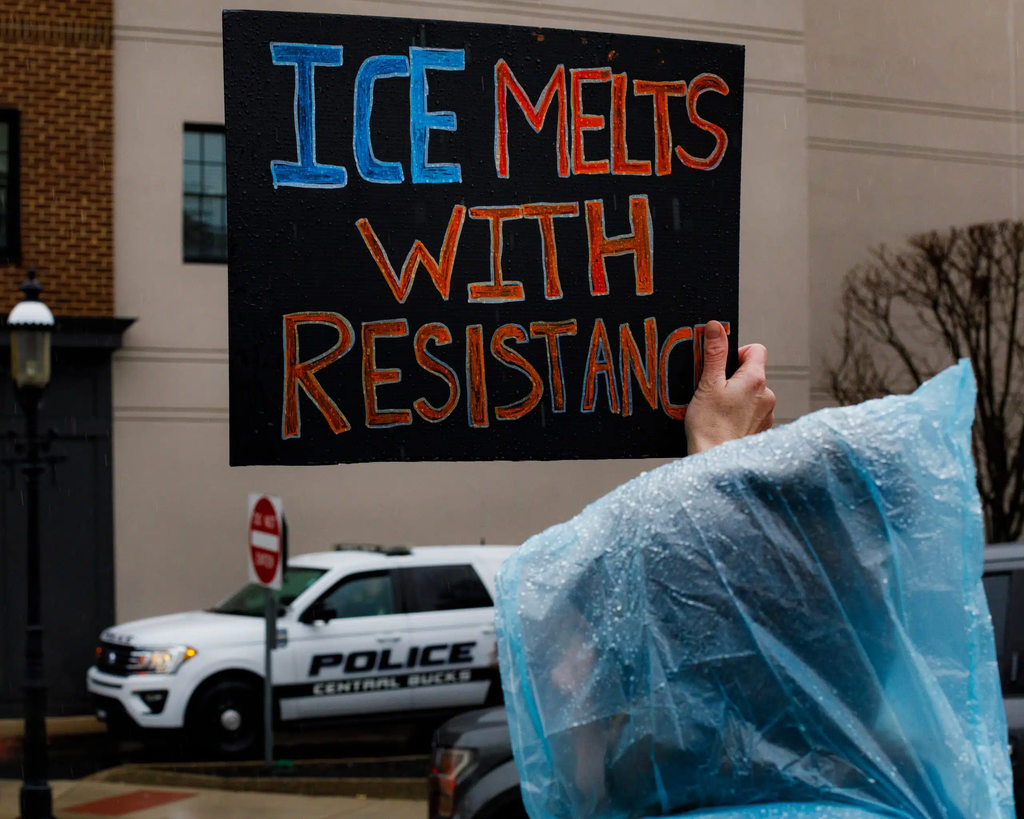
Well, I’m in the Los Angeles area. That already put me in an opportune place geographically to cover what was happening both with the ICE invasion and the response to it. L.A. is the most immigrant-rich city in the nation, rivaling only New York City. And it is where the Trump administration decided to test out the Kristi Noem approach to ICE invasions and detentions and deportations in June 2025, we were on the front lines. L.A. was on the front lines of that, the terror, the wave of terror that ICE fomented and spread. And we were also the place that was highly organized, right? So that’s another thing that made L.A. such a useful place.
But in terms of me being appropriate to cover it, I do solutions journalism. So when I worked at Yes Magazine, which is one of was up until it closed down last year, was one of the leading solutions journalism outlets in the country, I learned how to change my focus as a journalist from the things that are devastating our nation and our world to uplifting how people are going about fixing our nation and our world. And so right from the start, my focus on the ICE raids was a very close look at how people were fighting back. And so while the New York Times or CNN would put a lens on the brutality of ICE and the bravery of activists, what they didn’t dig into was that that resistance had been, had its seeds sown for a long time.
It wasn’t spontaneous. It was something that activists were expecting the ICE raids to happen, were planning for it. They had practice from Trump’s first term. At the beginning of Trump’s second term, they organized, they met, they formed coalitions, they came up with playbooks, and so when the ICE raid happened, they immediately responded and they and they over months beat the ICE machine back. And that version of the story, the real version of the story, is something that we didn’t see very many places. And when my editor, longtime editor at Seven Stories Press, Greg Ruggiero, saw one of the interviews I had done, actually this one was not in L.A. He saw the one I did from Minneapolis with Yohuru Williams, a wonderful historian. And Greg saw that interview and he said, Do you have more of these? And if you do, could we collect them, the transcripts of these interviews, into a book? And I said, Yeah, I think so. I mean, I’ve been doing a lot of these interviews. And then he said, Well, and can you do it in six weeks so that we can like fast track it for publication in the fall? I do not know what possessed me to say yes, but I did. And I’m glad I did because it captured this moment in time. So I mean that’s a little bit of where the book came from and how it was conceived.
And the first part of the book, in separate interviews, you talk to nine people from different parts of the country who you describe as “foot soldiers of a well-organized community self-defense movement that has been remarkably successful in pushing back against white supremacist violence and the notion of a white homeland.” First, were there any organizing principles, strategies, or tactics that the people you interviewed talked about that you saw could be kind of applied universally? And then what were some of the differences maybe that might have depended on locale or the types of communities these folks were organizing in?
Different communities did it slightly differently, but they shared playbooks. So I’ll give you, for example, in L.A., people were outraged when David Huerta, the SEIU president, was arrested and detained, and roughed up and, head hit against the curb and in and detained in the Metropolitan Detention Center in downtown L.A., organized labor responded like nobody’s business. They showed up in tens of thousands the very next day. And ICE kind of realized they’d overplayed their hand right in that moment. And it helped galvanize the local organizing. Also in L.A., there was a focus on the parking lots of big box stores like Home Depot because activists were realizing that they were using, ICE was using parking lots as staging grounds. And so people were keeping track of that. There was a lot of really careful social media documentation, following cars around, writing down license plate numbers, posting them online, letting people know where the ICE activity was happening most, videos of how people were snatching them up.
Also one interesting thing in L.A. was that when people discovered where ICE agents were being held at hotels or not being held where they were live where they were staying at hotels, activists showed up outside those hotels with bullhorns and kept them up all night. And then these became physical places, gathering places for for the general community to come.
In my hometown of Pasadena, I spoke right outside of the AC Hotel with Pablo Alvarado, head of NDLON, who was out there giving interviews and was part of this organized noise-making campaign.
And then in other parts of the country, we saw slightly different things. We saw in Chicago people had an incredible handbook of resistance that they shared with Minneapolis activists. Like there was a Zoom call or several Zoom calls where hundreds of Minneapolis residents got trained up by Chicago activists on how to respond to ICE. In Chicago, I spoke with people like Richard Wallace, who is a longtime activist and organizer working around abolition, with an abolitionist framework and working on basic income projects with formerly incarcerated people. And he was pointing out how they had to really scramble on the Know Your Rights cards that they were handing out to update them because, they knew what to do when local police stop you and how to tell people what their rights are. But it’s different for federal police. The reaction is different. The requests are different. So people got really organized and trained themselves to ask for judicial warrants signed by a judge, right? Not just stamped. And in places like North Carolina, Charlotte, North Carolina, where I spoke with Nikki Marín Baena of Siembra NC, they had a handbook for like a playbook for how to respond to ICE, and they were sharing that online. And Nikki pointed out how lessons from the civil rights movement were very present in their activism. They would sometimes hold hands and sing together to bring down the temperature of the violent ICE arrests. And of course the with the whistles and there were all these incredibly creative, exciting, interesting ways of resisting ice and alerting people, alerting their neighbors and their community to ICE activity and they called it community self-defense.
And so the biggest overarching thread framing all of this that I just loved so much and was so excited to understand was this notion that nobody was coming to save people and people realizing that they have to save themselves. And that act of saving themselves was so empowering that it is, I’m hoping, the foundation for how we move forward. The Day Laborers Organizing Network has the slogan that they’ve had for years: solo el pueblo salva al pueblo, only the people can save the people, right? And that realization that the state wasn’t coming to save you because the state was actually actively targeting you…
The enemy was the state.
The enemy was the state.
Cops weren’t coming to save us because cops are police are just an ICE is just another form of policing, federal police as opposed to local police. And so that was I think critical understanding of what community self-defense looked like last year, going through this year, that the mainstream media has completely missed that story.
How do you think they were successful in kind of growing their movements to becoming maybe more inclusive of the general public outside of the activist communities?
So people got involved in ways that they hadn’t gotten involved before. But there was a lot of, like in Minneapolis in particular, this was an epicenter of racial justice resistance now, resistance for racial justice. Because only six years ago we had the George Floyd protests originating in Minneapolis and spreading across the country. And in that moment, you had this multiracial … you know Minneapolis is a fairly white city, but you had this multiracial and multi-sort of like across class divisions movement that sprang up in 2020 and then kind of got beat down by the pundits and the naysayers. But people were able to draw on those networks. That muscle memory of resistance was still there in Minneapolis.
And people who I talk to, like Shannon Gibney, who does activism around the public school system in Minneapolis, pointed out how she and others were able to just reactivate these networks. So bring in those people who are the kind of occasional activists, right? They’re interested in political activism, they know about the issues, but they might be too busy or they’re not thinking about it. It’s not something they necessarily enjoy doing till they have to, and they got pulled into mutual aid work and simple things like helping immigrant families like do drop off for their kids or raising money for rent because their main breadwinner was being detained. And so people, I think did expand those networks. They may contract again as the issues fade away, but ICE is still extremely active.
And now we’re seeing these other issues that are uniting people who again aren’t traditionally activists. You’re seeing, which I didn’t bring this up in the book, but you’re seeing this immense activism around the flock cameras, the ALPRs, automatic license plate readers, that are essentially sweeping up data, using AI to process it, and essentially turning us all into suspects. And, so the Flock surveillance network, and the data centers that are processing this incredible amounts of information, and so people are rising up against those things and are seeing the connections and are becoming activated in ways that they weren’t before.
And that is all related to the white supremacist project of ethnic cleansing, because what better scapegoat and distraction from how tech bros and elites like Elon Musk are fleecing us than to blame immigrants for all the reasons why we can’t afford healthcare.
Could you talk a little bit about maybe more rural organizing, say for example, with the Maine Immigrant Rights Coalition?
Yeah, Maine, Georgia, because in Georgia the activism was around the raid at the Hyundai plant. So, it was like outside city centers like Atlanta. North Carolina as well, a lot of rural organizing.
Maine is such an interesting example because it’s the whitest state in the nation. And the immigrants, but yet there are immigrants there, right? There are literally immigrants are all over the United States.
And this is an aspect that I do, by the way, as just a brief aside to write about in the introduction to the book, which is that it wasn’t just the September 11th attacks that were the pretext for the Department of Homeland Security and white supremacy resurging, but also the Census results from the year 2000 that showed the largest jump in the foreign-born population that the U.S. had ever seen. So immigrants are everywhere now. They aren’t just in the metropolitan centers like L.A., New York, Chicago. They are in rural America. They are in the service industry, they’re in the healthcare industry, they’re in agricultural fields. They are everywhere. And even Trump supporters have very good friends who are immigrants, but they of course don’t make that connection. So in Maine, the majority of immigrants are from Sub-Saharan Africa. So again, a very different situation in Maine, because unlike the rest of the country where it’s largely Latinx or Asian, in Maine you have African immigrants from Sub-Saharan Africa. And people rose up to defend them. Activists rose up to connect with them. Latinx activists rose up to connect with their Black fellow immigrants.
So I spoke with Rubén Torres of the Maine Immigrant Rights Coalition. And the other special challenge with Maine is that when the attacks happened by ICE, it was the dead of winter, right? So just as in Minneapolis and some other northern states, and Midwestern states, you have very harsh winter conditions that people had to deal with on top of their activism. So they adjusted and they pivoted and they did things like helping their neighbors, move their cars on days when the streets were blocked because of snow, etc. Very practical ways of working with their neighbors and their friends and fellow immigrants. And again, the organizing was happening in long established networks that far predated the latest ICE invasion. It’s very difficult to just spontaneously spring up and be very effective at organizing when you have such an attack from the government. So existing organizations, networks, coalitions like the main immigrant rights coalition were mobilized, were were put into play. And we saw the incredible dividends, if you will, to use like capitalist terminology, right that the people’s organizing, long term organizing has paid off in in very profound ways.
Can you explain why you think ICE and the Trump administration’s mass deportation program, if not human trafficking ring, maybe could be considered ethnic cleansing or part of a larger, broader white supremacist political project?
I mean, he says it himself, right? And before I even get to that, I’m so glad you brought up this aspect of trafficking. I was just traveling on book tour and you go into any major airport these days, and when you like get into the bathroom stalls, there’s always a sign about like if you are in danger, if you are being trafficked, if you are being taken somewhere against your will or your passport is being withheld, etc., make this hand gesture to this person wearing this badge, etc. And every time I saw that, I thought to myself, we have anti-trafficking laws on the books that could apply to what ICE is doing to immigrants and actually to US citizens, right? Taking people against their will, transporting them without like disappearing them in that in the system, transporting them far away from where they live, sometimes out of the country, not telling people who care about them, their family and loved ones, how they can find them, deporting them so fast that lawyers don’t have a chance to actually respond, or so slowly that they sometimes die behind bars because of medical neglect, right? That’s all trafficking. Like our government is literally trafficking them.
And so, to your question of how it can be seen as a white supremacist trend. Trump has been so clear about how he doesn’t like the fact that there’s so much immigration from non-white countries, right? He has literally used horrific, Hitlerian, dehumanizing language, equating non-white immigrants, Black and brown immigrants, with animals, equating them as subhumans, and openly saying, why can’t we get immigration from white countries?
And today, the only country where asylum laws actually are being applied is South Africa, specifically aimed at white South Africans. We don’t even have to like analyze the actions, we can just quote the leaders of this system themselves, who are very openly articulating their white supremacist agenda and even has supporters are very, very clear about their moral compass has been readjusted to justify violation and brutality against humans. So any attack on a non-white person by ICE, such as violent arrest or medical neglect, is met with well, they should have followed the rules. They should have known better. It’s not their fault. We love ICE because ICE is keeping us safe. And so what a reconfiguration of our moral compass, a perversion of our moral compass that to fit this ethnic cleansing ideology. And you see it, you can see the echoes of this in so many other historical and even more recent ethnic cleansing disasters where the dominant group of people uses the same kind of language to justify eliminating the vulnerable population. I mean look at look at look at is citizens of Israel who’ve doing interviews with the press ahead of their elections and think about how they talk about Palestinians. This is a similar language, a supremacist Hitlarian language, of a genocide language.
Even in in Guatemala in the eighties, how they spoke about the indigenous population there and then they committed a genocide there as well.
Yes. Absolutely. You can go you can look at Myanmar and the Rohingya. You can look at Rwanda. You can, the Houthis and the Tutsis. You can look at any major genocide. You can look at the internment camps here in the United States aimed at the Japanese people of Japanese origin here in the U.S., right? So over and over again we see the dehumanizing language being part of a genocidal agenda. So ethnic cleansing and all of that in its full glory. It’s happening right now.
It’s important to note though that the barbarism and brutality of the Trump administration isn’t unique or an anomaly to the United States. And then that’s something you kind of dig into in the second part of your book, which examines like the past social movement organizing for immigrant rights and just the multiracial democracy in the country, which is, even though we’re celebrating 250 years, multiracial democracy really has only been around since like 1965 with the Civil Rights Act. And even then there were still problems with it, but it at least then there was finally legal protections. But can you talk a little bit about some of the historical kind of perspectives on both sides that you get into with the interviews in this second section of your book?
Yeah, so the first section, as you pointed out, nine organizers on the front lines. It’s not comprehensive. There’s so many people that I could have talked to, but it was a sampling.
And then the second half is 10 historians, academics, storytellers, thinkers, people who put the big picture view on what we have experienced this past year and a half and what we have experienced way in the past, so that we get an understanding of how to respond in the future, what to expect in the future, right? These are the folks, the storytellers who are really thinking about issues holistically, right? I didn’t want this to just be like a microcosm of the 2025-26 activism. I wanted to zoom out and put into context what we’re experiencing today. And so yes, the civil rights movement in response to Jim Crow segregation and violent racism and the remnants of the mass enslavement and settler colonialism. Also, more recently in … I know not more recently, even before that, waves of anti-immigrant policies that resulted in deport deportations of millions of Mexicans. And of course, if you can go back, we can go really far back in every step of American history there has been this tension between language that has seemed inclusionary, but the realities that have been exclusionary. And actually, even exclusionary language, but justified. So there’s just been this constant tension to claim that the U.S. is a democracy while it … while it tries to apply those ideals to the most narrow, privileged parts of society. And so yeah, I think this was an important thing to remind us, and I put it in the book because I wanted people who are in despair right now, feeling a lot of despair, not only actually, not only come to the realization that actually we had more successes over the past year than we realized, but also that our ancestors have been here before and they persevered. And because they persevered, we are where we are today. Because they persevered, it is not an ethnostate entirely. Because they persevered, we had immigration policies that resulted in a fairer demographic change that resulted, and then because we had movements that demanded equality, we had the Voting Rights Act, which of course now the Supreme Court has all but undone … But it’s too late. The train has left the station, right? So there’s the other thing that I point out. We that Census result in 2000, the thing that caused mass panic among the disproportionately wealthy white members of Congress and their supporters was the projection that whites would be a minority in the year 2055. A few years later that were revised to 2045, right? So that is the precise thing that that prompted the attempt to pass the Senson-Brenor bill to deny immigrants benefits from the government treasury that they paid into their taxes into that got defeated because of mass movements. And so yeah I think that that the country is so multiracial right now, not just because of immigration, but because people have been intermarrying. We have this huge jump in the last census in the mixed race population. Like my children are mixed race. You can no longer cleanly decide this person’s white, this person’s not white. We have become a a nation where our racial makeup is so beautifully varied that it’s kind of, it’s too late. And so now those of us who are on the side of actually wanting to see a multiracial democracy, exist and thrive. So people of color and progressive whites together have the ability, have the numbers and have the power, if we exercise it, to force the white supremacists out. Because this is their dying, this is their last gasp of white supremacy, where they’re so terrified at the gains that have been made by our ancestors.
Yeah, and I think the book’s important not only because you provide that historical perspective, but you’re documenting the social movement resistance of now so that as years go by people can access that. I mean that’s why the current administration and some on the right see history as so subversive and it’s why there’s such a war on history.
And even before, often this social movement history was ignored either intentionally or not. And I think there was some progress made, but that’s why that kind of history they’re explicitly trying to ban from being taught so that people can have a fuller understanding of America’s complicated history. And one of the beautiful things is the social movement uprisings that kind of push back against these reactionary and regressive movements.
Yeah, and on that issue, one of the things that I have sort of seen, I’ve been a journalist for 25, almost 25 years now. And one of the things that I’ve noticed is that those very things that elites are trying to sell us as the things that we want, which is in particular social media, digital platforms and ability to communicate with one another over and over again.
Americans, people all over the world, have reconfigured them, reused them to benefit social movements and organizing, have used them as tools in organizing. And every time we’ve done so very effectively, someone’s come and changed the algorithm or bought it up or to try to take the rug out from under us and destroy our networks, right? We saw with the George Floyd protests, Black Twitter being incredibly important because Darnella Frazier, the young woman who captured the horrific footage of Floyd being killed, because she bypassed corporate media and posted the video directly, it was either Facebook or Twitter or both, and garnered all this attention because the Black Twitter networks was so enmeshed and so well organized that video caught on like wildfire and it had that incredible impact of generating mass outrage and people taking to the streets.
And then Elon Musk bought Twitter, renamed it X, and now we know that it’s a hub for right-wing activity. But people have done this again and again and again. Like TikTok was really central in many movement organizing, including like pro-Palestinian speech. Instagram has been is now like the me the platform de jour for activists trying to organize. And so every step of the way, the products that the predatory capitalists have sold to us, people, our very human impulse to work together to have a better place is is it wins out and we use these mechanisms to talk to one another, to figure out how to be active, to figure out how to to rise up together. My main sort of task, I feel, as a solutions journalist, is to get us beyond organizing into actually articulating the world we want. So the book that I wrote before this was called Talking About Abolition: A Police Free World is Possible. And the reason why I interviewed several Black abolitionists for a book about immigration was to try to bring that lens to it. This is where I feel like the next front in social media organizing and storytelling needs to go so that we can all be united in our broad-based approach for the world we want. We’re already mostly there, but I don’t know if we talk about it as effectively as we could and as we should.
What’s wild to think is that what you were just talking about with like the internet and social media. I mean, that can even be traced back like all the way back to like 1994 with the Zapatistas, right?
Yes. Yes. I mean some of us remember creating our own websites and learning HTML and that ‘90s, that movement that began in the ‘90s where people realized the power of having a central digital space like a billboard to like inform each other of our activities. We took advantage of that right from the start. I remember when the Democratic National Convention came to Los Angeles in 2000, and I was involved before I became a journalist, I was involved with some local activists. And I was working at Cal Tech at the time. And I knew how to make, I had made my own website when I was like a an undergrad. So I was like, sure, I can help. And so we created D2KLA.org.
Right. It was it was the Democratic Convention of 2000. And that was a way that we helped to mobilize people on the streets of Los Angeles against the Democrats who were seen even then, especially then I think, as the this party that has sold out its ideals.
Yeah, and even just around the same time, like just before that, the Battle of Seattle ‘99 with the IMCs, the Indie Media Centers. I mean when I was growing up, that a huge impact on myself as well.
Yes.
Exactly, absolutely. All of those movements, that anti-globalization movement, then the IMF protests in Washington, D.C. after that. It was it was a really interesting time. And people were honing in on predatory capitalism and the globalizing of predatory capitalism in a way that we hadn’t seen in a really long time. All of it derailed after the September 11th attacks.
So what is the world that we should want or aspire toward when it comes to immigration? I know public opinion has kind of shifted a bit and it’s not just because of Trump overplaying his hand with the kind of militarized and violent and repressive actions, but it’s also because of the resistances you write about. But I think so right now I feel like most people think that what ICE is doing is bad. It’s not what we want. But even within people who identify on the Left and you’ve had experience with this, there’s still these kind of like reactionary ideas that scapegoat immigrants or justify thinking that immigrants are responsible for people’s economic woes.
Yeah, I think that there is a lot of potential to get people on our side. There’s some combination of human psychology at play and of effective storytelling. So it’s hard to convince people who’ve bought into a particular ideology, who’ve believed their cult leader that they actually all along they were wrong.
Right. And it’s fun for us to like point out, look, did you really not think what was the thing that the leopard would eat your face type of thing? Like that’s what you signed up for and that’s what you got. But that doesn’t actually necessarily help bring those people over to our side, right? Pointing out how wrong everybody has been, pointing out the ills of the deeply immoral system that we’re in, may elicit outrage, but then what? Beyond that what? What is the thing that we need to articulate to have a world where we can all thrive, where we can experience joy, where we can have fulfilling, happy lives, right? How do we go about redesigning our society to have that? So trickle-down economics, supply side economics was promising that for years.
They’ve failed. They’ve failed. And it shouldn’t surprise anybody that they failed because it was always ludicrous to think that if you throw money at the top, they’re gonna share it with the rest of us. If you throw money at the top, it’s gonna stay at the top. And that’s what’s happened. And it’s continued to be sucked to the top.
So, how do we reverse that equation? And so it’s not always sexy to think about it, but we need to talk about budgets, right? We need to talk about city budgets, we need to talk about state budgets, and we need to talk about the federal budget, and we need to see how skewed all of those budgets are towards armed enforcement. Whether we’re talking about the U.S. military abroad or federal policing, such as ICE and National Guard and CBP Border Patrol, or state police, county police, sheriffs, local police. Every step of budgeting, people are shocked when they find out just how much of their tax dollars goes into armed enforcement.
Armed enforcement of what?
They’re really enforcing racial capitalism. They’re really just there to enforce inequality that happens to be along racial lines. So to pay for this armed enforcement of capitalism, we are all being deprived of Medicare for All, of good schools and debt-free higher education, and you name it, right? All of the things that we need for happiness, for thriving, for living fulfilling lives is underfunded, is defunded, and we’re funding these armed enforcers. And so the answer is really flipping that script, flipping the formula, changing the dynamics, changing the dynamics between what we pay for versus what we really need. And that’s an abolitionist goal, right? Abolition of prisons, abolition of police is built on this idea that we defund those things that don’t keep us safe, such as policing, and we fund the things that do keep us safe, such as jobs, schools, healthcare, etcetera, elder care, all of the things we need. And that we have to start talking about the upstream solutions to the problems that politicians use to freak us out, right? So, what do politicians always tell us? Well, what’s gonna happen about crime? Crime is an issue, everybody’s worried about crime.
People are worried about immigration, people are worried about those foreigners out there, Iranians, Palestinians, et cetera.
Or taking they’re taking their jobs.
Yeah. So they’re worried about yeah, they’re too many people coming and taking our jobs. So okay, so if you really do care about that, police are a downstream solution to crime. Immigration enforcement is a downstream solution to immigration. Military is a downstream solution to whatever, potential terrorist attacks, right? They don’t actually stop those things. They don’t prevent anything, they simply address it after it has occurred.
Would you rather a cop come and arrest somebody who has hurt you than not have somebody hurt you to begin with. If you are being hurt.
So, what are the upstream solutions to crime?
The strongest correlation to preventing crime is reducing inequality. The strongest correlation with crime is inequality. So study after study after study shows that when inequality goes down, crime falls. All right, so if you really care about crime, let’s do something about inequality, whether that is taxing the rich to pay for the things that for housing, for whatever. However you do it, the details are in the budgets and we need to control those budgets. The same thing for immigration. Did you think that people want to leave their community, their family, their networks, and go to a different, risk their lives going to a different country? Most of them would rather stay where they are if where they are was a safe place where they could thrive.
And so how do we create a world where that’s true?
Same with people in other parts of the world … because our liberation is bound up? That’s literally what it means by the fact that our liberation is bound up with one another, that our collective freedom is linked to everyone else’s freedom. And it shows the reason why that’s true is because when there is less inequality, there’s less crime. So so we need to start talking in abolitionist terms. We don’t even need to use the word abolition if it makes some people uncomfortable. We don’t even have to use the word defund if it makes some people uncomfortable. I think there’s a problem with feeling uncomfortable with the idea of defunding the police, but that’s just me. I think about these things all the time. But we can talk of in terms of invest to divest, right? Invest in the things that keep us safe, divest from the things that don’t keep us safe. And that’s what I’m really hoping through this book, through my previous book.
And through the work that I do as a journalist, that we start to see people articulate because that anti-war rallying cry, money for schools, not for war, that is an abolitionist cry. So if we can start to see a unified approach, an elegant way to think about these things, then we can better articulate it to politicians, to the policymakers, to the stakeholders, the ones who are busy designing our lives and our societies. And make th we need to make our demands along those lines and with that logic in mind.
I mean hopefully we can, the policymakers and some in the general public can demilitarize their thinking to talk more about how to address immigration in a way that makes it more humane and accessible to people coming to the United States who need it.
Why do we have an inhumane immigration system, right? Like it’s really kind of silly. We design the system to be inhumane and then hurt people, blame people, penalize people for trying to work around that system. If you really cared about undocumented immigration, quote unquote illegal immigration, fix the legal immigration system. That is the fastest way to making sure that there isn’t illegal immigration, right? But of course, that is not what they really want. What they really want is for not so many brown and Black people to come to this country. and so yeah, I think it’s it’s really important for us to understand that our immigration laws are what we say they are, what we’ve designed them to be, and for us to constantly put into context: borders are imaginary, people are real.
Borders are lines drawn on a map that we have decided ought to be drawn, and we have decided the rules governing those borders. And frankly, most borders are destructive, no matter whether they are lines on a map or they are requirements for healthcare and social security and any kind of welfare benefits. Because anytime you have a border and you say that this is who is eligible and this is who’s not eligible, then you put money into enforcing that eligibility and into policing it and policing that border. And then it’s all about stigmatizing people who are on the other side of it versus not.
But if you just had no borders, everybody and nobody out, if you made the lines on the map mean nothing more than a passport, right? Or or the definition of a passport or a currency or any of those things that don’t have to do with your right as a human being to exist, then you don’t have to worry about policing those borders. But the powerful, the elites, they want they want borders that they can police because that’s how you rally the public. You can rally the public to uphold a flag, uphold through patriotism and nationalism, then you can get them hating their fellow human beings instead of hating the elites who are hurting them.
Yeah, unless of course you’re a multinational corporation or like international capital, then the borders mean very little, right?
Then there’s no passports required. There’s nothing required. You can just sail across a border, right? Yeah. And that’s something that many economists, Marxist economists have pointed out for years, which is that if capital can cross borders without paperwork, why can’t humans?
And if you want to talk about murderers, rapists, and thieves, right, like there’s no better place to look than multinational corporations. And that’s not hyperbole. I mean, these are documented facts, whether it’s Shell in Nigeria working with the repressive military dictatorship to kill by hanging human rights activists, Chiquita arming death squads in Colombia, or Chevron dumping billions and billions of gallons of toxic waste in the Amazon. I sometimes wish there was the outrage for those border crossers that are actually causing real harms in communities that force the people that live there to actually migrate somewhere else because of the conditions they created.
Exactly. Exactly. So if we cared about immigration, we would address, the upstream solution to that would be to address those perpetrators that you were just pointing out. But of course it’s more attractive for elites to push us to adopt the downstream solutions because it turns a blind eye toward their misdeeds and it takes money out of the things that truly keep us and communities safe.
What would we do with with if we didn’t have to worry about how to pay our bills, if we didn’t have to worry about doctors’ bills or whether our HMO was going to cover this procedure or whether our kid was going to be able to afford, were we going to be able to afford to send our kid to college. What would we do? We might actually organize against mass corporations and the and the devastation that they’ve wreaked against us. So yeah, they they it’s it’s convenient to keep us distracted and insecure.
Well, Sonali, I know you’re super busy promoting your book and just doing your journalism and everything else. And we’ve already gone over what I was hoping to keep this interview too. But I just want to thank you so much for one, writing this amazing book, which I want to encourage everyone to go to your local bookstore and get a copy of, which is Seven Stories Press’, Breaking Ice, Community Defense Against State Terror and MAGA Fascism.
Sonali, thanks again and I hope you’ll come back on soon.
Thank you so much, Cyril. And if you don’t mind me plugging my website, people can find out my journalism at risingupwithsonali.com. I’m an independent journalist and we need journalism more than ever at a time when it’s least sustained and supported. So, don’t give your money to Democrats, give it to an independent journalist.
Well said. Thanks, Sonali.