AUSTIN, Texas — It was a good day for the defense.
Standing in front of a judge in Austin’s Blackwell-Thurman Criminal Justice Center, attorney Matthew Shrum secured a ruling that spared his client from serious punishment on a shoplifting charge.
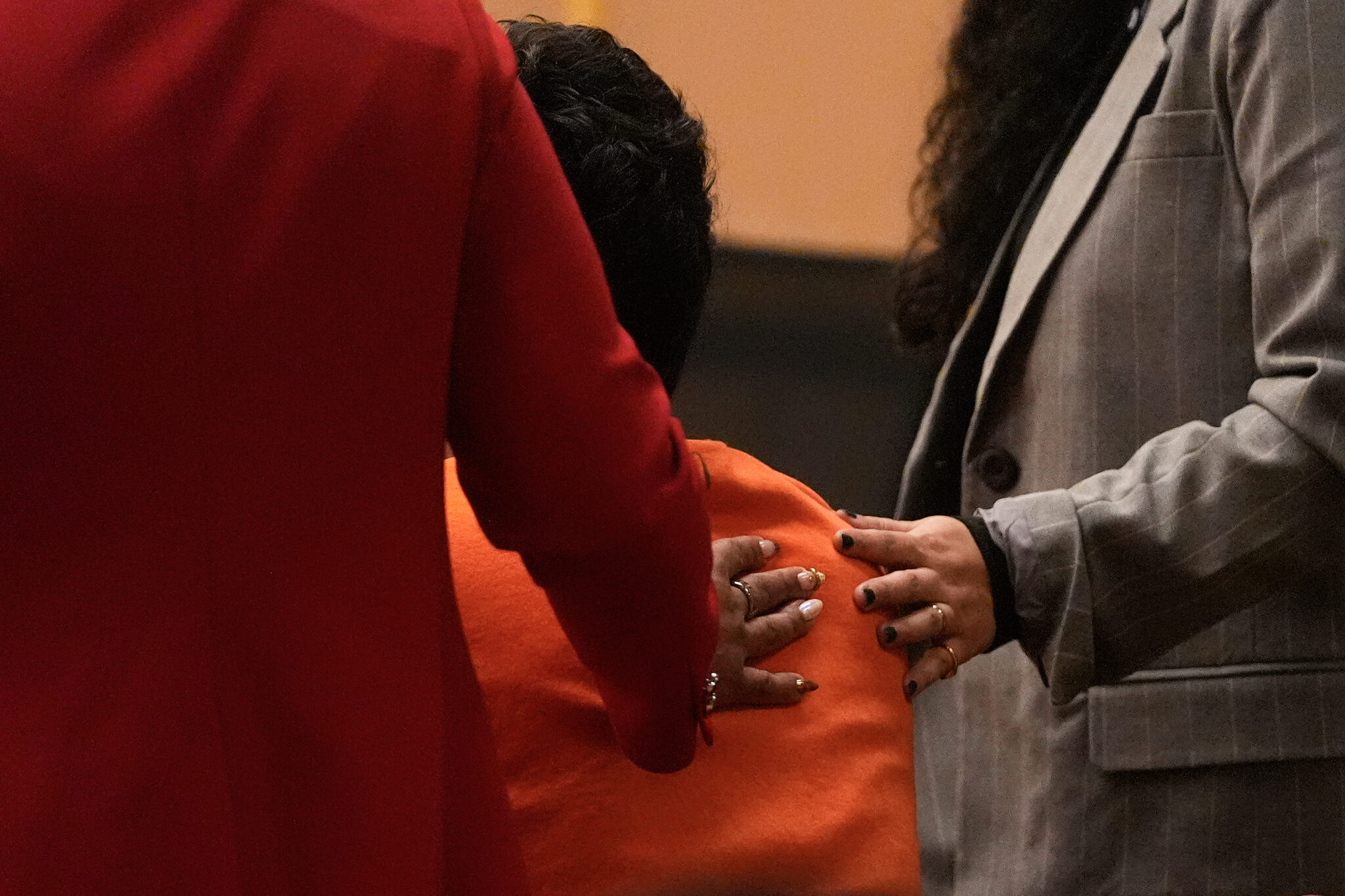
In the hallway immediately afterward, the defendant thanked Shrum with an appreciative hug.
“She walked out of there a free lady,” Shrum observed later. “It was Christmas in October.”
The 49-year-old Austin lawyer has spent most of his 20-year legal career as a defense attorney, and since 2023, he has been affiliated with the nonprofit Capital Area Private Defender Service, one of two entities in Travis County charged with representing indigent clients who can’t afford an attorney. The Travis County Public Defender’s Office performs a similar mission.
In 1963, the U.S. Supreme Court ruled unanimously that under the Fourteenth Amendment, states must provide lawyers to criminal defendants who cannot afford one. But throughout Texas and many other states, the rosters of public defenders have been shrinking at an alarming rate, often leaving defendants in jail for days, weeks or months without access to an attorney.
Many public defenders are leaving, while those that remain are forced to juggle enormous caseloads. At one point, Shrum told Stateline, he had more than 500 cases. The overload facing him and other public defenders in Travis County, he said, results from “more indigent people than there were lawyers to take court-appointed cases.”
In a report to the Texas Indigent Defense Commission, which was created to monitor and partly fund county indigent defense programs, researchers from the Public Policy Research Institute at Texas A&M found that the state lost 1,345 attorneys tasked with representing indigent clients between 2014 and 2024 — nearly a fourth of all such attorneys. The decline occurred even as the total number of attorneys in Texas grew by more than 25,000.
A 2023 study by the Sixth Amendment Center in Cambridge, Massachusetts, ranked Texas 46th nationally in per capita spending on indigent defense at $9.19. “Some states are struggling more than others,” said Aditi Goel, the center’s executive director.
Goel said there are no national statistics on the shortage of public defenders.
“It’s a complete black box,” she told Stateline. “We do not know as a country right now. There is absolutely no way to know whether every single person is getting their right to an attorney, and if not, how long they’re waiting for their right to an attorney.”
Problems across states
But there is plenty of evidence to suggest that jurisdictions across the nation are struggling to provide attorneys to the estimated 80%-90% of criminal defendants who cannot afford one.
Earlier this year, for example, the Oregon Supreme Court ruled that more than 1,400 criminal cases had to be dismissed because there weren’t enough lawyers to represent the defendants. A 2022 report by the American Bar Association found that Oregon would need an additional 1,296 attorneys — more than three times the number it had at the time — to meet its constitutional obligations.
In Pennsylvania, a 2024 study by the Quattrone Center for the Fair Administration of Justice at the University of Pennsylvania found that in a typical year, the state’s 850 public defenders are assigned cases that would require 1,200 lawyers to provide adequate representation. Sixty of Pennsylvania’s 66 counties don’t have enough attorneys, the study found.
Last year, a report by the Deason Criminal Justic Reform Center at Southern Methodist University in Dallas estimated that Kansas needed to add 277 public defenders to its roster of 123 lawyers to provide effective counsel to every indigent defendant. And a 2022 study found that New Mexico, which had 295 public defenders, needed an additional 602 full-time attorneys to provide effective counsel.
In Texas, the shrinking number of attorneys has been caused in large part by retirements and burnout among older defense attorneys and an accompanying shortage of younger lawyers or law school graduates willing to replace them. Instead, many younger lawyers are drawn to more financially rewarding jobs with private firms.
READ: Pennsylvania’s Inadequate Funding of Public Defenders Is Unconstitutional, ACLU Suit Claims
The growing complexity of evidence such as videos and body camera footage and increases in prosecution budgets also are contributing factors.
The indigent defense commission says one in three attorneys handling indigent defense in Texas is overburdened, carrying caseloads that exceed the commission’s caseload guidelines.
“It’s a big demographic problem of lawyers aging out, nobody to replace them,” said Keith Lauerman, another Austin public defender who is close to ending his 33-year legal career to become a Red Cross volunteer. Lauerman, 70, says he’s enjoyed his years representing defendants but felt it was time to “pivot for a third act” after working as an attorney and school teacher.
Cited for contempt
A number of states and communities have been credited with taking steps to shore up support for public defenders while are others are embroiled in turmoil over the issue.
In California, San Francisco Public Defender Mano Raju was cited for contempt by Superior Court Judge Harry Dorfman after he announced that he would periodically stop taking “a very small percentage” of new cases because of “a dramatic increase” in active cases coming into his office.
“The pressure has been tremendous,” Raju told Stateline, citing a 78% increase in active misdemeanor cases and a 56% increase in active felony cases from 2019 to 2026. Raju, the state’s only elected public defender, was also hit with $26,000 in sanctions by Dorfman but the fines haven’t gone into effect while the case is on appeal.
The Los Angeles County Public Defender, the largest public defense agency in the country, also made news following a study that defenders are carrying workloads more than double the volume that allows them to effectively represent their clients.
READ: It’s Time to Change the Way Pennsylvania Deals With Probation and Parole
A new commission co-organized by former District Attorney of San Francisco Chesa Boudin has been empaneled to push California toward new standards and legal regulations for public defense.
“There was a crisis playing out in plain view and people weren’t paying attention,” said Boudin, who is the founding executive director of the Criminal Law & Justice Center at the UC Berkeley School of Law.
Texas is one of about 15 states in which counties bear the responsibility for representing indigent defendants, although the Texas Indigent Defense Commission provides limited state funds through grants partly reimbursing counties for their costs.
“Travis County, like a lot of counties, we have an attorney shortage,” said Geoff Burkhart, county executive for Community Legal Services, which oversees Travis County’s two indigent defense organizations. “We don’t have enough lawyers for public defense.”
Working miracles
Supporters of the Capital Area Public Defenders Service and the Travis County Public Defender’s Office turned out at a September budget hearing before Travis County Commissioners to urge a funding boost for the organizations. Kaylee Brilhart, who is in her third year as an attorney at the public defender’s office, warned that the “public defense system in Travis County is at capacity.” She said there are people in jail who have been “without attorneys for months.”
“I have clients who express gratitude just because I answer their calls from the jail or I respond to their texts or phone calls,” she said. “We work miracles in our office every day.”
The larger Capital Area Private Defender Service, known as CAPDS, was created in 2015 to manage and oversee appointments of private attorneys contracted to represent indigent clients. The Travis County Public Defender’s Office, composed of staff attorneys and support personnel, was created in 2020 to further expand indigent services.
As of the 2024 fiscal year, the two organizations spent a total of $29 million on indigent defense services, handling 17,000 cases, with CAPDS shouldering the biggest caseload.
The leaders of both organizations say they are committed to the highest quality representation but acknowledge that the lingering shortage of attorneys is a constant challenge. “You’re doing it because you believe in justice and want to help people,” said Adeola Ogunkeyede, the county’s chief public defender, while acknowledging that “there are not enough attorneys to represent people.”
Bradley Hargis, executive director of CAPDS, said the shortage has worsened over time. “It started quietly,” he said. “There was an occasional shortage, an occasional day in which we were struggling to find the right attorney for each case, and then those occasional days became more regular, and then became chronic.
“It leads us, our attorneys, having caseloads greater than we would want, and really leads to overwork and burnout, and that’s what we are trying to guard against — overworking our attorneys,” he added.
“It’s important to me that my attorneys are advocates, that they’re not just a plea mill. So now we don’t have as many people waiting in jail without an attorney.” – Chief Public Defender Karli Kennell of Boerne, Texas
Two of the state’s most populous counties — Travis, anchored by Austin, and Bexar, anchored by San Antonio — have seen their indigent defense pools shrink by 50% over the past five years amid a 26% drop in the state’s urban counties.
In rural Texas counties, the number of public defenders has dropped by 29% in the past decade, from 1,926 to 1,371 attorneys.
After Bandera County Judge Richard Evans noticed an alarming absence of defense attorneys in his home county, he rallied leaders in neighboring jurisdictions to create the five-county Hill Country Public Defenders Office. Similar multicounty defense organizations have sprouted up elsewhere across the state.
“I really do believe we’ve improved indigent defense in the region,” said chief public defender Karli Kennell of Boerne, Texas. The nearly six-year-old defense organization includes 20 attorneys and a staff of 30 charged with Kennell’s commitment “to go in and fight for our clients.”
“It’s important to me that my attorneys are advocates, that they’re not just a plea mill. So now we don’t have as many people waiting in jail without an attorney,” she said. “I do take pride in what we’ve done in this region because I think most of Texas is still struggling quite a bit.”
Pamela Metzger, executive director of the Deason Criminal Justice Reform Center at Southern Methodist University, said the stakes could not be higher.
“Every day that an arrested person doesn’t have a lawyer is a day that their constitutional rights are being violated — period, full stop,” she said.
Stateline, where this article was originally published, is part of States Newsroom, a nonprofit news network supported by grants and a coalition of donors as a 501c(3) public charity. Stateline maintains editorial independence. Contact Editor Scott S. Greenberger for questions: info@stateline.org.