Since ancient times – across continents and cultures – tables have symbolized family, friendship, gathering and community.
Aligned with a desire and mission to encourage peace around the globe, the Nakashima Foundation for Peace has named Rachel Eichem its newest executive director.
Eichem, of Solebury Township, will steward the Nakashima Foundation’s nonprofit legacy mission. She was previously an executive director for Pennsylvania and Delaware at the Susan G. Komen breast cancer foundation.
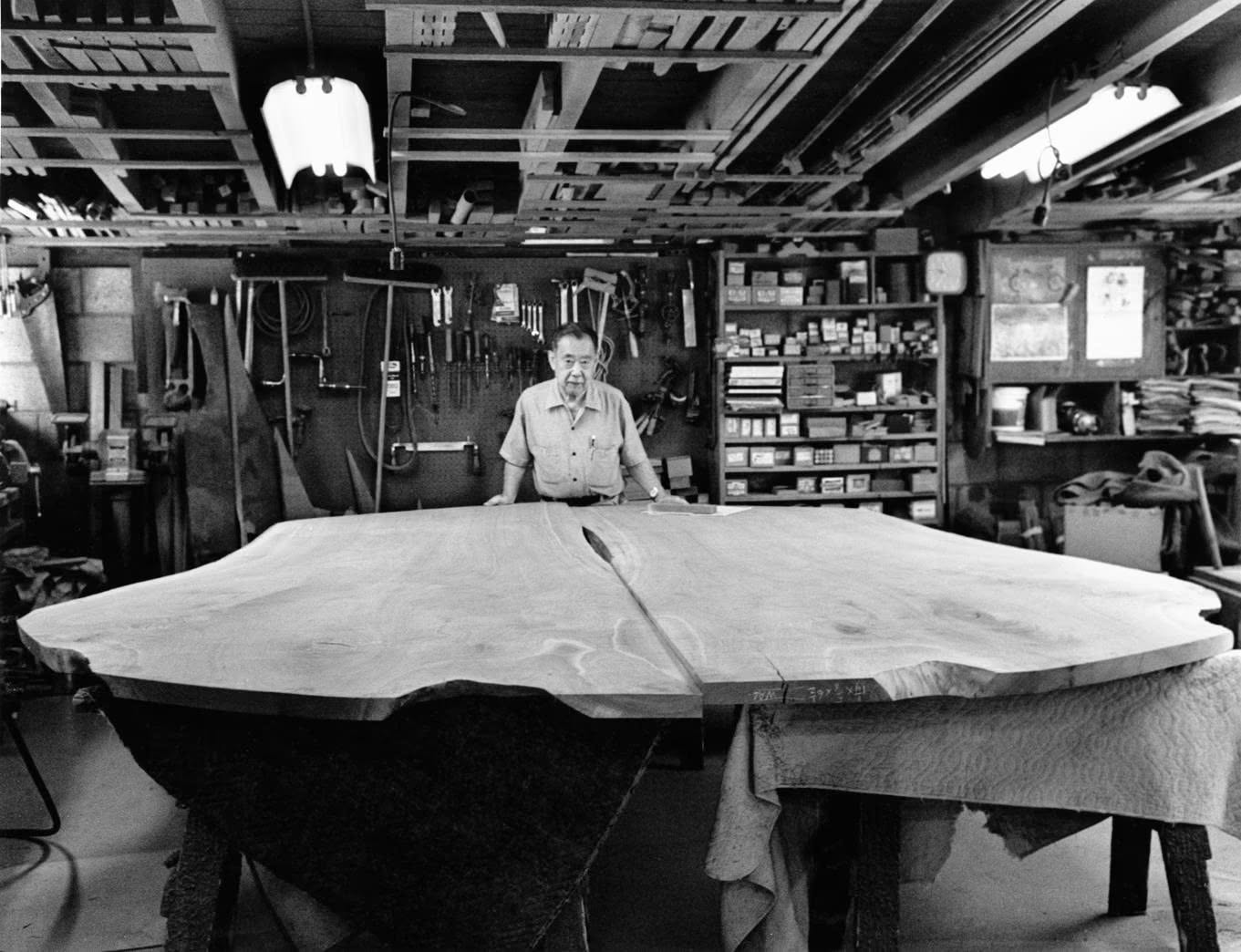
George Nakashima (1905 – 1990) envisioned a world where everyone was welcome to take a seat at the table. He was world-renowned for crafting live-edge slab tables as works of functional art – as a woodworker, furniture maker, architect and stalwart advocate for peace.
Considered an icon of the American Studio Craft Movement, the George Nakashima Woodworkers studio is located on nine acres in Solebury Township. It continues to operate under his daughter Mira Nakashima’s leadership. Also an architect and craftsperson, Mira Nakashima is president and creative director of her late father’s business.
Peace tables are at the heart of the Nakashima Foundation for Peace and why it was founded, according to Eichem.
“Even as I applied for the job and devoured everything I could find, understanding where [George’s] journey took him, from school to India to living with a guru and learning about self-awareness and peace; his devotion to forestry and scouting and making his way to this property,” Eichem explained.
It was during Nakashima’s time in India that the concept for the foundation began and the idea that “if we could all just sit at a table and talk – any differences could be worked out.”
The global peace table initiative envisions a Nakashima studio table located on every continent.
The Altar for Peace at St. John the Divine Cathedral was installed in New York City in 1986.
“Once the first Altar for Peace was placed at the Cathedral of Saint John the Divine in New York, we looked to the broader vision for a world encircled by magnificent symbols of peace. We set our path to be most inclusive of all the peoples of the world aspiring to peace,” said the late George Nakashima on Oct. 1, 1984.
The table was installed at the Episcopal cathedral, less than two decades before the Sept. 11, 2001 attacks on American soil. St. John is located about seven miles north of the World Trade Center, where the two towers were targets of four coordinated terrorist attacks.
A third plane crashed into the west side of The Pentagon in Washington D.C. A fourth plane was diverted by passengers and crashed in an open field in Stony Creek Township, Shanksville, Pennsylvania – killing all aboard the tragically-fated flight.
Eichem said three tables are currently placed. The second is the George Nakashima Table for Asia. It was placed at the Hall of Peace at the Unity Pavilion in the International Zone of Auroville, South India.

The third Sacred Peace Table is located at the Russian Academy of Arts in Moscow. It was dedicated in 2001.
Eichem said plans for the fourth peace table are in progress for a placement in Africa.
“We’re working with Nairobi Africa to work toward honoring George’s desire to have a table with the United Nations,” Eichem explained.
She said while the African continent table is not made yet, the wood for it is currently on site.
Peace tables measure roughly four times that of an average table with the ability to seat from 16 to 18 people. The existing tables are made from black walnut with rosewood butterfly joinery. English and American black walnuts are the most sustainable woods – which is a hallmark of the Nakashima philosophy.
The “live edge wood, book-matched with butterfly joinery” pieces are hallmarks of each individually crafted Nakashima table piece.
“While [placement in] Antartica may be a stretch, Africa, Australia and South America are forthcoming,” Eichem noted.
Eichem has more than 25 years of fundraising and community engagement experience in the non-profit sector, according to a Nakashima Foundation press release.
“Rachel brings something very special to the foundation – a rare combination of experience, vision and an ability to connect genuinely with people,” said Mira Nakashima.
According to Mira Nakashima, Eichem understands relationship building and partnerships “that allow an organization to grow, bring communities together and create opportunities to…carry George’s vision of peace forward.”
Eichem said she was looking for a lifestyle change and the position gave her “an opportunity to recalibrate.”
In the spirit of collaboration, she said the newly designed position is a chance to create and craft the role “not only for myself – but for the foundation.”
Eichem said she’s quickly absorbed Nakashima’s reference for nature and peace, including the nine-acre property with its ideal positioning for tree growth and passive solar energy.
She added the greatest need for Nakashima’s voice and vision in modern times is why the foundation was started.
After the 2020 pandemic, Eichem said tours of the property became part of growing educational outreach, alongside occasional scheduled wellness events on the property.
“George Nakashima’s vision of peace through craftsmanship, art, and connection to nature is something deeply needed in the world right now,” Eichem said. “I’m honored to help carry that legacy forward, and to work alongside the community to build on the Foundation’s mission of building Sacred Peace Tables and preserving this remarkable place for future generations.”
Born in Spokane, Washington, Nakashima along with his wife and newborn daughter were forcibly removed from their home and incarcerated at the Minidoka Camp in Idaho from 1942 to 1943 as part of the World War II War Relocation Authority internment program.
“I want to honor the fact we are called the Nakashima Foundation for Peace, and I want to act on that,” Eichem said.
The Nakashima Foundation for Peace is located at 1847 Aquetong Road in New Hope.
For more information, visit here.