There’s synchronicity blowing in the Bucks County breeze this Spring. Newly minted resident and multimedia artist, Jesse Krimes, now lives and creates in the sprawling Pipersville estate of author James Michener. Both share notoriety – and brushes with confinement that deeply inform their body of work.
Not commonly known, Michener’s early childhood in and out of the Bucks County Poorhouse in Doylestown shaped much of his life and writing. His extensive body of work consistently underscores the universal nature of human dignity, examining how diverse cultures share common fundamental aspirations and challenges and exhibit perseverance that can overcome prejudice and systemic oppression.
In an artistic parallel, Krimes’ six-year sentence in a federal penitentiary on drug charges, which is openly documented in his Emmy award-winning film, Art and Krimes by Krimes, impacted and unfettered his formidable imagination and inherent creativity. Imprisonment has shaped themes of power and control, with a focus on criminal and racial justice, that populate his impressive oeuvre.
Although Krimes strongly identifies as a “formerly incarcerated artist,” New York Times Art critic Arthur Lubow lauds his talent on its own merits. In a recent review of Krimes’ work, Lubow proclaims: “While the reformist fervor of the artist is unquestionable, frequently his work succeeds on aesthetic principles, not political ones. Maybe that is its own kind of triumph: a testament to his deep belief that art provides a path for the human spirit to rise above the degradation of prison.”
“I think a lot about the label ‘formerly incarcerated artist,’” says Krimes. “It accurately describes the experience that shaped my life and work. But I also don’t want the label to become a limit. My goal has always been for the work to stand on its own terms, as art that is formally rigorous, conceptually complex, and emotionally resonant. The incarceration history is part of the work, but it is not the whole of it.”
And stand on its own his work does.
Two of his seminal pieces, “Apokaluptein: 16389067” and “Purgatory,” now live in the permanent collection of The Metropolitan Museum of Art.
“Having work in The Met’s permanent collection is incredibly meaningful, not only personally, but because of what it represents,” Krimes confides. Referring specifically to “Apokaluptein,” a massive 15-by-40-foot installation created from prison laundry bedsheets, Krimes highlights the irony that both the cloth and the prison hide inmates from society.
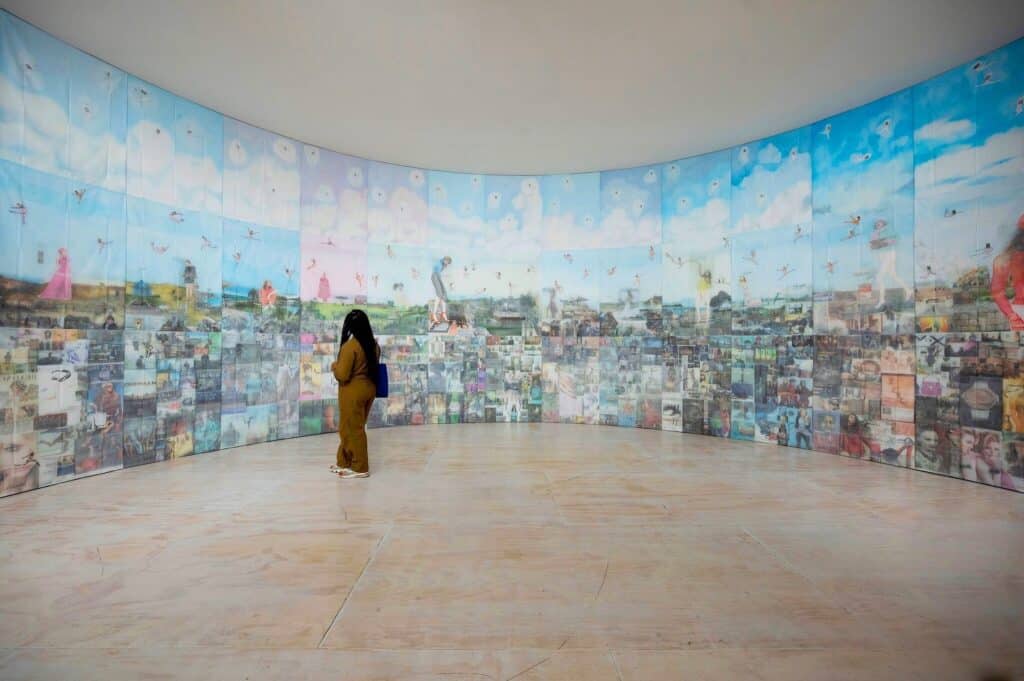
“A work that was made under conditions meant to disappear people,” he emphasizes, “is now held in one of the most visible cultural institutions in the world. That reversal is profound – a signifier that works created by people directly impacted by incarceration are core to culture and not at the periphery.”
“Lubow’s observation gets at something else that is important,” admits Krimes. “The work may emerge from a political reality, but it has to succeed as art. That is where I want the conversation to go, not away from incarceration, but toward a fuller understanding of what artists who have lived through those systems are capable of making.”
Artists who have lived through the system
Krimes embodies and emphasizes this contrast. His own artwork has been exhibited at the likes of the Philadelphia Museum of Art, the Palais de Tokyo in Paris, the Brooklyn Museum, and MoMA PS1. And he has received fellowships from the Guggenheim Foundation, The Pew Center for Arts & Heritage, Rauschenberg Foundation, Creative Capitol, and Art for Justice Fund.
Yet Krimes steadfastly balances his artistic ascendency with his trailblazing leadership as founding director of The Center for Art & Advocacy in New York.
Established in 2022, the Center was built on the success of another of Krimes’ initiatives, the Right of Return Fellowship, which he helped start a few years after his release from prison. He explains, “As that community grew, it became clear that a fellowship alone was not enough. We needed a larger structure, a true organization, to support artists over time, create public platforms for their work, and build pathways into the cultural field. That became the Center for Art and Advocacy.”
The Brooklyn-based Center is the first and only national organization dedicated to supporting artists who have been directly impacted by incarceration, providing funding, mentorship, exhibition opportunities, professional development, and community support to help them build sustainable creative careers.
“The Center is the organization I wish had existed when I came home,” he divulges. “It is a place where artists are not reduced to their incarceration, but supported as whole people with serious creative visions, professional ambitions, and the ability to shape culture.”
Part of the Center’s success is due to two pioneering women philanthropists, whose vision for social justice included substantial financial largesse. “Fortune smiled upon us when noted philanthropist and avid art collector, the late Agnes Gund, incorporated the Center as a legacy project into her celebrated Art for Justice Fund,” which was designed to tackle mass incarceration and underlying racial bias through art and advocacy. Krimes also extols the role of Elizabeth Alexander for a second jaw-dropping donation from the Mellon Foundation where she served as president.
In his own right, Krimes’ inspiration in founding the Center is directly linked to his tenure in the legendary Mural Arts Philadelphia’s Restorative Justice program, directly after his release from prison in 2014. As a person re-entering society, he says he found “grace and opportunity” in the program and the leadership style of Jane Golden, the nonprofit’s founder, who states, “Jesse Krimes’ work reminds us that everyone deserves safety, security, and dignity, no matter their circumstances.”
Paying it forward
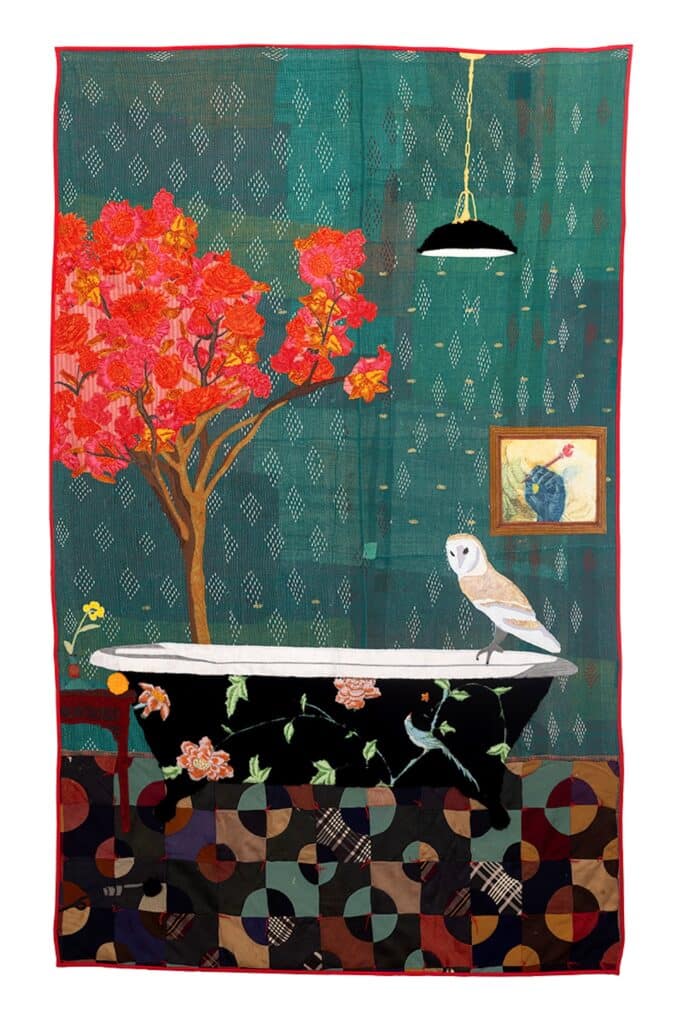
In an apt return to the source, Krimes’ new work, “Riverside,” has been commissioned by Mural Arts. The work, which will be unveiled on the evening of June 3 at a public event at Triple Bottom Brewing, 915 Spring Garden Street, Philadelphia, is based on Krimes’ “Elegy Quilts” exhibition at The Fabric Workshop and Museum in collaboration with Mural Arts.
Kelly Shindler, FWM’s Executive Director and curator says, “We’re thrilled to partner to present this vital body of work by Jesse Krimes, whose voice brings compassion and urgency to issues of incarceration and reintegration.”
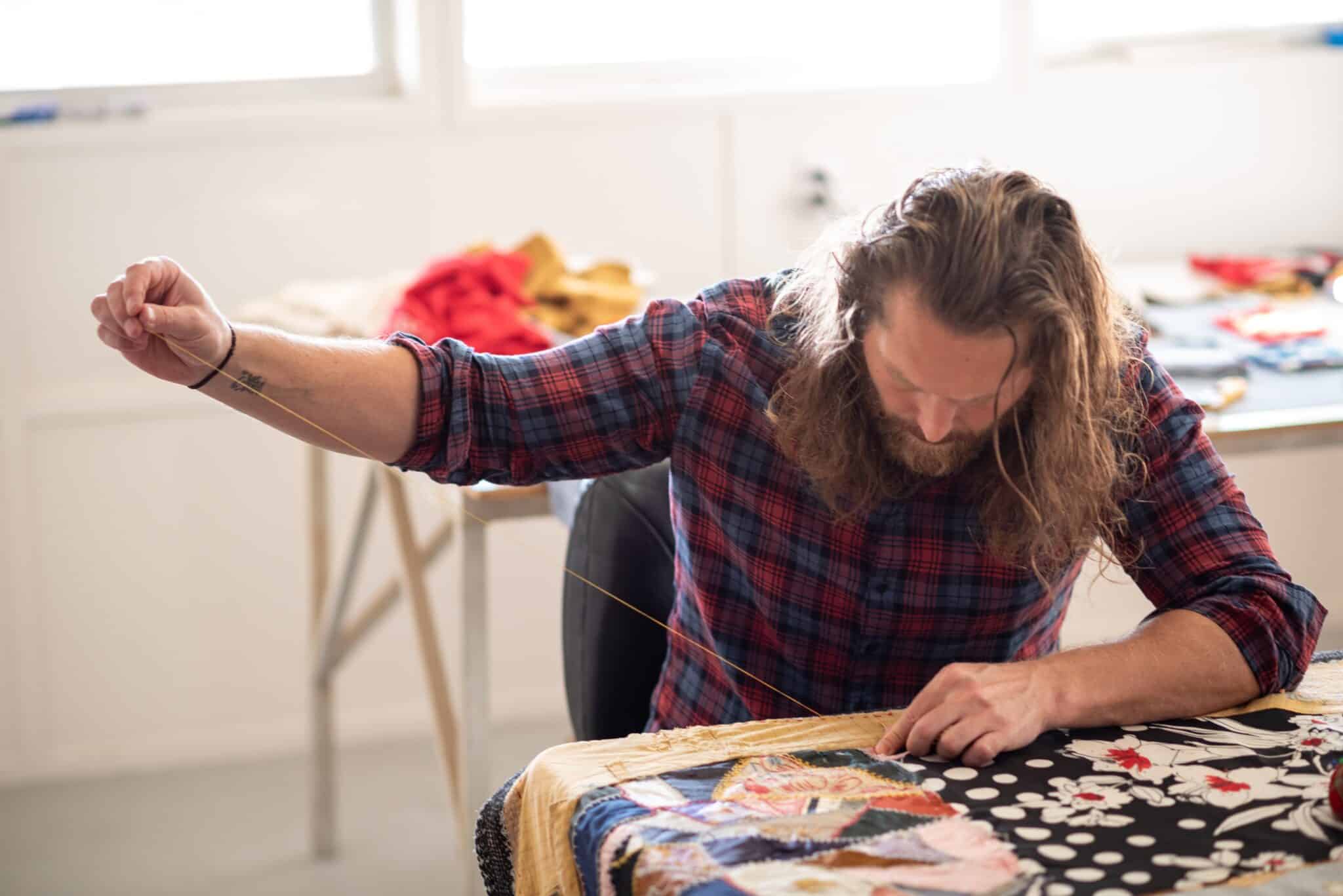
For this exhibition, Krimes drew upon his own awareness of incarceration as well as the experiences of selected incarcerated collaborators who were asked to articulate memories of home. Collecting clothing and textile fragments donated by current and formerly incarcerated individuals, Krimes then assembled them into intricately patterned quilts that contemplate themes of memory, loss, alienation, and comfort. This process, emblematic of American quilting traditions, demonstrates Krimes dedication to craft practices grounded in community storytelling.
Closing the Circle
Growing up in Lancaster County, Krimes was exposed to a rich tradition of quilting. He finds parallels in his new Bucks County home with the natural and creative landscape of his childhood.
Krimes believes that Bucks County, where “people seriously value art, craft, and place,” is an ideal place to build a residency and retreat for the Center, “somewhere artists can step away from the pressures of daily life, focus on their work, and experience the kind of reflection and renewal that is almost the exact opposite of being inside systems of confinement.”
“We are just beginning discussions with community officials and organizations hoping to form partnerships on what it will take to support and build out this vision,” he notes. “My hope is that the Center’s residency will contribute meaningfully to the region’s already vibrant arts community while bringing new nationally significant artists into dialogue with the community.”
A Krimes-Michener connection would be the possibility of the James A. Michener Art Museum collaborating in the Center’s efforts to establish its residency and retreat. Ironically, Michener put years of effort into establishing a Bucks County regional arts center in the 1960s that finally came to fruition in 1988 with the opening of the Museum in what had once been the old county jail! Such an affiliation would certainly put a fine point on Krimes’ noble arts vision.
* Correction: A previous version of this article incorrectly stated that Elizabeth Alexander was deceased. We apologize for the error.