
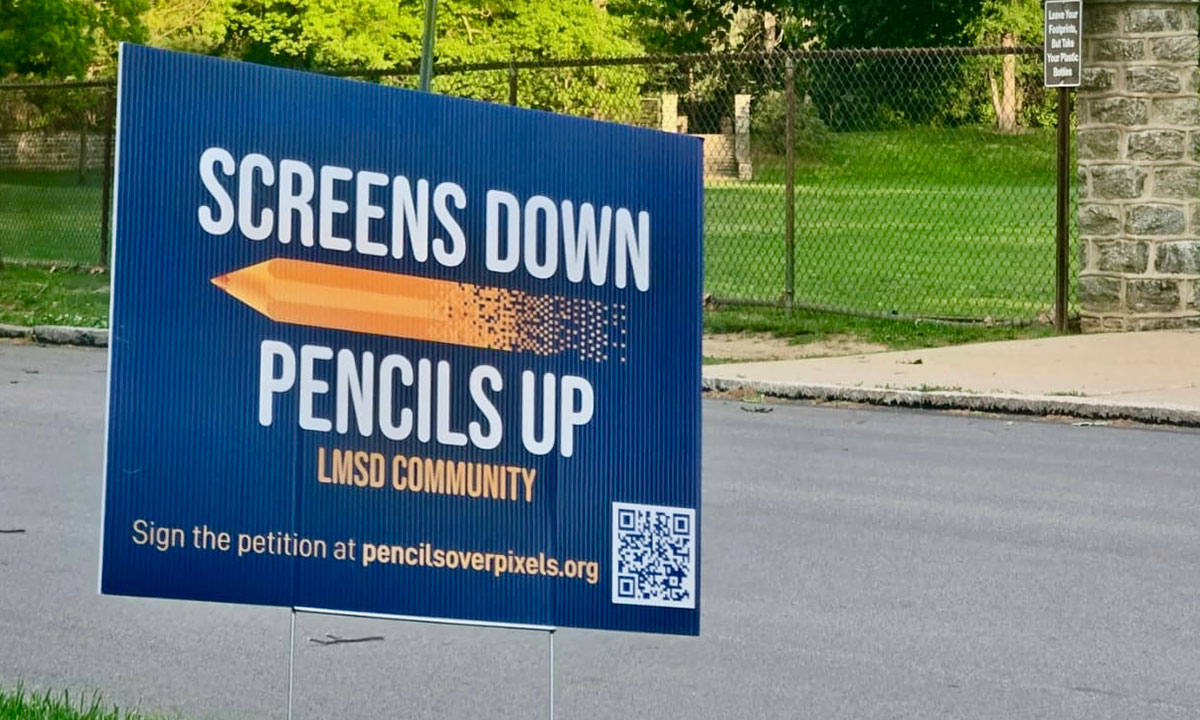
Resistance to AI has spread rapidly across the political spectrum. New York City, Los Angeles, and the states of Florida and Oklahoma, political entities that don’t agree on much, have all put restrictions on the use of Artificial Intelligence programs in schools.
New York City Public Schools have put a moratorium on student use of AI up through eighth grade. Mayor Zohran Mandami told ABC news that “the tech industry wants us to believe that A.I.-powered early education is not only inevitable, but necessary. We do not see it that way.”
The Los Angeles Unified School District this year has banned generative AI from district-issued devices for all students.
At their September 16 meeting, Florida’s Board of Education put some guardrails in place, most notably requiring schools to inform parents of all AI use. And while this parallels a policy adopted in red state Oklahoma, it offers one critical difference—while Oklahoma offers parents an opt-out option for AI in school, Florida requires parents to opt in before their child can be exposed to AI.
Republican Governor Ron DeSantis said in a statement:
Florida will not outsource childhood to a chatbot. We welcome tools that help teachers teach and students learn. We will not accept tools that hide from parents, harvest student data, grade kids in secret, or pretend to be a friend.
Policy leaders from both the very red and very blue ends of the spectrum are agreeing that we need to put the brakes on AI use in schools.
Why resist AI?
Concerns about generative AI in the classroom encompass far more than simply cheating. An increasing body of research shows that use of AI can get in the way of learning.
A report from Brookings declared that “the risks of AI overshadow the benefits” for students. Brookings found that reliance on AI didn’t just negatively affect what students actually learned, but their capacity to learn. “These risks can impact students’ capacity to learn, their social and emotional well-being, their trusting relationships with teachers and peers, and their safety and privacy.”
Back in 2025, educators like Jen Lumanian were already sounding the alarm, arguing that AI use hurts the development of critical thinking skills and even emotional intelligence.
A paper from researchers at Carnegie Mellon, Oxford, MIT, and UCLA found dramatic results with even mild use. Spend 10 to 15 minutes with AI answering your questions, and you may even feel helped, even smarter. But immediately afterwards you not only perform worse on the same task, but you are more likely to give up.
READ: Is it Smart to Let ‘Big Tech’ and Its Profit-Driven AI Tools Into Bucks County Classrooms?
Another paper by a different team, “Faster Completion, Less Learning: Generative AI Reduced Study Time on Math Problems and the Knowledge They Build,” found that students have spent less time on math word problems (the kind that a chatbot can help with) over the past three years, and now students have 25% less math knowledge than before the creation on chatbots.
A study of 26,811 Chinese high school students over 30 months found that those using AI completed homework in 30% less time, and their homework scores rose by 18%. However, their closed-book exam scores dropped by 20% within six months. Scores on Chinese entrance exams dropped by as much as 24%, with the greatest drops coming two years after AI use.
Both an ever-increasing body of research raises alarms not just about learning, but about the ability to learn.
Learning requires a certain amount of friction and difficulty, and AI removes that friction. Using AI to help you learn is like hiring a robot to lift for you in the weight room. It’s not simply that you don’t develop the muscles the weights were meant to exercise; your muscles actually atrophy if you do nothing but watch the robot heave away.
Adults who have already developed a body of knowledge and the skills involved in independent learning may be less susceptible to these effects, but for children who are acquiring the body of knowledge that will be the foundation for future learning and who are also learning how to learn, the effects of generative AI are potentially devastating, particularly given the indications that these effects may be very long lasting.
Guardrails for Young Students
The pressure to put AI into schools is tremendous. The industry itself needs to make back its money, facing, as The Guardian puts it, “billions spent and hypothetical returns.”
Schools have been hammered with a constant refrain of AI inevitabilit: “It’s coming and you just get on the bandwagon or your students will be left behind.”
The way some embrace it is almost comical. More than a few teachers have (anonymously) shared with me administrative directives along the lines of “I don’t know how you’re going to do it, but I want AI worked into student work on a regular basis.”
Meanwhile, the industry has worked to put its AI bot Gemini in students’ paths by adding it to Google Classroom, a widely used piece of school software found, among other places, on Google’s widely used school chromebooks. This, they proudly announce, will bring Gemini to “students of all ages.” There is no reason to expect that the tech giants who need to make back their AI investment will in any way restrain themselves.
There is no question that generative AI will be a major part of some sectors. Tech companies are already fully embracing AI’s ability to quickly code. But in some areas, the jury is still out. AI advertisements have been promoting such use cases as using AI to show you if a costume will look cute on your dog or using AI to write a simple note to a friend.
But let’s assume that AI is definitely a major part of the future for students. Does that mean they should be using it as students?
It is safe to assume that for most students, sex and alcohol are a part of the adult world they will inhabit. And yet, nobody concludes that this means schools should encourage students to drink and have sex, and certainly not to include those activities in school work. Most students will be driving vehicles as adults, but we do not put third graders behind the wheel of an automobile. These are all activities for adults.
What schools do is teach students about these subjects, so that when the time comes from them to be involved in adult activities, they have hopefully acquired the knowledge to make wise choices.
It makes sense to do the same for students when it comes to AI. They need to learn what it is, how it works, what it can and can’t do (a topic on which too many adults are woefully ignorant), and consequently what it can and cannot be safely used for.
We need guardrails, and it would help if the state imposed them.
Where is Pennsylvania on AI in Schools?
Pennsylvania is way behind the curve when it comes to protection for students in the AI world.
A memo revealed in a lawsuit provided a clear understanding of Google’s motivation in being a major player in education tech. Google’s presence in school—chromebooks, Google Classroom, Youtube—helps the company build a “pipeline of future users.”
They have had plenty of help in the commonwealth. The University of Pennsylvania Graduate School of Education operates the Pioneering AI in School Systems (PASS) program, which depended on a million dollars from Google to get off the ground, spearheading AI adoption in five school districts.
The state has a page devoted to “Implementing AI in Schools.” But it consists simply of a series of questions and issues that school districts ought to consider, somehow. Student data is sensitive, so the AI should comply with federal and state rules. Schools might want to see if the AI helps test scores go up. Districts should look at the program’s terms and conditions. The AI should meet accessibility requirements.
These are not guardrails. They are a suggestion of a framework for a concept of some thoughts about guardrails.
Governor Josh Shapiro has not done much better. Back in February, he announced an intention to protect Pennsylvanians using AI from “bad actors.” This included an AI literacy page featuring six topics, an AI task force to crack down on chatbots pretending to be licensed professionals, and “coordinating closely” with the State Attorney General to strengthen consumer protection when it comes to companion chatbots.
INTERVIEW: Why We Need ‘AI for the People’, with Congressman Ro Khanna
As in many other states, the rhetoric in Pennsylvania has tried for a tone of “We’re definitely doing this, but we promise to be careful”, rather than questioning whether or not we should allow AI unrestricted access to markets, including schools full of vulnerable students, in the first place.
“Artificial intelligence is transforming how we live, work, and learn — and Pennsylvania is embracing it responsibly,” said Governor Shapiro. “But as this technology advances, we will not allow bad actors to exploit our kids, mislead seniors, or impersonate licensed professionals.”
This echoes the industry talking point, which is that of course there are some bad apples in the bunch, but we should go whole hog for AI and just weed out the few bad apples. It’s a halfhearted attempt to reassure the civilians while also simultaneously reassuring giant tech companies that they will be allowed to conduct business as usual as they see fit.
It’s not enough.
Students who are developing the thinking and learning skills they will need for life should be protected from the kind of cognitive offloading that generative AI encourages. There is no earthly reason for an elementary school student to be using or engaging with AI, and those programs should be barred from elementary classrooms.
If AI is allowed into middle or high school classrooms, it should be with tight controls. There should be AI literacy programs at all levels. The guardrails and literacy programs should be developed without the involvement of the multi-billion dollar corporations that are looking to profit, both now and in the future, from this generation of students.
Mayor Zohran Mandami and Governor Ron DeSantis are both able to see this, so surely Josh Shapiro and his well-developed sense of which way the wind is blowing should be able to embrace the need to protect students from the increasingly unpopular AI industry. Because right now, the one politician who whole-heartedly embraces AI and opposes any sort of guardrails is Donald Trump.