Long ago Alexander the Great deployed religious myths to conquer much of the known world. Today, a different religious vision animates an intention to conquer the world.
The late C. Peter Wagner, a thought leader and a top apostle in what came to be known as the New Apostolic Reformation, was unambiguous in a 2009 sermon about their vision for taking religious and political power in “all nations.”
“Dominion has to do with control. Dominion has to do with rulership. Dominion has to do with authority and subduing and it relates to society,” Wagner said. “Dominion means ruling as kings — it says in Revelation 1:6 that ‘He has made us kings and priests.’ But read the rest of that verse — it says for Dominion. So we are Kings for Dominion.”
Wagner — then a professor of church growth at Fuller Theological Seminary — and his colleagues were seeking to lead and to shape a movement that was already well underway in historic Pentecostalism as well as the more recent charismatic Christian movement. They saw that the churches experiencing the most growth were non-denominational and were also adopting a different style of church governance they called apostolic. They pronounced the movement the New Apostolic Reformation (NAR).
Although still largely unknown among the general public, the NAR is at the cutting edge of the Pentecostal and charismatic movement, which has been the fastest-growing expression of U.S. and global Christianity in recent decades. The NAR seeks to restore what they imagine the church of the first century to have been in terms of leadership, vision, and growth.
Re-creating what they see as the biblical church model, the NAR seeks to phase out traditional denominational churches in favor of hubs for international apostolic networks. Formed in recent decades, these networks are led by a “five-fold ministry” of church offices consisting of Apostle, Prophet, Evangelist, Pastor, and Teacher — in accordance with the book of Ephesians (4:11-13).
What is the New Apostolic Reformation?
Leading the way, the office of Apostle holds a comprehensive vision of the direction of the church and maintains direct communication with God. But all five church offices or functions are needed for a successful ministry. Prophets are understood to have unique inspiration from the Holy Spirit, enabling them to receive supernatural revelations from God, help apostles with insights from their revelations, and facilitate the growth of God’s Kingdom on Earth. Evangelists, pastors, and teachers each have important roles to play, although not every church is able to support all five offices. Thus the movement is being built unevenly, and individual leaders often play multiple roles.
The five-fold ministry is different from traditional hierarchies of any kind, in that there is an inherent recognition that no one can do everything, and that these five specialties need one another to achieve their ideal ministerial goals. This is one reason, for example, why these leaders do not usually dress like traditional clerics. They are more likely to wear flannel shirts and jeans (and sure, sometimes cowboy hats and boots) than business suits or clerical collars. What’s more, their “networks” have much more in common with ideas of “relational” political organizing than any structured hierarchy.
It is important to note that the NAR is a movement, not a denomination or an organization. Nonetheless, there are any number of organizations within the New Apostolic Reformation, like any other social movement. The NAR is so new that its doctrines and five-fold ministry have been unevenly applied, so various ministries can be quite different. The movement is also rather diffuse and has no central authority.
It is also important to note that NAR churches do not embrace the democratic polities of traditional Baptist and mainline Protestant churches, and usually eliminate all forms of internal democratic governance. Significantly, this internal authoritarian culture is also expressed in their external vision of society and its accompanying politics.
Somewhat counterintuitively, the movement’s most politically engaged leaders, all close to President Donald Trump, are far from household names. While some are frequent guests in the Oval Office or at Mar-a-Lago, they do not seek traditional press attention.
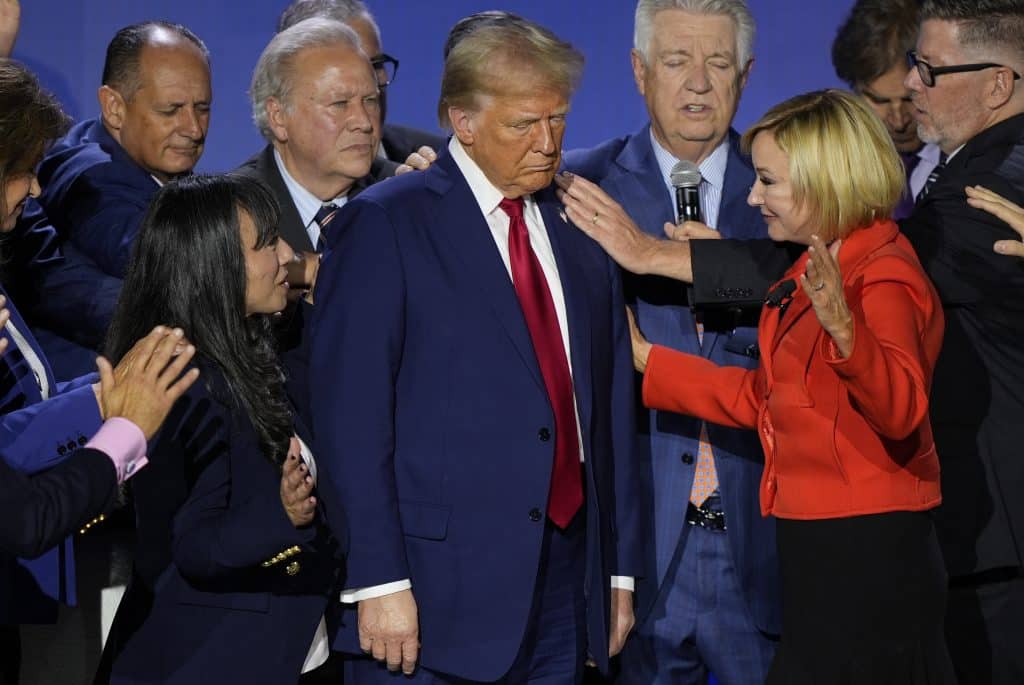
Even so, some leaders play significant and outsized roles in public life. Apostle Ché Ahn of Pasadena, Calif., with Prophet Lou Engle of Colorado Springs, Colo., have staged mass rallies, such as the “Million Women” political mobilization event in Washington, D.C., last fall. Apostle Paula White-Cain of Apopka, Fla., is Trump’s longtime spiritual advisor. Apostle Lance Wallnau of Dallas is a leading author, theorist, and political mobilizer. Apostle Cindy Jacobs of Red Oak, Texas, is the leader of the growing women’s dimension of NAR leadership. Apostle Chuck Pierce of Corinth, Texas, is a convenor of major NAR events at his Glory of Zion Church. Apostle Dutch Sheets of South Carolina is a promoter of political violence from the January 6th, 2021, insurrection at the U.S. Capitol to threats against state and federal judges who obstruct Trump’s agenda.
How does the movement relate to white Christian Nationalism?
The NAR and its political antecedents — such as the late televangelist Pat Robertson’s 1988 campaign for president — have been hiding in plain sight at the center of American politics for a generation. Long before the movement came to be folded under the rubric of Christian Nationalism, Robertson’s charismatic and Pentecostal political base (which in the 1990s became the now defunct Christian Coalition), was developing an emerging wing of the Christian Right. At that time, the Moral Majority, led by Jerry Falwell, publicly represented what is now known as Christian Nationalism: The organization was overwhelmingly white, Southern Baptist, and insistent that America was founded as a Christian nation — a narrative within which the NAR movement never really fit.
While there are certainly those who cleave to the notion that America was founded as a Christian nation and must be restored as such, the NAR is more complicated than that. The movement sees us as living in a biblically prophesied “End Times.” Israel, not the U.S., is the central nation in their story. This is why at NAR events, one is likely to see a lot of flags of the nation of Israel, but few (if any) American flags.
INTERVIEW: America Is a White Christian Nationalist Project, With Religion Dispatches Editor Megan Goodwin
It’s fair to say that a global movement centered on Israel is not an American nationalist movement. More complicated still, the NAR is multiracial and has no overt agenda of white nationalism or white supremacy.
Anthea Butler, a historian of African American and American religion at the University of Pennsylvania, summarized these complexities of NAR at a webinar on “Challenging the Christian Right,” hosted by Political Research Associates in June. “It is not just an American phenomenon,” she observed. Nor is it white-centric. “They want to have Christians in power.” But, she avers, “If you think about race in a binary way, then you don’t get what’s really happening here.” Due to the NAR’s global presence, including in Africa, “this thing is bigger than you think it is.”
Butler thinks the NAR has been “very clever” in creating intercontinental apostolic networks led by individual apostles across multiple countries.
What is the NAR’s strategy for obtaining power over the world?
It’s important to note the global intention and applications of the mobilizing strategy of the NAR’s Seven Mountain Mandate, which has become a popular metaphor for taking religious and political dominion. It’s a metaphor that has been adopted beyond the NAR world — for example, by the late Charlie Kirk. The seven mountains of influence NAR seeks to conquer are family, religion, education, media, arts and entertainment, business, and government.
Wallnau, who has been a principal promoter of the idea, stresses that “it is a 7M world… (and) these mountains exist in every nation, and the sum total of these mountains determines whether the nation is oppressed under the heel of a hostile government or whether it’s free, prosperous and blessed.” Historic changes in nations, Wallnau asserts, come through what he calls “reformation,” and “cultural change comes from the top down and rarely, if ever, from the bottom up.”
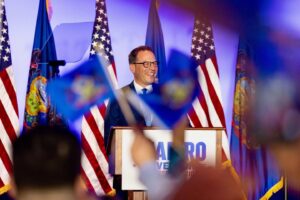
Thus it is no surprise that the NAR played prominent roles not only in the election campaigns of Trump, but nationwide, at all levels of government — notably the 2022 election campaigns of the (unsuccessful) GOP candidates for governor of California and Pennsylvania.
But not all Christian Nationalists trying to overthrow our government are the same. There are important differences between the NAR and the white-centric, conservative Presbyterian Reformed sector, of which Idaho theologian Doug Wilson is the best-known contemporary proponent. But there are important overlaps as well. Wagner acknowledges the influence of theocratic Reformed thinkers, such as 20th century Christian Reconstructionist theologian R.J. Rushdoony, in his 2008 book Dominion! How Kingdom Action Can Change the World.
This thinking was one outcome of a multi-year series of theological dialogues among evangelical thinkers (including Wagner and Rushdoony) in the 1980s staged by the Coalition on Revival to try to graft Christian Reconstructionist thought onto the theologically amorphous Pentecostal movement, in order to create the formidable political movement we see today. The work of Rushdoony and fellow Christian Reconstructionist writers provided previously apolitical evangelicals a biblical rationale and program for seeking earthly power that made possible today’s Christian Nationalism.
Both the NAR and Reformed factions are important parts of a strategic political alliance evoking violence. The NAR lacks the systematic theology that the Reformed wing has spent centuries honing and arguing about, but the NAR has generated large numbers of people they are grooming to be warriors in what they believe to be an End Times war.
So far, there is no indication that they are engaged in paramilitary preparations. However, they are being coached into a permission structure for mass violence, if the apostles give the word. NAR leaders frequently invoke the notion of being an “army of God” in the manner of Old Testament kings and generals such as David and Joshua. Women are increasingly being taught to consider their roles as warriors in the mode of biblical figures such as Esther, Rahab, and others.
Where is the NAR visible today?
Perhaps most visibly, the NAR includes women leaders, whereas Reformed Christian Nationalism does not. The most dynamic element of NAR is talent-scouting women leaders, such as former businesswoman Jenny Donnelly, who is now a leading apostle from Oregon. They are also encouraging women’s active participation, including in politics. By way of contrast, the Doug Wilson Reformed faction does not believe women should be allowed to vote.
In addition, while the NAR is focused on the nation of Israel, Reformed Christianity in all of its expressions has never been in the Christian Zionist camp. There are, however, Reformed members like Defense Secretary Pete Hegseth who carry out the pro-Israel foreign policy of the Trump administration. Theological orientation does not always fit neatly into policy.
Contrasting with “white” Christian Nationalism, the NAR is visibly and deliberately multi-ethnic, multiracial, and multinational: There are many men and women of color in NAR leadership roles. As Anthea Butler suggests, some people of color may be seeking greater cultural standing and access to the advantages in the social power structure in this seeming melting pot that may ostensibly be more culturally “white.” But of course that does not mean that people are changing their racial or ethnic identities. Members and leaders in the global South — Africa, Asia, and Latin America — are overwhelmingly people of color.
In reality, terms are fluid and can conceal as much as they reveal. Christian Nationalism requires some further explanation simply because it is subject to a lot of assumptions and interpretations.
READ: The Seven Mountains Mandate Is the Biggest Political Story the Mainstream Media Is Missing
Like Christian Nationalism, NAR is a term used by insiders, scholars, and journalists; most participants may never have even heard the term. But the movement it describes is visible, if hard to identify in many communities. NAR churches are non-denominational and not usually affiliated with one another. A few of the more prominent hubs go by such names as Mercy Culture Church in Fort Worth, Texas; Lord of Hosts Church in Omaha, Neb.; Bethel Church in Redding, Calif.; and Life Center Ministries in Harrisburg, Pa.
After determining that a church is charismatic or Pentecostal, clues about a potential NAR orientation of a church may often be found in their social media. Look for such terms as deliverance ministry (exorcism), ekklesia (a theocratic vision of church governance), and Seven Mountains — or a striking emphasis on Israel.
In addition, one thing that will turn out NAR churches in a more public fashion is an appearance by Sean Feucht, an NAR musician, evangelist, and political provocateur.
While most Americans are unaware of the New Apostolic Reformation, it is at the cutting edge of Christian Nationalism and is one of the most important religious and political movements in the country, perhaps in the world. It’s important that those of us who believe in democracy and the values of religious freedom, pluralism, and separation of church and state that sustain it, get up to speed on this important movement.
This article was originally published in the October 2026 issue of Church & State magazine, a project of Americans United for Separation of Church and State. It is reprinted here with permission.
This article represents the personal views of the author and does not necessarily represent the views of Americans United.