Over the course of two centuries, British colonial policies in India starved and killed 100 million people – or more. On August 14, 1947, India gained independence from the United Kingdom.
Victimized for hundreds of years, the newly minted south Asian country inherited a starving population, incapable of feeding itself.
Presidents Truman and Eisenhower negotiated U.S. food deliveries to the hungry as American scientists collaborated with Mexican farmers and shared agricultural innovations. A collaboration that came to be called the Green Revolution made India self-sustaining by the 1970s.
Fast forward nearly 79 years from their first Independence Day to the present as organizations in a now agriculturally independent India have transformed the nation into one of the largest distributors of humanitarian aid on the earth.
World Food Movement, inspired by the Akshaya Patra Foundation – has a regional headquarters in New Jersey. As they have turned some of their attention toward New York and New Jersey, with plans to expand into Pennsylvania, students at colleges in the tri-state area (as well as Texas, Massachusetts, Virginia and California through other regional coordinators) are receiving food assistance.
World Food Movement New Jersey representative, Vaishnava Bandhu Dasa, elaborated, “Our program addresses this food insecurity in two aspects. One is by providing hot, freshly prepared nutritious vegetarian meals. And the second one is by providing a weekend nutrition kit [consisting of six take home meals].”
World Food Movement has provided more than 75,000 meals to American college kids since they started a little more than a year ago, in 2025.
This is a far cry from the origins of the organization’s initial outreach – responding to global food insecurity and focusing primarily on famine in Asia. It later expanded to war-torn regions, including Ukraine, Türkiye and Syria, as well as Nepal after the devastating 2015 earthquake.
Invited by the United Nations to attend a special event in their honor entitled, Achievements in Food Security: India’s Strides Towards Sustainable Development Goals, Akshaya Patra was honored in recognition of providing 4 billion meals to hungry people around the globe. Consequently, in 2024, foundation representatives visited New York City.
What the organization did not anticipate when they touched down in the United States was the stunning food insecurity experienced by college students seeking an education at the nation’s colleges and universities. Nor did they expect to find a national nutritional crisis impacting millions of Americans of every age.
READ: The Man Behind Bristol Township School District’s Free Meals
Naveena Neerada Dasa, Executive Director of World Food Movement explained the need as they identified it, “As you know, food insecurity is a major crisis here [in the U.S.]. One in four college students face food insecurity and one in seven Americans face this challenge every day.”
The United Nations estimates that a little over 8% of the world is hungry, with still more people unsure where to find sufficient food – leading to a global statistic with a staggering total of 23% of humanity facing food insecurity.
Back in 2024, the United States Department of Agriculture put the number of food insecure persons close to 14% – with Pennsylvania and New York hovering around that same number and New Jersey lower with only 12%.
The Central Pennsylvania Food Bank cautions that when it comes to children, the numbers get rapidly worse. More than 18% of kids in the commonwealth are food insecure. Bucks County hovers at or around the national average, but in Philadelphia County nearly one-third of all children (30.5%) aren’t sure if and when they’ll have anything to eat.
Naveena Neerada Dasa didn’t expect WFM to start feeding programs when they arrived at the United Nation, but once they assessed the situation, they couldn’t ignore the need. “It’s the reality that we have. We heard at the grassroots – when we initially came here in 2024 – several leaders inviting us to start something here.”
While not naming names, Dasa started researching the conditions in the wealthiest nation on earth. “But from the research data and on the ground testimonials from the people, we realized, ‘Yes, there is need here and we should start a pilot.’”
Dasa said that they narrowed their scope for the pilot. “We heard from students that they were skipping meals to pay for their tuition.” They contacted local colleges and received favorable support from school leadership. “We were told that [on some campuses] more than fifty percent of their students are food insecure.”
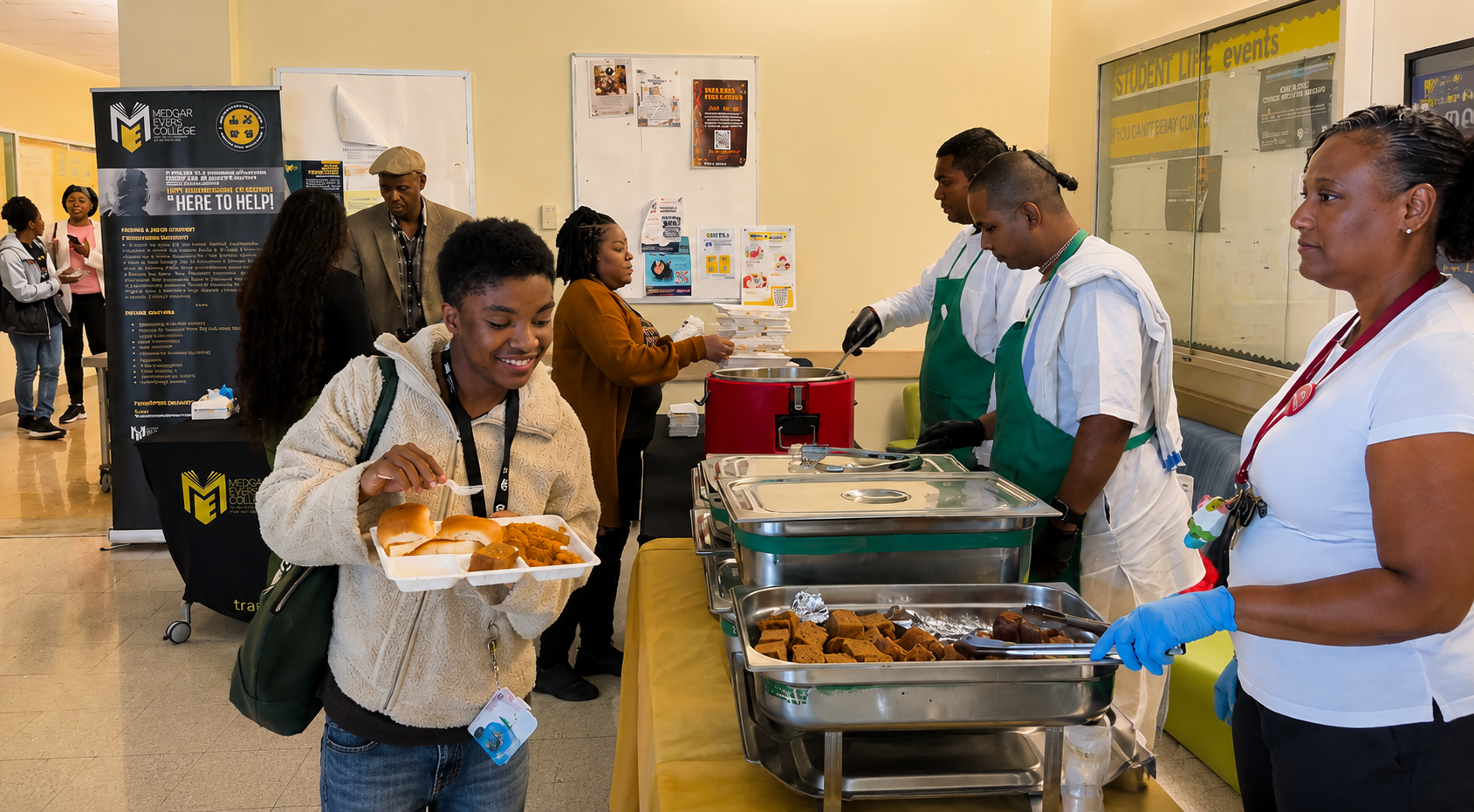
One of those students, Tiffanie – a freshman and Criminal Justice major at Medgar Evers College in Brooklyn New York – receives food assistance. She explained that she’s grateful for the World Food Movement’s New Jersey chapter. “They provide hot meals for students and staff on campus. It’s always vegetarian and you can have it throughout the day.”
When asked if it made life easier because she doesn’t have to cook for herself one day a week, Tiffanie replied that while she enjoys the hot meal, it’s the take home meals that really help. “It’s hard. Having to work and even just adjusting to college. But once you have a resource like that on campus, they help us survive a lot easier.”
Another student, Atara, will start her senior year in the fall. She’s majoring in Financial Economics at the same school. Atara says that after receiving her bachelor’s in science, she’s headed for Wall Street. And while she can see the light at the end of her college tunnel, it’s not been easy. “So, as a first generation going to college, I literally had to do everything myself. My background is low income.”
Further explaining, Atara added, “I had to do FAFSA myself. But financial aid doesn’t close the gap for other stuff like food and clothing. I didn’t have that and my mom has other kids to worry about.” Since she’s on her own, she says, “I have to worry about it.”
Consequently, without help, Atara took a few years off, went back to work and saved more money before returning last year to finish her degree. “I’m navigating the adult thing. Finding some place to live, food, and then still doing my education. It’s kind of hard.”
Then Atara found out about the World Food Movement. “Honestly, thank God for Medgar Evers College and this [program]. I’m able to go and say, ‘I need help with food or I can’t afford groceries.’ And they give out food to the students.”
Atara appreciates their open-hearted generosity saying that it’s not even just about the students. “I’ve seen them give food to others in the community.”
Tiffanie and Atara share deep respect for the World Food Movement’s desire to feed them while they study to better themselves. And while Dasa doesn’t have a starting date for college feeding programs in Pennsylvania – they do have a goal of providing 100,000 meals in the United States next year. Working with a Pennsylvania college could help them meet that goal.
Interested PA college officials can reach out to World Food Movement NJ on their website.