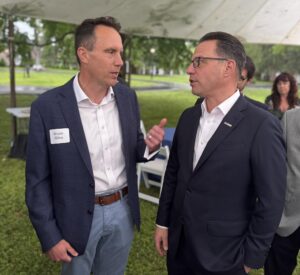
Something historic happened in Norristown last week. State Representative Joe Webster, who chairs the Pennsylvania House Subcommittee on Campaign Finance and Elections, publicly announced the introduction of House Bill 2728, legislation that would end corporate and dark money political spending in Pennsylvania elections.
This is not another campaign finance disclosure bill destined to be filibustered in the Senate. It is not another incremental measure that courts will strike down in six months. HB 2728 uses a legal framework that is fundamentally different from anything tried before, one that does not fight the Supreme Court’s Citizens United ruling on its own terrain, but sidesteps it entirely. And it is already the law in Hawaii.
This article explains why this bill matters, how it works, what has already been accomplished, and exactly what you can do right now to help turn this bill into law.
“A corporation cannot exercise the right to engage in a power they are not given by a state.” – Rep. Joe Webster, HB 2728 introduction notes, August 5, 2026
Dark Money is Rapidly Corroding Our Fragile Democracy
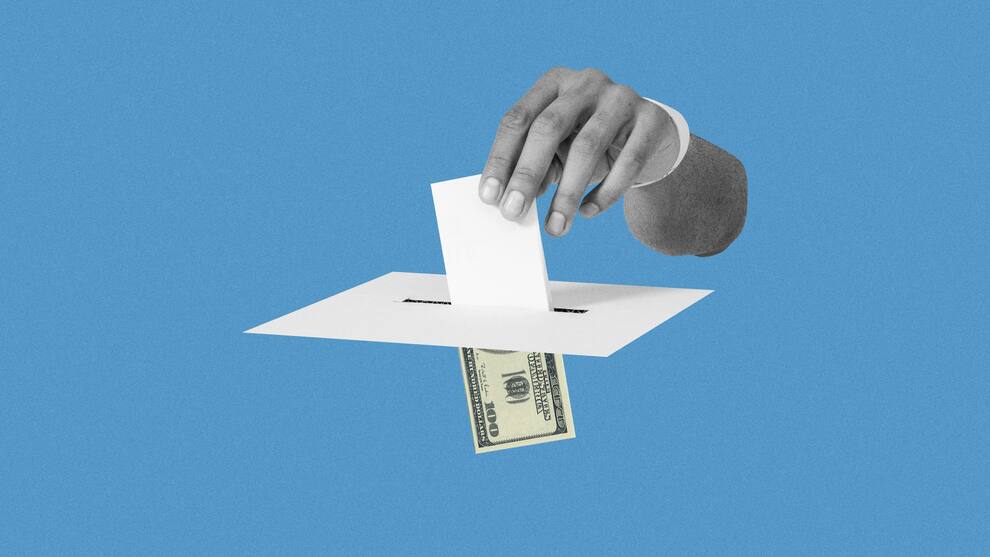
In 2024 alone, outside groups spent more than $4 billion on federal elections nationwide, nearly 12 times the amount spent in 2008, before the Supreme Court’s notorious Citizens United decision opened the floodgates. A substantial portion came from “dark money” organizations: nonprofit corporations that can accept unlimited donations from corporations, billionaires, and special interests without ever revealing who funds them.
As a perennial swing state, Pennsylvania has been a primary target. Outsiders poured a breathtaking $240 million into our 2024 U.S. Senate race. Dark money poured through anonymous nonprofits into Pennsylvania Supreme Court elections, state legislative contests, and local races across the Commonwealth. Deceptive mailers, attack ads, and targeted social media campaigns were paid for by organizations whose funders you will never know. As Rep. Webster put it at his announcement: the political influence of “big money” and “corporate money” holds Pennsylvania back from addressing the hundred or more vital issues, such as roads, clean water, fair wages, education, healthcare, that Pennsylvanians actually need their legislators addressing.
This is not a partisan complaint.
Dark money flows to both parties. It corrupts elections regardless of which side it favors. Polling on this issue often approaches 80%, with most voters supporting restraints on dark money. The question is whether the people of Pennsylvania, through their elected representatives, have the will to stop it.
The Breakthrough: Why This Bill is Different
Every previous attempt to limit corporate political spending has run into the same wall: Citizens United v. FEC.
In 2010, the Supreme Court ruled that political spending is protected First Amendment speech, and that corporations have the same rights as people when it comes to independent election expenditures. State after state tried to limit this spending through campaign finance regulations. Federal courts struck them all down.
HB2728 takes a completely different approach, one that Rep. Webster articulated clearly at at Wednesday’ event where he introduced the bill, and that legal scholars at the Center for American Progress have spent years developing.
The insight is simple but powerful:
“Citizens United said a government cannot restrict a power a corporation already has. It said nothing about whether states must grant corporations that power in the first place.”
READ: AI Super PACs Are Unleashing Millions to Tilt Primaries in Their Favor
Corporations are not natural persons. They exist because states created them, through charters that grant them specific powers. Pennsylvania’s own corporation law has always reserved the General Assembly’s right to amend, limit, or revoke those chartered powers. HB 2728 exercises that authority to make explicit what was always true: the powers granted to corporations, LLCs, and nonprofits in Pennsylvania do not include the power to spend money to influence elections.
No chartered power means no First Amendment protection. Citizens United cannot reach a power that was never granted. As Rep. Webster stated: “a corporation cannot exercise the right to engage in a power they are not given by a state.”
The bill covers every entity type through which dark money flows, including for-profit corporations, nonprofit corporations (including the 501(c)(4) organizations that are the primary dark money vehicle), LLCs, limited partnerships, and unincorporated associations. Any spending on elections by a covered entity is legally void and triggers forfeiture of the entity’s state-granted charter privileges, including limited liability.
Hawaii proved that this is possible; Pennsylvania is next
This is not an untested theory. Hawaii enacted identical legislation on May 14, 2026. Governor Josh Green signed Senate Bill 2471 into law after it passed the Hawaii Senate unanimously and the House 41-10, with nine Republicans voting yes. It takes effect July 1, 2027.
Montana’s Transparent Election Initiative, backed by a bipartisan coalition including former Democratic U.S. Senator Jon Tester and former Republican Governor Marc Racicot, is gathering signatures to place the same approach before voters in November. A 2025 poll found 74% of Montana voters in support, including majorities of Republicans and independents. Legislation is moving in fifteen states.
Minnesota is on the same track, as Rep. Webster noted. Pennsylvania, with the introduction of HB2728, can be the largest state to act, and the second to enact this framework into law.
The coalition Chester County built supports this bill
Last week’s announcement did not happen in a vacuum. Chester County Marching Forward (“CCMF”), a grassroots Democratic organizing coalition based in northern Chester County, has been building the legislative coalition behind this effort for months. Inspired by what was achieved in Hawaii, CCMF organized a strategy to get every elected Democrat in the County to support a similar effort in Pennsylvania.
The idea was to spark support for this legislation in Chester County, then use the influence of our leadership to expand into neighboring counties and, eventually, the entire Commonwealth.
This would be a test of the democratic bona fides of the representatives we fought hard to put into positions of power for exactly this purpose: to strengthen democracy and loosen the grip of the country’s oligarchs over a government who seems to cater only to the billionaire class. Overwhelming support, achieved relatively quickly, is a testament to electing the kinds of representatives who are committed to strengthening democracy, not catering to their donors. Here is what that work produced:
Chester County Reps. Melissa Shusterman (HD-157), Paul Friel (HD-26), Chris Pielli (HD-156), Danielle Friel Otten (HD-155), and Christina Sappey (HD-158), Dan Williams (HD-74), and Kristine Howard (HD-167): are all named co-sponsors of this House Bill 2728.
Sen. Katie Muth (SD-44), who posts a sign outside of her office that says “democracy dies in dark money”, is a leader in this effort and is working with her staff on introducing a companion bill in the Senate. Senator Muth’s office has identified some deficiencies in HB 2728, and is expected to address those in the Senate’s version of the bill.
READ: America, We Have a Super PAC Problem
Specifically, the Senate bill is expected to extend coverage to limited partnerships and limited liability partnerships, entity types increasingly used as political spending pass-throughs that HB 2728 does not reach. We are hopeful that the Senate bill will also add a foreign entity provision ensuring that out-of-state shell companies cannot be used to funnel anonymous money into Pennsylvania elections, a private right of action allowing Pennsylvania voters to enforce the law directly in Commonwealth Court, and a severability clause protecting the statute from being invalidated in its entirety if any single provision is successfully challenged.
Chester County Sen. Carolyn Comitta (SD-19) also supports the effort to restrict the influence of dark money over our politics.
Madelyn Alvarino (candidate, HD-13) and Elizabeth Moro (candidate, HD-160): Both are running for the Pennsylvania House and have committed to support this legislation if elected. Moro has stated publicly: “We must end the practice of dark money from influencing our elections.”
Every Democratic sitting member of the Pennsylvania General Assembly representing Chester County is a co-sponsor of HB2728. That is unanimous regional backing, seven House members before the bill has even been in committee for a single day. CCMF corralled the support, and this was not a difficult pitch. Even the most idealistic politician can be coerced against representing the interests of their constituents if they must contend with threats from dark money campaigns designed to influence voters. A typical campaign for a seat in the General Assembly can cost up to $250,000 in competitive districts like those in Pennsylvania’s collar counties. That is the equivalent of pocket change for any billionaire. The threat from dark money is real and it provides the most coherent explanation for why both our federal and state governments so utterly fail to serve the vast majority of “we the people”.
To make matters worse, the US Supreme Court’s June 30, 2026, decision in NRSC v. FEC, where J.D. Vance was among the named plaintiffs, further dismantled campaign finance protections. This now allows wealthy donors to route up to $500,000 through party committees directly to specific candidates, compared to the $3,500 direct contribution limit.
Bucks County: Your Turn
Now HB 2728 needs to move through the Pennsylvania House State Government Committee, and that requires a show of support from across the Commonwealth, including Bucks County.
The good news: Bucks County has Democratic House members who can and should co-sponsor this bill immediately. The House State Government Committee, chaired by Rep. Carol Hill-Evans (HD-95), is where HB2728 will be referred. Constituent pressure on committee members is the single most effective tool for moving a bill from introduction to hearing to floor vote.
Here are your specific action targets:
Reps. Perry Warren (HD-31), Tim Brennan (HD-29), and Tina Davis (HD-141): Yardley/Lower Makefield, Doylestown, and Lower Bucks County respectively. All three are Democratic incumbents. Ask each of them to co-sponsor HB2728.
Sen. Steve Santarsiero (SD-10): Lower and Central Bucks. Ask him to support the Senate companion bill.
Rep. Carol Hill-Evans (HD-95): Chair, House State Government Committee. The most critical ask: contact her office and request a hearing on HB 2728.
Don’t forget the Republicans because they matter too
Dark money is not a Democratic problem. It is a democracy problem. Bucks County’s Republican legislators represent constituents who are just as sick of anonymous money distorting their elections as Democratic voters are. Call them. They need to hear that this is not a partisan ask. And, if they refuse to support this effort, there’s a Democratic challenger running to replace each of these representatives who can likely use the information to better inform voters about the priorities of the politician currently representing them in Harrisburg.
Bucks County’s Republican House members and senators are:
Reps. K.C. Tomlinson (HD-18), Joe Hogan (HD-142), Shelby Labs (HD-143), and Kristin Marcell (HD-178): covering Bensalem, Lower Southampton, Langhorne, Middletown, Plumstead, Bedminster, Hilltown, Perkasie, Sellersville, Warwick, Wrightstown, and Upper Southampton. Ask each of them to co-sponsor HB2728.
Rep. Craig Staats (HD-145): Quakertown and upper Bucks. Republican chair of the House Intergovernmental Affairs and Operations Committee. Ask him to co-sponsor HB2728.
Sens. Frank Farry (SD-6) and Jarrett Coleman (SD-16): together covering all of Bucks County from Bensalem and Warminster in the south to Quakertown and Sellersville in the north. Ask both to support the Senate companion bill. Sen. Coleman, as chair of the Senate Intergovernmental Operations Committee, has particular standing to engage with legislation that redefines state corporate powers.
Three things you can do right now
1. CALL OR EMAIL your state representative and senator. Find your legislator at www.legis.state.pa.us. Say: “I am a constituent calling to ask Representative/Senator [NAME] to co-sponsor HB2728, Rep. Webster’s dark money bill. The entire Chester County delegation is behind it. Bucks County should be too.”
2. CONTACT the House State Government Committee Chair, Rep. Carol Hill-Evans, and ask her to schedule a hearing on HB2728. Her office: www.pahouse.com/HillEvans
3. SHARE THIS ARTICLE. Dark money is a nonpartisan issue. It corrupts elections regardless of which side it flows to. Republican and Democratic voters alike are targeted. The more Bucks County residents who contact their representatives, the more likely this bill is to move.
The bottom line
Justice Brandeis warned us over a century ago: “We may have democracy, or we may have wealth concentrated in the hands of a few, but we cannot have both.”
We are living his prediction.
The Supreme Court has dismantled campaign finance protection piece by piece, from Citizens United in 2010 through NRSC v. FEC at this end of this year’s term, opening a 70-to-1 ratio between what a billionaire can route through a party committee versus give directly to a candidate.
But Pennsylvania does not need the Supreme Court’s permission to take its own corporations’ powers back. HB2728 does exactly that. Hawaii has already done it. Pennsylvania can be next.
Rep. Webster introduced the bill today. The Chester County delegation is unanimously behind it. Senator Muth is preparing a Senate companion. The framework is sound, the legal analysis is thorough, and the national support structure, through the Center for American Progress, is ready to defend it in court.
All that remains is the constituent pressure to move it.