
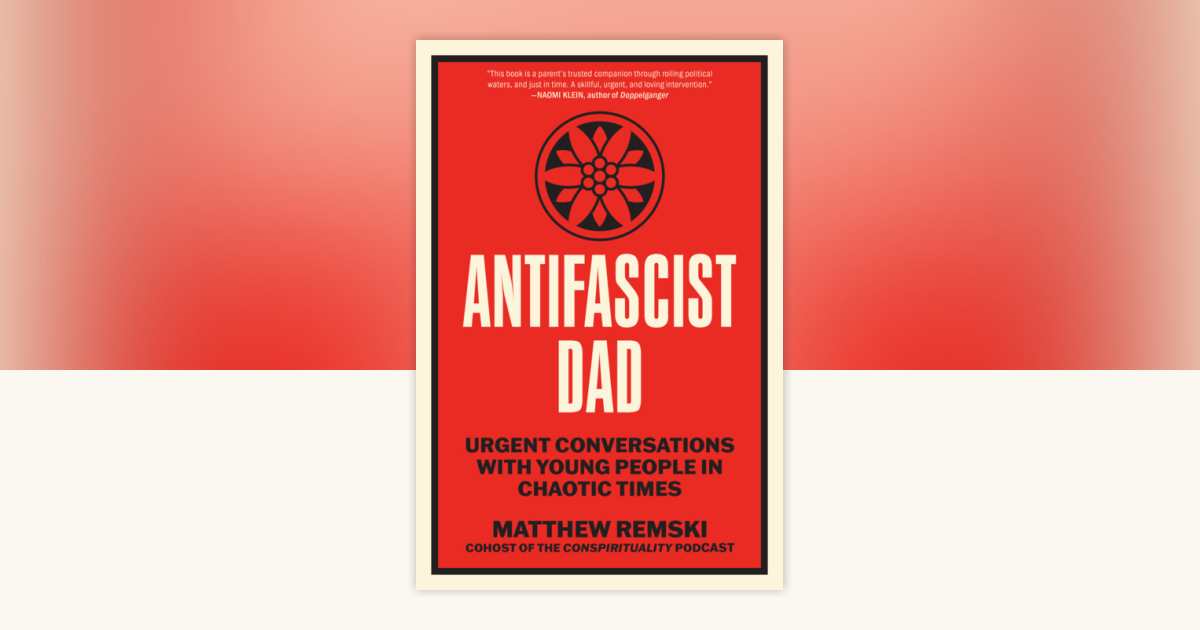
Matthew Remski faces a problem occupying most parents today: How best to raise a child at a moment in history when democratic and social norms are coming apart at the seams, economic inequality ravages enormous parts of the world, and the distinctions between facts and fiction grow increasingly tenuous on internet platforms that dominate our daily interactions?
More importantly, how do parents and families cope with a system that thrives in our increasingly divided and chaotic world? How do we confront fascism?
Before moving on to this dilemma, Remski carefully defines what fascism means, borrowing from a variety of academic sources. Historian Robert Paxton is one of them, and effectively characterizes fascism as an “obsessive preoccupation with community in decline, humiliation, or victimhood” and a subsequent response formed around “cults of unity, energy, and purity” that abandon democracy in favor of “redemptive violence without ethical or legal restraints.”(12) If any of this sounds familiar, then you should read Antifascist Dad: Urgent Conversations with Young People in Chaotic Times.
What allows fascism to expand is the very frenetic environment that we live in, particularly online. As the author succinctly puts it: “Fascism is speed.”(17) The tempo of life, dictated by the constant need to find decent housing, food, and health care demands more and more of our attention and energy at the cost of thoughtfulness and contemplation. Neoliberalism, which rejects collective action as a society in favor of individual competition, has resulted not just in an unraveling social safety net, but also, over the course of two generations, a present day where it is now difficult to conceive of alternatives to free market Darwinism, what British political theorist Mark Fisher describes as the “slow cancellation of the future.” (86)
Latter day fascism has filled the vacuum left in the wake of neoliberalism. It places a premium on action over reflection. Fascism bypasses peer review, fact checking or content moderation. It rewards content creators like Jordan Peterson, who gets repeated attention in the book for transforming anxiety into aggression rather than careful scrutiny (26) and opens up the floodgates of disinformation, misinformation, and the warped cultures that thrive on prejudice and violence.
Fighting fascism is to practice its opposite.
First, Remski counsels the reader to simply slow down. There is a value to slowness. It allows for intellectual and moral due diligence. It encourages and develops patience and calm. Slowness gives us time to breath.(19-22)
Next, the author asks us to remember the importance of genuine human friendship between individuals. Remski invokes Aristotle when defining his point. According to the Greek philosopher, there are three general types of friendships: those based on simple enjoyment, the ones that are useful, and the ones you cultivate because a friend is an exemplar of what you aspire to be.(171) Although Aristotle’s three forms of friendship involve affirmative qualities, the acid test comes when friends can disagree, fight, but also reconcile and learn from that experience. (178)
In contrast is fascism, which Remski immediately correlates with cults, both of which make a “toxic mimicry” of friendship that “tears people down by eroding their moral core.”(173) In practice, fascists move with a common purpose, but don’t develop bonds of loyalty or affection with each other. These are reserved for their leader, or the state, or the cult, or all three. To challenge this rule is to risk everything, most of all to be denounced as disloyal. In practice, proving your loyalty to power is a routine and constant enterprise. Whether considering the show trials of Stalin’s Soviet Union or contemporary political purges in the Republican Party, even the most calculating and orthodox loyalists have little hope of reciprocity for their loyalty much less justice.
INTERVIEW: The History of Fascism and Anti-Fascism in America, with Bill Mullen and Christopher Vials
Finally, Remski advises the reader to understand the difference between morality and strategy. We can be outraged and debate the value of violent and non-violent resistance, but this is not a substitute for a plan.(193) However, it is possible to combine morality and strategy. The Debt Collective movement organized a tuition strike against for profit colleges in 2014 and prompted federal intervention for defrauded students.(205) Building a coherent response to evil is critical. “Antifascism never just opposes fascism. It indicates the basic logic of how we organize everything.”(234)
Remski suggests a few methods that individuals might pursue to combat fascism, especially when it comes to our children. He is realistic when discussing the impossibility of returning to some nostalgic pre-internet age. Although we periodically see cellphones and laptops banned from our schools and throwback analogue methods — like the college “Blue Book” — wielded to combat AI, technology is here to stay.
Rather than actively oppose modern platforms and devices, we should embrace them. When we play, whether using analogue experiences like Dungeons and Dragons or join multiplayer games on Steam, we can enjoy ourselves, establish friendships, and learn about each other. We can also learn about “gamification,” a process by which corporations and social media influencers alike build incentives into their platforms to boost sales or clicks and views. (220) Teaching this version of communication literacy is a shield against such manipulation and key to combatting fascism.
Remski seems conflicted about how long antifascism might take. At the start of the book, he maintains that “Fascism moves faster than books. But antifascist culture always outlives fascism.”(xi) However, towards the end, he stresses urgency following the “book’s breathless sprint through a grab bag of ideas.”(235) The paradox of being the antifascist dad (or mom) is to be constantly overcome by events and reacting to them. In fact, American fascists count on this dynamic. Steve Bannon once revealed his true agenda in 2018: “The real opposition is the media. And the way to deal with them is to flood the zone with shit.”
Regardless, Remski is optimistic about the long term. “There is a river of joy passing through us, into each other, and nothing can stop it. Fascism cannot survive it.” (243) In the end, we can hope that reason and introspection outlast anger and chaos. We can hope.